Operations | Monitoring | ITSM | DevOps | Cloud

Enrichment: Better Data in for Better Response Times Out

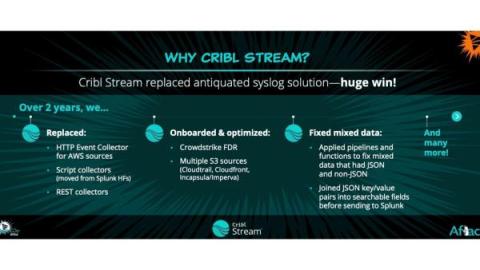
In this conversation, Cribl’s Carley Rosato talks to Aflac’s Shawn Cannon about his role as a Threat Management Consultant, and how he manages their SIEM environment, brings in new data as needed, and works to improve the ingestion process. Our customers are always coming up with new and exciting ways to implement Cribl tools — importing a 34 million-row CSV file into Redis and enriching events in Splunk might be one of the most impressive we’ve seen so far.

OpenTelemetry Overview

Monitoring distributed systems means collecting data from various sources, including servers, containers, and applications. In large organizations, this data distribution makes it harder to get a single view of the performance of their entire system. OpenTelemetry helps you streamline your full-stack observability efforts by giving you a single, universal format for collecting and sending telemetry data. Thus, OpenTelemetry makes improving performance and troubleshooting issues easier for teams.

Understanding the difference between OpenSearch and Elasticsearch

Search is a fundamental requirement for anyone working with log files. When you have terabytes and petabytes of data, you need to find answers to questions – fast. The search engine that you choose sits as the cornerstone for any technology that helps you look for the information needed to answer questions. While OpenSearch and Elasticsearch may have similar beginnings, their modern iterations have significant differences.

Canonical Kubernetes 1.29 is now generally available

A new upstream Kubernetes release, 1.29, is generally available, with significant new features and bugfixes. Canonical closely follows upstream development, harmonising our releases to deliver timely and up-to-date enhancements backed by our commitment to security and support – which means that MicroK8s 1.29 is now generally available as well and Charmed Kubernetes 1.29 will join shortly.

LLM Monitoring and Observability

Large Language Models (LLMs) are advanced artificial intelligence models designed to comprehend and generate human-like language. With millions or even billions of [parameters, these models, like GPT-3, excel in natural language processing, understanding context, and generating coherent and contextually relevant text across various applications.

Optimize Azure App Service costs professionally for peak savings

Azure App Service is a platform as a service (PaaS) that enables developers to make, deploy, and scale web apps, mobile backends, and RESTful APIs efficiently. A powerful component of an organization’s cloud strategy, Azure App Service offers numerous advantages in terms of development, deployment, and operations.

Monitor MySQL Performance Using Telegraf

Monitoring the performance of your MySQL database will help identify performance bottlenecks, inefficient queries, and resource-intensive processes. By tracking metrics like query execution times, server load, and resource usage, administrators can optimize configurations and fine-tune the database for better efficiency and speed. Additionally, monitoring any running process allows for the early detection of potential problems such as server overload, disk space shortages, or network issues.

My Recap on the Gartner IT Infrastructure, Operations & Cloud Strategies Conference

Last week, I attended the Gartner IT Infrastructure, Operations & Cloud Strategies Conference (IOCS). Gartner IOCS is my favorite conference every year because of the quality and level of the presentations. Gartner analysts deliver most sessions and put a lot of effort into the presentations and supporting research. ‍ I’d like to highlight two sessions that I found to be very informative.

How to fix Kubernetes init container errors

One of the most frustrating moments as a Kubernetes developer is when you go to launch your pod, but it fails to start because of a problem during initialization. Init containers are incredibly useful for setting up a pod before handing it off to the main container, but they introduce an additional point of failure. In this post, we'll take an in-depth look at init containers in Kubernetes: what they are, how they work, how they can fail, and what that means for your Kubernetes deployments.