Operations | Monitoring | ITSM | DevOps | Cloud

AzCopy and Azure File Sync: How They Work Together

In the ever-expanding landscape of Azure data management, two powerful tools emerge as essential assets for tech professionals: AzCopy and Azure File Sync. While each has its unique capabilities, together they create an intricate symphony that enhances data transfer and synchronization within Azure. In this comprehensive guide, we’ll unravel the functionalities of both, explore their common use cases, delve into their integration processes, and weigh their benefits and drawbacks.

Scaling Software Delivery: Continuous Delivery, Overcoming Challenges, and the Power of Cloudsmith

Explore the intricacies of scaling software delivery, from the nuances of continuous delivery to overcoming common challenges. Dive deep into how Cloudsmith can be the game-changer in your DevOps journey, ensuring agility, security, and efficiency in every release. Every business, from startups to established enterprises, feels the urgency to scale their software delivery. Why?

A Modern C Development Environment

Sometimes, C/C++ projects have a long development cycle. When working on such a project, it can be easy to take our development environment for granted, and forget about the effort invested in its bring-up. The build environment works like magic, the test framework is neatly integrated, and the CI/CD pipeline relieves us of tedious, repetitive tasks.

Cribl Makes Waves at Black Hat USA 2023, Unveils Strategic Partnership with Exabeam to Accelerate Technology Adoption for Customers

One of our core values at Cribl is Customers First, Always. These aren’t just buzzwords we use to sound customer friendly; it’s ingrained in our daily communication and workload. Without our customers, we wouldn’t exist. One of the ways we’ve upheld this value is to seek out strategic partnerships with other companies aligned with our customers’ needs – both present and future.

Measuring the time between spans in an OpenTelemetry trace with a Clickhouse query

In a recent conversation on our SigNoz community Slack, a user shared their query that asks a deceptively simple question: what is the average time between two spans in a trace? The usefulness of this answer is evident if you think about how often the total trace time does not highlight the time you care about most. This could mean any number of things: that the total trace time of handling a web request might include lots of spans after a satisfying response was sent to the user.

DataDog Flex Logs vs Coralogix Remote Query

While Coralogix Remote Query is a solution to constant reingestion of logs, there are few other options today that also offer customers the ability to query unindexed log data. For instance, DataDog has recently introduced Flex Logs to enable their customers to store logs in a lower cost storage tier. Let’s go over the differences between Coralogix Remote Query vs Flex Logs and see how DataDog compares. Get a strong full-stack observability platform to scale your organization now.

InfluxDB 3.0 is up to 45x Faster for Recent Data Compared to InfluxDB Open Source

With the release of InfluxDB 3.0, one of the big questions is: how does it compare to previous versions of InfluxDB? We have begun benchmarking InfluxDB 3.0 with production workloads to start giving users more insight into the benefits of adopting InfluxDB 3.0. In this post, we look at recent benchmarks comparing InfluxDB 3.0 to InfluxDB Open Source (OSS) 1.8.

G2's Most Recommended WAF & DDoS Protection

In case you missed it, HAProxy Technologies recently put out a press release about our stunning leadership position in G2’s Summer 2023 Grid® Reports for load balancing. We’re incredibly proud of these results, which are a direct result of the hard work and dedication of HAProxy’s community developers and our enterprise product and support teams. Looking at the Momentum Grid® Report for Load Balancing, the gap between HAProxy and the rest is impossible to ignore.

What is virtualization? A beginners' guide.

While information technology continues to evolve rapidly, virtualization remains a cornerstone of modern computing, enabling businesses to maximise resource utilisation, enhance flexibility, and reduce the total cost of ownership (TCO). It is a key building block of the cloud computing paradigm, and millions of organisations use it daily worldwide. All existing cloud platforms, such as AWS, Azure, Google or OpenStack, use virtualization underneath.

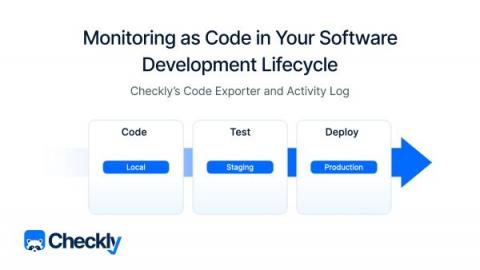
Monitoring as Code in Your Software Development Lifecycle

When we launched the Checkly CLI and Test Sessions last May, I wrote about the three pillars of monitoring as code. Code — write your monitoring checks as code and store them in version control. Test — test your checks against our global infrastructure and record test sessions. Deploy — deploy your checks from your local machine or CI to run them as monitors.