Operations | Monitoring | ITSM | DevOps | Cloud

The latest News and Information on DevOps, CI/CD, Automation and related technologies.

Business Entities

We’re thrilled to share Version 4.4 release with new feature updates: Business Entities for tracking customers, partners, and departments, improved control for transfer switch power devices, streamlined bulk actions for Business Entity association with assets, enhanced import capabilities for connections and circuits, and advanced search function to filter by Business Entity for easier, more efficient work.

How to Monitor Host Metrics with OpenTelemetry

Today's environments often present the challenge of collecting data from various sources, such as multi-cloud, hybrid on-premises/cloud, or both. Each cloud provider has its own tools that send data to their respective telemetry platforms. OpenTelemetry can monitor cloud VMs, on-premises VMs, and bare metal systems and send all data to a unified monitoring platform. This applies across multiple operating systems and vendors.

Mastering SQL PARTITION BY with dbForge Studio for SQL Server

The role of data analysis and manipulation in SQL Server is hard to overestimate. By partitioning data effectively, you can handle large datasets and get accurate and relevant results for various analytical and operational tasks. This is when PARTITION BY proves invaluable. In this article, we are going to talk about the theoretical foundations and practical applications of this SQL argument with the help of a convenient IDE — dbForge Studio for SQL Server.

Introducing a Brand New Microsoft Teams Integration

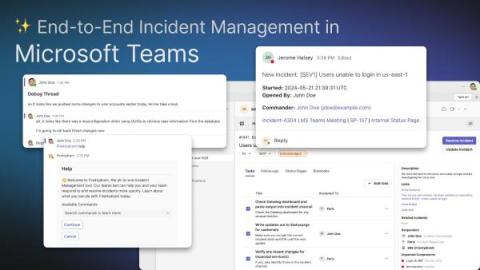
We’ve gotten clear feedback from our customers that we’ve needed a strong Microsoft Teams integration. Responders want a full suite of incident management functionality, no matter what chat application their organization uses. We heard you. That’s why we’re proud to announce a brand new MS Teams integration with fully robust incident management lifecycle capabilities.

SQL Update With JOIN Techniques for Efficient Data Management

One of many things SQL Server, MySQL, PostgreSQL, and Oracle have in common is that they store data in multiple tables related to each other with a common key value. This means you cannot avoid retrieving records from two or more tables based on some condition while working with these relational databases. In SQL, this can be easily achieved with the help of JOINs.