Operations | Monitoring | ITSM | DevOps | Cloud

Tales From The Good/Bad Old Days Of Freelance Gigs

This week The Founders take a trip down freelancer memory lane and talk about the hot apps they built and which of them are still alive. They also cover NFTs, pivoting to private equity, and candy bar servers. Also, is "spider season" an official season in the Pacific Northwest?!?!? Click to listen now on the interwebs.
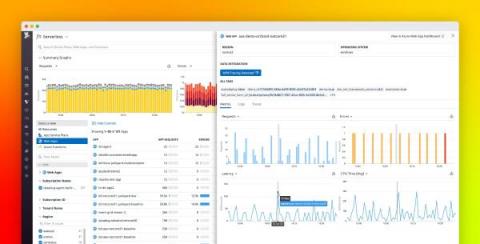
Explore Azure App Service with the Datadog Serverless view

Azure App Service is a platform-as-a-service (PaaS) offering for deploying applications to the cloud without worrying about infrastructure. App Service’s “serverless” approach removes the need to provision or manage the servers that run your applications, which provides flexibility, scalability, and ease of use. However, App Service also introduces infrastructure-like considerations that can impact performance and costs.

Best AWS monitoring management tool

Amazon Web Service or AWS has an immense cloud ecosystem now counting at over 200 services and products. Started with first generation services like EC2, S3, and RDS, now you can have satellite control centers, build virtual reality, and compose music using Artificial Intelligence. As the variety of services expanded, the necessity to monitor all those services efficiently became critical. Running a service without a proper monitoring system is no different from running while blind-folded.

Introduction to Custom Metrics in Java with Logz.io RemoteWrite SDK

We just announced the creation of a new RemoteWrite SDK to support custom metrics from applications using several different languages. This tutorial will give a quick rundown of how to use the Java SDK. This SDK – like the others – is completely free and open source, and is meant to apply to any output destination, not just Logz.io.

A FinServ Charming Legend - Automating application deployment and management

This session explores how charmed operators help streamline the deployment and Day-2 ops of Legend platform. Goldman Sachs had open sourced its internally developed Legend data management platform into FINOS. Legend is an end-to-end data platform that handles the full data lifecycle used across pricing, risk and reporting business function for FS organisations. It allows companies to build data-driven applications and insightful business intelligence dashboards.

Working with external data, a look at classfiltercsv()

When working with CFEngine, it’s common to hear advice about separating data from policy. Separating data from policy allows for separation of concerns, delegation of responsibilities and integration with other tooling. Each organization is different, and a strategy that works well in one environment may not work as well in a similar environment of another organization, so CFEngine looks to provide various generic ways to leverage external data.

DNS filtering: What is it and why do companies use it?

The Domain Name System (DNS) makes it possible for users to access websites using domain names, like wikipedia.org, in place of nine-digit IP addresses. Due to its ubiquitous nature, DNS can be used to block access to selected websites, which is commonly known as DNS filtering. Many companies see security and productivity benefits from implementing this strategy where appropriate. Read on as we explore some of the key details around how DNS filtering works and how it can be beneficial.

Observability trends 2021

Observability has gained a lot of momentum and is now rightly a central component of the microservices landscape: It’s an important part of the cloud native world where you may have many microservices deployed on a production Kubernetes cluster, and a need to monitor these microservices keeps rising. In production, quickly finding failures and fixing them is crucial. As the name suggests, observability plays an important role in this failure discovery.

We Just Gave $154,999.89 to Open Source Maintainers

Sentry is an open source company. We started out in 2008 as a small open source side project, and we grew within the community for years before commercializing in 2012. We’ve worked hard to keep our full product as open source as possible, while scaling as a business. Considering our commitment to open source, we are grateful to be able to give back to the community (and what better time than during Hacktoberfest, amirite?). (P.S.