Operations | Monitoring | ITSM | DevOps | Cloud

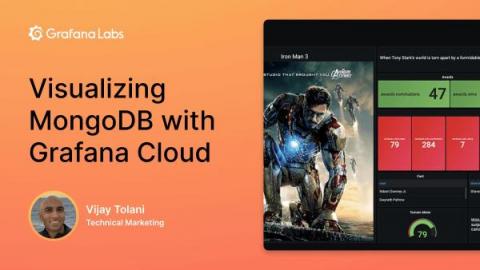
Video: How to get started with MongoDB and Grafana

MongoDB is one of the most popular NoSQL databases in the world, used by millions of developers to store application metrics from e-commerce transactions to user logins. The MongoDB Enterprise plugin for Grafana — which is available for users with a Grafana Cloud account or with a Grafana Enterprise license — unlocks all of the data stored in MongoDB as well as diagnostic metrics for monitoring MongoDB itself for visualization, exploration, and alerting.

To Observability and Back Again: A Context's Journey

How do you pass context from events that concern Security teams to Development teams who can make changes and address those events? Often this involves a series of meetings and discussion that can take days or weeks to filter down from security event to developer awareness. Compounding the problem, developers generally do not have access to Splunk Core, Cloud or Enterprise indexes used by security teams, and indeed, may use only Splunk Observability for their metrics, traces and even logs.

Shell Scripting FTW! | Intro to the CLI Part 5

In previous articles in our Intro to the CLI series, we’ve gone over why to master using the command line, some command line basics and tools, and tips for customizing your CLI shell. In case you missed any, feel free to catch up using the links below. And now, you’re going to learn the basics of shell scripting to automate complex jobs and build entirely new applications!

The regulation driving multi-cloud adoption

Cloud computing can bring many benefits to financial services companies such as increased speed and agility, easier innovation and scalability. It is no wonder then that cloud adoption is set to continue increasing with 54% of financial services companies expected to have more than half of their entire IT footprint in public clouds in the next five years. However, despite the benefits that this can bring for financial services, it also brings a new set of challenges for financial market stability.

Improving DevOps Performance with DORA Metrics

Everyone in the software industry is in a race to become more agile. We all want to improve the performance of our software development lifecycle (SLDC). But how do you actually do that? If you want to improve your performance, first determine what KPI you’d like to improve. DORA metrics offer a good set of KPIs to track and improve. It started as a research by the DevOps Research and Assessment (DORA) and Google Cloud (which later acquired DORA), to understand what makes high performing teams.

Lessons Learned From Building a Company and Raising Kids

When I had my first child almost six years ago, I expected that most of my time would be spent in the role of a teacher rather than a student. I have two kids now — and I’m certainly teaching them as much as I can as they grow and learn to navigate the world — but if someone were keeping score, my kids might end up on top when it comes to who’s taught who more. Another thing that surprised me is how similar building a family is to build a company from the ground up.

Importance of Data Warehouse Automation

The enterprise data warehouse (EDW) provides access to business data stored in a denormalized structure called a star schema, which makes it easy to analyze, visualize, and forecast essential business metrics. Business intelligence (BI) reporting makes use of the data warehouse for real-time self-service dashboards, custom visualizations, data marts, decision-making reports, and machine learning (ML).

Saving bandwidth with delta firmware updates

Firmware update capability has become a must-have for most devices. Whether to add new features after launch, fix bugs, or urgently patch a security hole, firmware updates gives modern teams the flexibility they need to move fast and react to a changing environment. I’ve written at length about firmware updates in the past, including on Interrupt with a Firmware Update Cookbook and a post about code signing, and even recorded a webinar on the topic.

Tensu: An Open Source Text UI for Sensu Go

A Two Sigma engineer explains why we built Tensu, an open source TUI (text user interface)-based program for interacting with Sensu Go’s observability pipeline and backend API. In this article we will be putting a spotlight on Tensu, an open source terminal-based dashboard for interacting with and responding to events from the Sensu Go observability pipeline and backend API.