


Boston, MA, USA
2014
  |  By Raul Gurshumov
AI agents are only as effective as the context they can access. The problem is that most of that context lives outside your observability platform.
  |  By Gavriel Mor
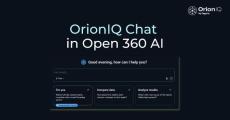
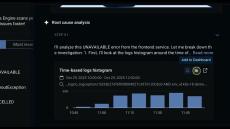
OrionIQ’s agentic investigation is now built into Logz.io Open 360 AI. Ask a question and OrionIQ investigates across your telemetry, shows its work as it goes, links every finding back to the exact query behind it, and tells you how much to trust the answer. Today we’re bringing OrionIQ Chat into Open 360 AI. This is the first OrionIQ product to ship inside the Logz.io platform, and it’s the same agent that powers the standalone OrionIQ app, now available right where you already work.
  |  By Seth King
When an alert fires at 2 a.m., responders need context more than another dashboard. A suspicious authentication event may begin in an identity provider, touch a cloud control plane, appear in an application log, and end with an unusual data transfer. If each signal lives in a separate tool, analysts spend the first part of the incident rebuilding a timeline instead of containing the threat.
  |  By Libi Michelson
Ask ten engineering leaders how far their organization has actually gotten with autonomous AI, and most will admit the same thing once the marketing language drops away: not nearly as far as it looks from the outside. That was the undercurrent of a roundtable Logz.io and Twingate hosted on July 22, 2026, bringing together VPs of engineering, CTOs, senior security directors, and several product leaders across different industries and company stages.
  |  By Amos Etzion
TL;DR: Prometheus’s biggest structural weakness has always been cardinality. A stable feature years in the making is finally addressing it, and the rest of the observability market is already responding. Native histograms allow for more efficient metrics storage, reducing cardinality strain and enabling faster, more cost-effective AI-powered observability. Ready to see how AI-powered observability can simplify your monitoring? Book a demo of the Open 360 platform.
  |  By Kevin Klein
TL;DR: This is the engineering companion to our announcement post, Upgraded Alert AI Analysis: Automated Incident Investigation, read that one for what the new generation does for your team; read on for how it works under the hood. Interested in hearing more? Book a demo to see the Alert AI Analysis Agent live. Root cause analysis is one of the harshest tests you can give an AI.
  |  By David Lotan Bolotnikoff
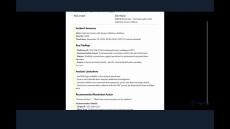
TL;DR: OrionIQ has launched the next generation of its Alert AI Analysis agent within the Open 360 AI platform, designed to automate and accelerate incident investigation. Key features of this evolution include: Agent-Based Investigation: Instead of relying on a single prompt, the system coordinates specialized AI agents to correlate data across diverse sources like logs, metrics, deployments, and tickets.
  |  By Libi Michelson
TL;DR: Modern monitoring platforms face a “workflow problem”: engineers are drowning in telemetry but lack tools that connect detection to resolution, often leading to fragmented, manual incident investigations. Most organizations have mastered data collection but fail at incident response. Engineers waste precious time manually stitching together logs, metrics, and traces across siloed tools. The Solution: Workflow-driven monitoring acts as a guide, not just a dashboard.
  |  By Libi Michelson
TL;DR Agentic observability uses AI agents to autonomously investigate incidents, identify root causes, and take action in production environments. Unlike traditional monitoring (which alerts and waits) or AIOps (which assists human analysis), agentic platforms conduct the investigation themselves. Key capabilities include autonomous incident triage, evidence-backed root cause analysis, alert noise reduction, and governed remediation.
  |  By Libi Michelson
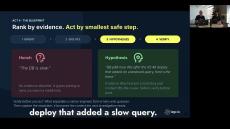
Incident investigations take so long not because the fix is hard, but because finding the right fix is. Most engineers spend 20 to 60 minutes just understanding what’s wrong before they can act, not fixing anything, just trying to see the full picture. The framework that changes this has four steps: Orient, Isolate, Hypothesize, and Verify, and the order matters more than the tools.
  |  By Logz.io
Incident investigations take so long not because the fix is hard, but because finding the right fix is. Most engineers spend 20 to 60 minutes just understanding what’s wrong before they can act, not fixing anything, just trying to see the full picture. The framework that changes this has four steps: Orient, Isolate, Hypothesize, and Verify, and the order matters more than the tools.
  |  By Logz.io
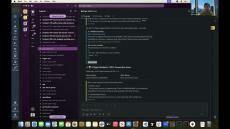
A short demo showing how Logz.io, powered by the AI Agent, helps investigate security incidents by analyzing and correlating data. The AI Agent uses natural language to: Query and correlate SIEM questions with related logs Detect anomalies and highlight unusual activity Summarize findings to speed up root cause analysis Provide recommended actions This video demonstrates a practical SIEM use case for the AI Agent inside Logz.io.
  |  By Logz.io
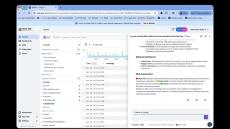
Experience the new Open 360 AI, built to help you explore, analyze, and act on your observability data in a smarter way. See how the AI Agent works directly inside dashboards to explain anomalies, summarize trends across your telemetry data, and guide you to root cause, without switching views or writing queries. Everything you know and love is still here, now enhanced with AI.
  |  By Logz.io
A short demo showing how Logz.io, powered by the AI Agent, helps investigate security incidents by analyzing and correlating data. The AI Agent uses natural language to: This video demonstrates a practical SIEM use case for the AI Agent inside Logz.io.
  |  By Logz.io
Watch how AI is reshaping observability for the years ahead. In this fireside chat, Logz.io founders Tomer Levy and Asaf Yigal reveal how the most innovative AI-first companies are breaking free from dashboards, avoiding common RFP mistakes, and building future-ready stacks. You’ll see: Watch and learn how autonomous AI eliminates noise, slashes costs, and gives engineering teams back their velocity.
  |  By Logz.io
Watch AI transform alert management in real-time. This technical demonstration compares manual alert investigation with AI alert investigation. It shows how AI agents automatically investigate production alerts, correlate telemetry across distributed systems, and identify root cause, faster and with more insights than manual processes. Watch and learn how to shift your team from reactive firefighting to proactive system reliability management with agentic AI.
  |  By Logz.io
Logz.io’s OpenSearch Optimization Tool is a free, open-source CLI utility that gives you fast, actionable insights into your cluster’s performance, cost, and configuration.
  |  By Logz.io
Struggling with high observability costs? In this video, Jade Lassery breaks down the challenges of managing excessive data and skyrocketing expenses. She introduces the Logz.io AI agent, a powerful solution designed to optimize data usage, reduce unnecessary costs, and improve efficiency. Learn how to take control of your observability spending while maintaining high performance. Watch now to discover smarter data management strategies!
  |  By Logz.io
Struggling with Kubernetes performance issues? This video introduces an AI-powered agent designed to help users quickly identify and resolve bottlenecks. By analyzing logs, the AI detects performance issues, streamlining troubleshooting and improving system efficiency. Watch now to see how AI can simplify Kubernetes performance management and keep your infrastructure running smoothly!
  |  By logz.io
In the video, Jade Lassery discusses how to effectively manage complex environments, especially when faced with unexpected spikes in errors. She introduces a Logz.io AI agent prompt that assists users in quickly identifying the root cause of these issues. By simply asking the right questions, users can streamline their troubleshooting process and enhance their operational efficiency.

Logz.io is an AI-powered log analysis platform that offers the open source ELK Stack as a enterprise-grade cloud service with machine learning technology. Our platform uses AI and and machine-learning algorithms to help DevOps engineers, system administrators, and developers to find critical events in the volumes of information that are now constantly generated in IT environments.

Created by a Check Point veteran and a former algorithm engineer for the Israeli military, the enterprise-grade, cloud platform is built on top of the ELK Stack and provides real-time access to data insights based on the collaborative knowledge of IT executives throughout the world. The ELK Stack -- Elasticsearch, Logstash, and Kibana -- is the world’s most popular open-source log analytics software stack.