










San Francisco, CA, USA
2016
  |  By Dillon Barry
You know every service in your cluster by name. You know which team owns each one, what it talks to, how it scales, where its logs go. The agents are a different story. That’s not a criticism, it’s an observation, and it’s one we keep running into. Every company we talk to is shipping agents of some kind, from scales of 10s to 1000s. Customer service bots that field tier-one tickets. Internal copilots that draft emails and summarise meetings and write the boring half of every PR.
  |  By Alister Baroi
The first post in this series argued that AI agent governance hasn’t kept pace with deployment. The second laid out the five pillars of accountability, and what is required. The third walked through why network policies, API gateways, MCP/A2A protocols, DIY security patterns, and Role-based Access Control (RBAC) each leave critical accountability gaps. So what does good look like? The five pillars define what AI agent accountability requires.
  |  By Veronika Smolik
Kubernetes has come a long way since its debut in 2014. It’s gone from running a couple of containerized microservices to orchestrating fleets of production workloads spanning everything from AI agents to full scale VMs running in pods. As Kubernetes adoption grows, and its use cases stretch to cover more ground, managing its increasingly complex networking and security landscape demands operational maturity and a platform that supports it.
  |  By Alister Baroi
In The Five Pillars of AI Agent Accountability: A Diagnostic Framework for Engineering Leaders, we walked through each pillar of AI agent accountability (traceability, authorization provenance, identity and ownership, policy at scale, and human oversight) and argued that most enterprises today sit at Level 0 or Level 1 of the Accountability Maturity Model. The most common reaction we get when we share that framework is some version of: “We’re already covered. We have network policies.
  |  By Dillon Barry
Two platforms, two teams, two procurement relationships, all doing one job. There’s a reason it ended up this way. There isn’t a reason it has to stay this way. Ask anyone at a typical enterprise why the VM platform and the container platform are separate, and they’ll give you a sensible answer. The VM estate has been there for fifteen years. It runs the workloads the business depends on.
  |  By Alister Baroi
You’re in a board meeting. The CISO is presenting on AI risk. The CFO asks a simple question: “When that finance agent we deployed last quarter accessed a customer payment record, can we tell who authorized it, what policy permitted it, and produce the full audit trail?” The CISO looks at the head of the platform. The head of the platform looks at security. Nobody answers. If you can picture that meeting happening at your company, you’re not alone.
  |  By Veronika Smolik
Running VMs in Kubernetes sounds like a crazy workaround for avoiding vendor lock-in, and standardizing legacy applications and newer containerized workloads on one control plane with one set of security policies to govern them all. It is, however, a rapidly growing pattern, and KubeVirt live migration — moving running VMs between nodes without downtime — is increasingly central to platform engineering use cases that require full VMs, like on-demand CI/CD pipelines.
  |  By Alister Baroi
Every enterprise is building AI agents. Marketing has one summarizing campaign performance. Engineering has one triaging incidents. Customer support has one resolving tickets. Finance has one processing invoices. Each was built by a different team, using a different framework, with different assumptions about security. Now those agents are talking to each other through agent-to-agent (A2A) communication. The incident-triage agent calls the customer-support agent to check affected accounts.
  |  By Reza Ramezanpour
We’re excited to announce the release of Calico Open Source v3.32! This release corresponds with Kubernetes v1.36 (Codename Haru) and it goes beyond just sharing a cat as the mascot of the release, it actually extends capabilities and features of Kubernetes to keep you up to date with the latest innovations of the cloud. This release brings some of the most significant architectural changes in Calico, from live-migrating KubeVirt VMs to eBPF based Maglev load balancer.
  |  By Veronika Smolik
It was 11:47pm on a Thursday night, and a senior platform engineer at a large North American bank was rolling back a ‘simple’ configuration change. The change itself was small, a routine update approved through the usual review process, but when it was applied, pods began cycling and connections started dropping. For the next three seconds, mobile banking sessions already mid-transaction dropped. Customer support lit up.
  |  By Tigera
Tigera provides the industry’s only active Cloud-Native Application Protection Platform (CNAPP) with full-stack observability for containers, Kubernetes, and cloud. Calico prevents, detects, troubleshoots, and automatically mitigates exposure risks of security issues in build, deploy, and runtime stages across multi-cluster, multi-cloud, and hybrid deployments. Calico works with popular managed Kubernetes services such as AKS, EKS, and GKE, as well as self-managed Kubernetes distributions including Red Hat OpenShift, SUSE/Rancher, VMware Tanzu, and Mirantis.
  |  By Tigera
How can you scale your organization without losing an understanding of your environment? Services mesh is here to help! It gives you the observability of connected services and is easier to adopt than you might think. Come and learn service mesh concepts, best practices, and key challenges.
  |  By Tigera
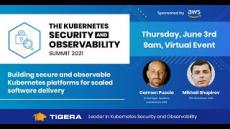
Attackers are continuously evolving their techniques to target Kubernetes. They are actively using Kubernetes and Docker functionality in addition to traditional attack surfaces to compromise, gain required privileges and add a backdoor entry to the clusters. A combination of Kubernetes security and observability tools is required to ensure the cloud infrastructure monitoring and lockdown and to enable DevSecOps teams with the right tools for the job.
  |  By Tigera
It’s a daunting task starting down the path to securing your workloads running on Kubernetes in the Cloud. There are no shortages of vendors with great tools in the Cloud security space. There is a multitude of domains that must be accounted for, along with internal challenges in bringing an organization along into new ways of thinking. This talk will focus on Discover’s Cloud security journey, with an overview of how the program has evolved over the last 4 years, key capabilities & concepts that have been embraced and challenges faced.
  |  By Tigera
Containers, Microservices, and cloud-based applications have revolutionized the way companies build and deliver products globally. This has also changed the attack surface and requires very different security strategies and tools to avoid exposure to sensitive information and other cyber attacks. Regulatory compliance has also evolved making it ever so important for companies to adapt to this new paradigm.
  |  By Tigera
Join us as we look at the advantages, but also the practical challenges, of applying modern, policy-as-code ("PaC") approaches in a modern cloud-ready enterprise. This talk will show how Morgan Stanley is drawing upon years of experience in its own proprietary implementation of PaC in its approach to embracing today's ideas. We will look at a diverse set of considerations from GitOps as a method to applying PaC in modern software development and deployment to enforcement of best practices and compliance in the Cloud.
  |  By Tigera
Security as an afterthought is no longer an option and must be deeply embedded in the design and implementation of the products that will be running in the cloud. It is increasingly more critical for many security teams to be almost, if not equally, knowledgeable of the emerging and rapidly evolving technology. Join Manish Sampat from Tigera, as explores the topic in detail with Stan Lee from Paypal.
  |  By Tigera
Security is critical for your Kubernetes-based applications. Join this session to learn about the security features and best practices for safeguarding your Kubernetes environments.
  |  By Tigera
Through practical guidance and best practice recommendations, this book will help you understand why cloud-native applications require a modern approach to security and observability practices, and how to adopt a holistic security and observability strategy for building and securing cloud-native applications running on Kubernetes.
  |  By Tigera
A step-by-step eBook covering everything you need to know to confidently approach Kubernetes networking, starting with basic networking concepts, all the way through to advanced Kubernetes networking with eBPF.
  |  By Tigera
Discover how Tigera can help you achieve a scalable, secure, and compliant approach to containers on AWS.
  |  By Tigera
This whitepaper explains five best practices to help meet network security and compliance requirements for modern microservices stack.
  |  By Tigera
This guide contains detailed technical instructions on how to install and configure network security on Kubernetes platforms.
  |  By Tigera
Tigera commission an unbiased, third-party research firm to speak with enterprise security professionals to understand the state of network security with modern applications.
  |  By Tigera
OpenShift provides a declarative, automated platform to integrate developer workflows into application deployments leveraging open source building blocks such as Kubernetes.
  |  By Tigera
Applying a uniform policy framework allows enterprises to achieve consistent network policy across multiple container orchestrators.
  |  By Tigera
Using simplicity to deliver the performance, stability, and manageability for application connectivity at scale in cloud native platforms such as Kubernetes.

Kubernetes is being adopted by every major enterprise on the planet for deploying modern, containerized applications. However, containers are highly dynamic and break their existing security models. Tigera provides zero-trust network security and continuous compliance for Kubernetes platforms that enables enterprises to meet their security and compliance requirements.

Tigera’s technology is recognized and trusted as the de facto standard for Kubernetes network security. Our open source software, Tigera Calico, provides production-grade security, and our commercial offerings layer on advanced security capabilities, enterprise controls, and compliance reporting.

Kubernetes Requires a Modern Approach to Security and Compliance:

  • Zero-Trust Network Security: With 40% or more of all breaches originating from within the network, you must always have to assume that something has been compromised. Applications running on Kubernetes make heavy use of the network for service to service communication. However, most clusters have been left wide open and are vulnerable to attack. A zero trust approach is the most secure way to lock down your Kubernetes platform.
  • Continuous Compliance: Kubernetes is dynamic and constantly changing. Moments after a compliance audit is completed the environment will have changed again. A continuous compliance solution is the only way to prove that your security controls have been implemented properly now and historically.
  • Visibility and Traceability: Applications running on Kubernetes Platforms have constantly changing IP addresses and locations that makes it impossible to use traditional flow logs to debug issues and investigate anomalous activity. The only accurate approach is to use Kubernetes labels and workload identity in your netflow logs.
  • Multi-cloud and Legacy: Many applications running on Kubernetes will not be greenfield. Applications often need to communicate securely with other systems outside of the cluster, such as on-premises or cloud-based VMs, bare metal servers and databases. To achieve zero trust security for Kubernetes, your security policies must be capable of expanding beyond the cluster.

Zero Trust Network Security and Continuous Compliance for Kubernetes Platforms.