
The 4 Pillars of SEO: A Framework Built for Systems Thinkers

Image Source: depositphotos.com
Most businesses treat SEO like a checklist. Publish some blog posts, add a few keywords, maybe chase a backlink or two. Then they wonder why it doesn’t work. The problem isn’t effort - it’s the mental model.
SEO is a system. Every component depends on the others, and a weakness in any layer degrades the whole stack. According to BrightEdge, organic search drives 53.3% of all website traffic across major channels. That’s not a marketing metric - that’s critical infrastructure for any business that depends on being found online. If you work in operations, DevOps, or IT, you already understand what it means when one layer fails. SEO works the same way.
The four pillars of SEO - technical, on-page, content, and off-page - aren’t separate projects you tackle in sequence. They’re interdependent layers. Understanding how they connect is what separates teams that get consistent organic growth from those that spin their wheels.
What Are the 4 Pillars of SEO?
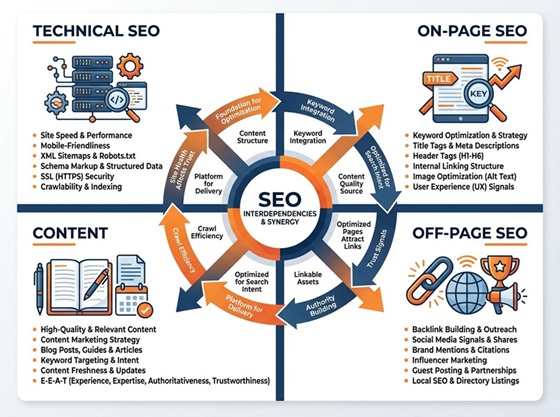
The four pillars of SEO function as an integrated system - a gap in any one pillar limits the performance of the whole.
The four pillars are Technical SEO, On-Page SEO, Content, and Off-Page SEO. Each one handles a distinct layer of your site’s search performance, but none of them works in isolation.
Think of it like a monitoring stack. You can have excellent alerting logic, but if the data pipeline feeding it is broken, alerts don’t fire. Similarly, you can have outstanding content, but if your site has crawl errors or slow page loads, that content may never get indexed or ranked. The framework known as SEO pillars covers exactly how each of these components supports the others and what breaks down when one is neglected.
Here’s the short version before we go deeper:
- Technical SEO - The infrastructure layer. Search engines must be able to crawl, render, and index your pages.
- On-Page SEO - The signal layer. Every page communicates its relevance through structure, metadata, and content formatting.
- Content - The substance layer. What you publish must satisfy the intent behind a user’s search query.
- Off-Page SEO - The authority layer. External signals from other sites tell search engines whether yours is trustworthy and worth ranking.
All four need to be healthy. There’s no shortcut that lets you skip one.
Technical SEO: The Foundation Your Site Runs On
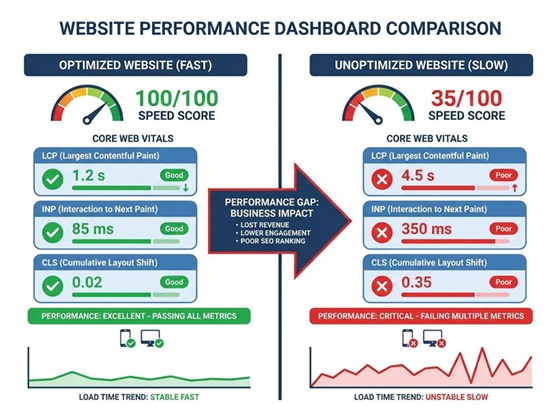
Google’s Core Web Vitals measure real-world user experience - sites that pass thresholds for LCP, INP, and CLS earn a measurable ranking advantage.
Technical SEO isn’t optional. It’s the layer everything else depends on. If search engine crawlers can’t access your pages, your content and backlinks are worthless.
The core elements are crawlability, indexation, HTTPS, mobile-friendliness, site speed, and Core Web Vitals. Each one maps to something operations teams already care about: uptime, response time, request handling, and security. The difference is that poor performance here affects your visibility in search, not just your users’ experience.
The stakes are real. Sites with poor Core Web Vitals scores experienced 20-30% more severe traffic losses in Google’s December 2025 Core Update compared to faster competitors with equivalent content quality, according to Google Search Central and ALM Corp analysis. And with mobile devices generating 58% of all Google searches (AIOSEO, 2026), a site that doesn’t perform well on mobile is already failing more than half its audience before they read a single word.
Google’s Core Web Vitals standards cover the three primary metrics - Largest Contentful Paint (LCP), Interaction to Next Paint (INP), and Cumulative Layout Shift (CLS). These aren’t abstract scores. They measure actual user experience: how fast content loads, how quickly the page responds to input, and whether elements shift around unexpectedly.
For teams managing cloud infrastructure and site reliability, this is familiar territory. The article on how cloud computing affects SEO and digital marketing breaks down the direct connection between your hosting decisions and your search performance - worth reading if you haven’t already.
Start with a technical audit before anything else. Fix crawl errors, ensure HTTPS is properly configured, check your mobile experience, and benchmark your Core Web Vitals. These are table-stakes requirements, not optimizations. Also worth reviewing are smart SEO strategies for operations teams for a practical implementation angle tailored to this audience.
On-Page SEO: Making Every Page Work Harder
On-page SEO is how each individual page communicates its relevance to search engines. Done well, it’s the difference between ranking and not ranking - even when your technical foundation is solid, and your content is excellent.
The key elements are title tags, meta descriptions, URL structure, header hierarchy (H1 through H3), keyword placement, internal linking, and image alt text. None of these is difficult to implement. The problem is that most sites implement them inconsistently.
The payoff for getting it right is significant. According to FirstPageSage data cited in AIOSEO’s 2026 report, the #1 organic result receives 39.8% of all clicks - and when a featured snippet appears, that share rises to 42.9%. The gap between position one and position two isn’t a small difference. It’s a difference in conversion rates that compounds over months.
A few practical rules: URLs should be short, descriptive, and contain the primary keyword. Title tags should be accurate and compelling, not keyword-stuffed. Headers should reflect a logical hierarchy that helps both users and crawlers understand page structure.
Beyond the structural basics, E-E-A-T signals - Experience, Expertise, Authoritativeness, and Trustworthiness - are increasingly factored into how Google evaluates page quality. Author credentials, accurate sourcing, and transparent content matter. Google’s page experience guidelines explain how these signals intersect with technical health indicators.
On-page SEO is where most sites leave ranking potential on the table. Audit your top 20 pages, fix the basics, and you’ll often see movement within weeks.
Content: Answering What People Actually Search For
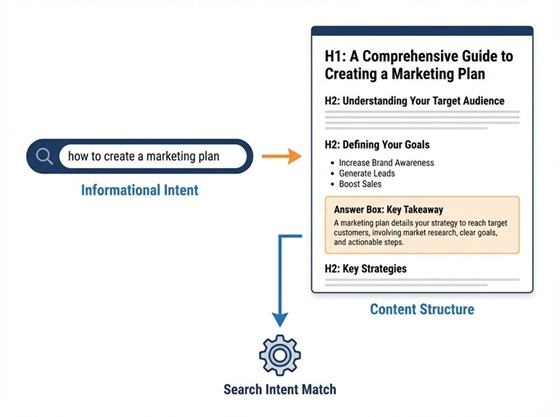
Great content satisfies search intent first - keyword presence matters far less than genuinely answering what a user came to find.
Content is the substance that search engines index and users consume. Keywords matter, but they’re secondary to intent. A page stuffed with the right keywords but structured around what the writer wanted to say - rather than what the searcher wanted to learn - won’t rank well for long.
The search intent categories are informational (how does this work?), navigational (where do I find X?), and transactional (how do I buy or sign up?). Each type requires a different content approach. Matching the right format and depth to the right intent is what separates content that converts from content that gets ignored.
Depth also matters more than most teams expect. According to AIOSEO’s 2026 report, long-form content exceeding 3,000 words earns 3x more traffic, 4x more shares, and 3.5x more backlinks compared to average-length articles. That’s not an argument to pad every post - it’s a signal that thorough, well-researched content outperforms shallow coverage.
One shift worth paying attention to: 60% of Google searches now end without a click, driven by AI Overviews in search results (AIOSEO, 2026). This means visibility in featured snippets and structured answer boxes is increasingly valuable. Content that directly answers specific questions - with clear structure and accurate sourcing - is more likely to surface in these formats.
Grounding your content strategy in proven SEO principles also means refreshing existing content regularly, not just publishing new posts. Search engines favor freshness, and a well-updated older post often outperforms a brand-new one on the same topic.
Off-Page SEO: Earning Authority Beyond Your Own Site
Off-page SEO is how the broader web signals to search engines that your site is worth trusting. The primary signal is backlinks - but not just any backlinks.
95% of web pages have zero backlinks (AIOSEO, 2026). That’s most of the content ever published. Among the top 100 ranking domains, 92.3% have at least one backlink. The correlation isn’t a coincidence. Backlinks from relevant, authoritative sources are one of the strongest signals Google uses to determine whether a page deserves to rank.
Quality matters far more than quantity. A single backlink from an established industry publication is worth more than a hundred links from low-authority directories. The goal isn’t to collect links - it’s to earn citations from sources that your target audience already trusts.
Practical approaches that work for operations and B2B technology teams include publishing original research, contributing expert commentary to industry publications, and writing guest posts on platforms where your audience reads. These activities build links and brand recognition simultaneously - which is the point.
The revenue impact is substantial. BrightEdge research on organic search shows that organic search generates 44.6% of all B2B revenue. That’s the outcome that off-page authority unlocks. Every link you earn contributes to a distribution channel that compounds over time.
For teams thinking about how link building connects to broader digital marketing performance, the guide on optimizing digital marketing for operational efficiency covers how to measure and iterate on these efforts systematically.
How the 4 Pillars Work Together
The systems analogy holds throughout. In a monitoring stack, every layer has to report cleanly; a single failure can cascade and degrade the whole system’s reliability. SEO works the same way.
Technical SEO sets the floor. Without crawlability and performance, everything built on top is at risk. On-page optimization makes your content legible to search engines. Content gives users and crawlers something worth engaging with. Off-page authority tells the ranking algorithm your site is trustworthy enough to surface. Remove any one of these, and the others can’t compensate.
This is also not a one-time project. It’s a continuous process - like uptime monitoring or incident management. SEO drifts when left unattended: pages get orphaned, content goes stale, competitors earn links you don’t. Regular audits and iterative improvements are what keep performance stable.
The ROI is real and consistent. According to the HubSpot State of Marketing 2026 report, website, blog, and SEO are the #1 ROI-driving channel for B2B brands, cited by 27% of marketers. That’s not a soft brand metric. That’s the pipeline.
Where to Start
If your SEO program feels like a loose collection of tactics rather than a working system, the four pillars give you a way to diagnose gaps.
Start with a technical audit. Crawl your site, fix indexation errors, measure your Core Web Vitals, and confirm your mobile experience. This is the foundation. Once it’s clean, audit your top pages for on-page signals - title tags, headers, internal linking. Then look at your content library with fresh eyes: what’s actually matching user intent, and what’s just filling a content calendar?
Off-page authority takes longer to build, but it starts with producing content worth linking to. That’s the cycle. Each pillar reinforces the next.
SEO done right isn’t complicated - but it does require treating it like the operational system it actually is.