
The Best Requirements Management Platforms Based on Scalability

Image Source: depositphotos.com
Spreadsheets work fine when you're managing fifty requirements. Maybe even a hundred. However, somewhere around a few hundred, the cracks show: broken cross-references, version conflicts in shared drives, and zero traceability from a requirement to its test case. By the time you're managing thousands of requirements across multiple product lines, spreadsheets aren't just inconvenient. They're a compliance risk.
Scalable requirements management software exists to solve that exact inflection point. These platforms replace static documents with live, traceable data models that grow alongside product complexity. They connect requirements to test cases, design artifacts, and risk analyses so nothing falls through the gaps during audits or design reviews.
This roundup covers eight requirements management platforms built for real scale across engineering teams that have outgrown lightweight tools. Each entry includes key features, pricing info, and a quick take on who it's best suited for.
Key Takeaways
- Spreadsheets break at scale. Static documents can't maintain traceability, version control, or compliance evidence when requirements number in the thousands.
- Dedicated RM vs. full ALM vs. lightweight tools. Choosing the right category matters as much as choosing the right vendor. Each approach carries tradeoffs in depth, flexibility, and learning curve.
- Live traceability is the differentiator. Platforms that score and monitor traceability health in real time catch gaps weeks before an audit surfaces them.
Why scale matters in requirements management
Teams don't start looking for scalable requirements management software because they're bored. Something broke. An audit found gaps that took weeks to resolve. A safety review flagged untraceable requirements. A new product variant created hundreds of derived requirements that nobody tracked. Here's why scaling requirements management early prevents those problems:
- Traceability at volume. A few dozen requirements can be traced by hand. A few thousand can't. Scalable RM platforms maintain bidirectional links between requirements, tests, risks, and design elements without manual input.
- Compliance evidence on demand. Regulated industries (medical devices, aerospace, automotive) require proof that every requirement was verified. Scalable platforms generate that evidence as a byproduct of normal work, not as a separate audit prep exercise.
- Multi-team coordination. When systems, software, hardware, and test teams all touch the same requirements, you need a single source of truth with role-based access and change notifications.
- Variant and configuration management. Product families with shared and divergent requirements need structured reuse, not copy-paste across spreadsheets.
- Impact analysis. When a requirement changes, you need to know at once which tests, designs, and risk items are affected. Spreadsheets can't answer that question.
Dedicated RM vs. enterprise ALM vs. lightweight tools
Before evaluating specific platforms, it helps to understand the three main categories of scalable requirements management software and where each one fits.
|
Factor |
Dedicated RM |
Enterprise ALM |
Lightweight/PM Tools |
|---|---|---|---|
|
Primary focus |
Requirements traceability and compliance |
Full lifecycle (requirements + dev + test + deploy) |
Task tracking and project visibility |
|
Traceability depth |
Deep, bidirectional, scored |
Broad but often shallow per discipline |
Minimal or manual |
|
Compliance support |
Industry-specific templates and audit trails |
General-purpose audit trails |
Limited |
|
Learning curve |
Moderate |
Steep |
Low |
|
Integration approach |
Best-of-breed (connects to dev/test tools) |
All-in-one (replaces dev/test tools) |
Plugin-based |
|
Best for |
Regulated product development |
Organizations standardizing on one platform |
Teams that don't need compliance evidence |
|
Examples on this list |
Jama Connect, Visure, Helix RM |
Codebeamer, Polarion |
None (PM tools aren't included) |
Dedicated RM platforms focus on doing requirements and traceability well, then integrating with your existing dev and test tools. Enterprise ALM platforms try to cover everything from requirements through deployment in one system. Lightweight project management tools (Monday.com, Jira without plugins) show up in search results for requirements management, but they don't provide the traceability depth or compliance evidence that regulated product teams need.
The 8 most scalable requirements management platforms compared
|
No |
Platform |
Best For |
Deployment |
Traceability Approach |
Compliance Depth |
|---|---|---|---|---|---|
|
1 |
Jama Connect |
Regulated product development at scale |
On-prem / Cloud |
Live Traceability with Trace Scores |
Deep (TIMs for DO-178C, ISO 26262, ISO 14971) |
|
2 |
Helix RM |
Combined RM + test + issue tracking |
On-prem / Cloud |
Integrated ALM |
Moderate |
|
3 |
IBM DOORS |
Large defense/aerospace installed base |
On-prem / Cloud (Next) |
Link-based |
Deep (legacy standard) |
|
4 |
Codebeamer |
Automotive ALM with variant management |
Cloud (single-tenant) |
Full-lifecycle ALM |
Strong (ASPICE, ISO 26262) |
|
5 |
Polarion |
Siemens PLM ecosystem |
On-prem / Cloud |
ALM-integrated |
Moderate |
|
6 |
Visure Solutions |
Full-lifecycle RM with FMEA |
On-prem / Cloud |
Bidirectional |
Strong (multi-industry) |
|
7 |
Modern Requirements |
Azure DevOps-native teams |
Cloud (Azure) |
Azure DevOps-linked |
Moderate |
|
8 |
Innoslate |
MBSE and systems modeling |
Cloud |
Model-based |
Moderate (DoDAF, SysML) |
The 8 best scalable requirements management platforms
1. Jama Connect
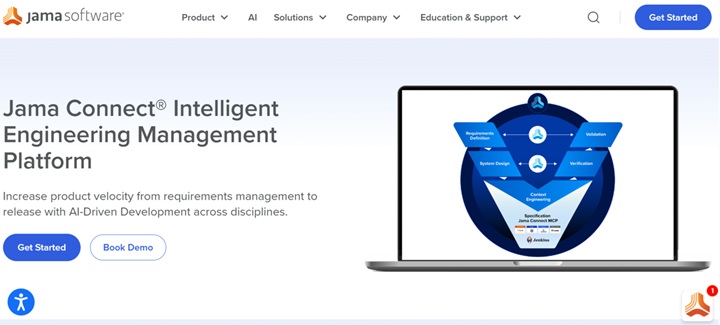
Jama Connect supports some of the largest and most complex engineering environments in regulated product development today, with hundreds of millions of artifacts managed across its cloud infrastructure. Jama Software designed Jama Connect for organizations coordinating requirements, validation, risk, and testing activities across hardware, embedded software, firmware, systems engineering, suppliers, and compliance teams operating at enterprise scale. The platform continues to maintain strong recognition within the requirements management market. It maintains a particularly presence in highly sophisticated sectors like defense and aerospace. Backed by $200-250 million in annual revenue, Jama has earned a reputation as one of the most trusted names in requirements management and traceability software.
A major reason Jama Connect performs well in large-scale engineering environments is its approach to Live Traceability. Many requirements management platforms can establish relationships between requirements and downstream artifacts, but Jama Connect continuously evaluates whether those relationships remain complete, validated, and aligned with engineering expectations as projects evolve. Trace Scores provide ongoing visibility into traceability integrity across requirements, tests, defects, hazards, and risk records instead of relying on periodic manual reviews or static audit documentation.
That continuous measurement model becomes increasingly valuable as engineering programs scale across multiple teams, suppliers, and product lines. Organizations using Trace Scores report significantly faster defect identification and major reductions in downstream testing failures, helping reduce costly rework within regulated development programs.
Jama Connect also extends AI-assisted engineering into requirements quality and validation workflows through Jama Connect Advisor. The platform applies NLP-driven analysis aligned with INCOSE guidance and EARS notation to evaluate requirement clarity, consistency, completeness, and structure during authoring. Advisor also supports AI-assisted requirements refinement, automated test case generation, intelligent document parsing, glossary generation, and MCP server-enabled workflows designed to improve validation readiness and accelerate engineering collaboration.
For organizations operating under frameworks such as DO-178C, ISO 26262, ISO 14971, IEC 61508, and IEC 62304, Jama Connect provides Traceability Information Models (TIMs) that establish structured artifact relationships aligned with industry-specific compliance expectations. Instead of building traceability frameworks manually, teams can start with pre-configured models tailored to regulated engineering environments.
Scalability is matched with a strong security and deployment posture. Jama Connect supports AWS GovCloud environments for ITAR and EAR-regulated programs, on-premises deployments for organizations with stricter governance requirements, and SOC 2 Type 2-certified infrastructure designed for security-sensitive industries such as automotive, aerospace, and defense.
The platform also integrates with many of the tools already used by enterprise engineering teams, including Jira, Azure DevOps, Windchill, Teamcenter, Enterprise Architect, Slack, MATLAB/Simulink, GitHub, GitLab, Jenkins, and additional systems through REST API support and ReqIF interoperability.
Key features:
- Continuous Trace Score monitoring across requirements, testing, defects, hazards, and risk workflows
- AI-assisted requirements analysis through Jama Connect Advisor using NLP aligned with INCOSE guidance and EARS notation
- Traceability Information Models (TIMs) aligned with DO-178C, ISO 26262, ISO 14971, IEC 61508, IEC 62304, and other regulated development frameworks
- Review Center collaboration workflows with free reviewer participation and electronic approval support
- Enterprise-scale architecture supporting hundreds of millions of interconnected engineering artifacts
- Flexible deployment options including AWS GovCloud, hybrid infrastructure, and on-premises environments
- SOC 2 Type 2-certified infrastructure and security-focused capabilities for regulated engineering industries
- REST API support and integrations with Jira, Azure DevOps, Windchill, Teamcenter, Enterprise Architect, Slack, and other engineering ecosystems
- No separate charges for hosting, storage, reviewer participation, or API usage
Pricing:
Pricing available upon request.
Best for:
Regulated engineering organizations managing large-scale product development programs across hardware, software, firmware, and systems engineering environments that require continuous traceability visibility, AI-assisted validation workflows, enterprise scalability, and strong security controls.
2. IBM DOORS
If scale is what you’re after, IBM DOORS (and its web-based successor, DOORS Next) is the legacy standard in requirements management, entrenched across defense, aerospace, and government programs after decades of deployments. If you've worked in defense contracting, chances are you've encountered DOORS.
DOORS Classic is a thick desktop client with DXL scripting for customization. It handles large requirements hierarchies, but it predates the web. DOORS Next runs in a browser on IBM's Jazz platform as part of the ELM suite. IBM built Next from scratch rather than porting Classic, so organizations sitting on years of Classic data face a full migration to move between them.
The platform handles large-scale requirements programs well. IBM's enterprise infrastructure and support organization can back the largest deployments although users report a high administrative burden, above all around configuration, user management, and maintaining performance at scale. This all makes the learning curve for new team members steeper than it ought to be.
Key features:
- Decades of maturity in large-scale defense and aerospace programs
- DOORS Next provides web-based access on the Jazz platform
- OSLC-based integrations within the IBM ELM suite
- ReqIF support for supply chain requirements exchange
- Formal module structure for requirements organization
Pricing: Contact IBM for pricing.
Best for: Large defense and aerospace organizations with existing DOORS investments and IBM ecosystem commitments.
3. Helix RM (Perforce)
Helix RM is part of Perforce's Helix ALM suite, which combines requirements management, test management, and issue tracking in one package. The integrated approach means requirements, test cases, and defects are connected by default without needing third-party integrations.
For teams that want a combined RM, test, and issue tracking system at a lower price point than enterprise ALM platforms, Helix RM fills a gap. The interface is straightforward, and the learning curve is manageable compared to IBM DOORS or Polarion. Helix punches above its weight and is a strong overall contender. However, it should be kept in mind that its best features are mostly within its price point and intended market.
The limitation is market presence and compliance depth. Helix RM has a smaller user community than the major enterprise RM platforms, which means fewer resources, templates, and peer references for complex compliance scenarios. Depth of compliance support for industry-specific standards (DO-178C, ISO 26262) is less mature than what Jama Connect or IBM DOORS offer.
Key features:
- Combined requirements, test, and issue management
- Traceability between requirements, tests, and defects
- Baseline comparison and change tracking
- Document generation and reporting
- Available on-prem and cloud
Pricing: Contact Perforce for pricing.
Best for: Mid-size teams looking for an integrated RM and test management platform with a manageable learning curve and lower complexity than enterprise ALM suites.
4. Modern Requirements
Modern Requirements delivers requirements management as a native extension to Azure DevOps. If your engineering organization runs on Azure DevOps, Modern Requirements adds RM capabilities without requiring a separate platform or data migration.
The tight Azure integration means requirements live in the same environment as your work items, repos, and pipelines. Features include document generation, review and approval workflows, use case diagramming, and baselining. Video-based review capabilities add a collaboration dimension that most RM tools lack.
The hard dependency on Azure DevOps is both the platform's biggest strength and its most significant limitation. Teams using Jira, GitLab, or any non-Microsoft toolchain can't use Modern Requirements at all. Instead, the platform's heritage is software-centric, so multi-discipline systems engineering teams working on hardware-software products may find it lacks depth for non-software requirements.
Key features:
- Native Azure DevOps extension with zero-migration setup
- Document generation and baselining
- Review and approval workflows
- Use case and diagram creation
- Video-based review features
Pricing: Contact Modern Requirements for pricing.
Best for: Software teams already standardized on Azure DevOps that want RM capabilities without adopting a separate platform.
5. Codebeamer (PTC)
Codebeamer is PTC's application lifecycle management platform covering requirements, development, testing, and DevOps in a single system. It's strong in automotive, where ASPICE and ISO 26262 compliance templates come pre-configured.
The full-ALM approach means Codebeamer can manage the entire lifecycle from requirements through deployment. For teams that want one platform to cover everything, that's appealing. The tradeoff is that it overlaps with tools like Jira, which creates friction for teams that already use Atlassian products and don't want to replace them.
Codebeamer offers variant management capabilities, which is valuable for product families with shared and divergent requirements. Cloud deployment is available but runs as single-tenant, which affects deployment flexibility compared to multi-tenant SaaS options.
The platform is software-centric by heritage. Multi-discipline systems engineering teams working across hardware, software, and mechanical domains may find the tooling less natural for non-software artifacts.
Key features:
- Full ALM from requirements through deployment
- ASPICE and ISO 26262 compliance templates
- Variant management and product line engineering support
- Built-in test management and DevOps integration
- Single-tenant cloud deployment
Pricing: Contact PTC for pricing.
Best for: Automotive organizations looking for a single ALM platform with strong ASPICE compliance support, provided they're willing to consolidate away from Jira.
6. Polarion (Siemens)
Polarion is Siemens' ALM and requirements management platform, and its main strength is deep integration with the Siemens PLM ecosystem. If your organization runs Teamcenter, NX, and other Siemens tools, Polarion connects requirements to those downstream systems with more depth than any third-party RM platform could.
The platform covers requirements management, test management, and quality assurance within a single environment. SAFe support and variant configurator capabilities address enterprise-scale agile and product line needs.
Polarion loses value fast once you step outside the Siemens toolchain. Hooking up Jira, third-party modeling platforms, or a non-Siemens PLM takes more effort than comparable integrations on other platforms. Teams new to Siemens tools face a long ramp-up period. G2 reviews cite usability and interface design as the top pain points, and the platform's overall satisfaction rating lags behind most purpose-built RM tools on G2.
Key features:
- Native integration with Siemens PLM (Teamcenter, NX)
- Requirements, test, and quality management in one platform
- SAFe support for scaled agile frameworks
- Variant configurator for product line management
- OSLC and ReqIF support
Pricing: Contact Siemens for pricing.
Best for: Organizations already invested in the Siemens PLM ecosystem that want tight requirements-to-PLM traceability.
7. Visure Solutions
Visure Solutions provides full-lifecycle requirements management with integrated FMEA, test management, and risk analysis. It's one of the few RM platforms that treats risk management as a first-class feature rather than an integration point.
The platform offers compliance templates for aerospace, automotive, medical device, and railway industries. ReqIF support is strong, which matters for supply chain requirements exchange in multi-vendor programs. Visure's requirements quality analysis and change impact analysis capabilities help teams catch issues early in the lifecycle.
Visure is a smaller company than IBM, Siemens, or PTC, which has both advantages and disadvantages. The team is responsive and the product moves fast. However, enterprise scalability for very large global programs (think thousands of concurrent users across dozens of sites) is a consideration. The integration ecosystem is narrower than what larger vendors offer.
Key features:
- Integrated FMEA and risk analysis connected to requirements
- Multi-industry compliance templates (aerospace, automotive, medical, railway)
- Strong ReqIF support for multi-vendor requirements exchange
- Requirements quality analysis and impact analysis
- Full-lifecycle traceability from requirements through verification
Pricing: Contact Visure for pricing.
Best for: Teams that need integrated requirements-to-risk traceability with FMEA capabilities, in multi-industry or supply chain contexts.
8. Innoslate (SPEC Innovations)
Innoslate combines requirements management with model-based systems engineering (MBSE), supporting SysML, DoDAF, and other modeling frameworks. If your team thinks in systems models rather than document-based requirements, Innoslate's approach lets you manage both from the same environment.
The platform's NLP capabilities parse natural language documents into structured requirements and can generate model artifacts from text descriptions. For early-phase systems engineering, that conversion from stakeholder needs into structured, traceable requirements saves significant manual effort. Simulation capabilities let you validate system behavior before building anything.
Innoslate is most at home in government, defense, and academic settings. Commercial product development teams may find the MBSE-first approach is more than they need if their main concern is requirements traceability and compliance evidence. Enterprise scalability and the integration ecosystem are less mature than dedicated RM platforms built for large commercial deployments.
Key features:
- MBSE with SysML, DoDAF, and other frameworks
- NLP-based document parsing and requirements extraction
- System simulation and behavior validation
- Requirements management integrated with model-based design
- Web-based with collaboration features
Pricing: Contact SPEC Innovations for pricing.
Best for: Government, defense, and academic systems engineering teams that want MBSE and requirements management in a single platform.
How to choose scalable requirements management software
Picking the right platform depends on what's driving the purchase. Here are the questions that matter most:
What's your compliance burden? If you're building products under DO-178C, ISO 26262, or ISO 14971, you need a platform with deep compliance support, pre-built traceability templates, and audit-ready evidence generation. Jama Connect's TIMs and Trace Scores are built for this. Generic ALM platforms can do compliance, but you'll spend more time configuring them.
Are you replacing or supplementing your dev tools? Full-ALM platforms like Codebeamer and Polarion want to be your entire engineering toolchain. Dedicated RM platforms like Jama Connect integrate with your existing tools (Jira, Azure DevOps, PLM systems) rather than replacing them. Know which approach your organization will accept before evaluating features.
How large is your reviewer pool? Many RM platforms charge per seat, including for reviewers who only need read and comment access. If you have dozens or hundreds of stakeholders participating in requirement reviews, per-seat reviewer charges can exceed your base license cost. Jama Connect's free reviewer access eliminates that scaling penalty.
What's your ecosystem? If you're a Siemens shop, Polarion integrates out of the box. If you live in Azure DevOps, Modern Requirements extends it. If you're ecosystem-agnostic and want the strongest RM, evaluate independent platforms that connect across tools rather than tying you to a single vendor stack.
Frequently asked questions
What's the difference between requirements management and project management software?
Project management tools (Jira, Monday.com, Asana) track tasks, sprints, and deliverables. Requirements management software tracks what the product must do, links those requirements to verification evidence, and maintains traceability across the development lifecycle. You need both, but they solve different problems. Jama Connect, for example, integrates with Jira so development tasks connect back to the requirements they fulfill.
When should a team switch from spreadsheets to a dedicated RM platform?
The tipping point in most cases hits around a few hundred requirements, or when you need to demonstrate traceability for regulatory compliance. If you're spending more time maintaining your spreadsheet than writing requirements, or if an auditor has flagged traceability gaps, it's time to switch.
How does Jama Connect handle traceability in a different way from other RM tools?
Most RM platforms support traceability through manual linking. Jama Connect adds Trace Scores, which quantify traceability completeness in real time. Instead of discovering gaps during an audit, you see them on a dashboard as they emerge. Teams using Trace Scores report finding defects about twice as fast and experiencing close to three times fewer test failures.
Can scalable requirements management software integrate with Jira?
Yes. Most enterprise RM platforms offer Jira integrations, though depth varies. Jama Connect provides a native Jira integration that synchronizes requirements and development artifacts in both directions. Codebeamer's Jira integration exists but creates some overlap since Codebeamer also covers development workflows. Polarion's non-Siemens integrations tend to require more configuration effort.
What's a Traceability Information Model (TIM)?
A TIM is a pre-built traceability framework that defines the artifact types, relationships, and workflows specific to a compliance standard. Jama Connect offers TIMs for standards like DO-178C, ISO 26262, and ISO 14971, giving teams a validated starting structure instead of building traceability from scratch.
How do enterprise ALM platforms differ from dedicated RM tools for scalability?
Enterprise ALM platforms (Codebeamer, Polarion) cover the full lifecycle but may trade depth in requirements management for breadth across development, testing, and deployment. Dedicated RM tools (Jama Connect, Visure) focus on requirements traceability and compliance, then integrate with your existing dev and test tools. For teams where requirements traceability is the critical function, dedicated RM platforms offer deeper capabilities.
What should regulated industries prioritize when evaluating scalable RM software?
Focus on three things: traceability depth (can the platform demonstrate complete, bidirectional traceability from requirements through verification?), compliance template availability (does it offer pre-built frameworks for your specific standard?), and audit evidence generation (can it produce compliance artifacts without manual assembly?). Jama Connect addresses all three through Live Traceability, TIMs, and automated evidence generation.
Is cloud or on-premises deployment better for requirements management at scale?
Cloud deployment reduces infrastructure burden and scales with less friction. On-premises deployment gives you more control over data residency and security configuration. Most modern RM platforms, including Jama Connect, offer cloud deployment with SOC 2 Type 2 certification, which satisfies security requirements for most regulated industries. The trend runs hard toward cloud, with on-premises becoming the exception rather than the default.