
Commercial Security Systems and Operational Resilience - What Businesses Need to Know
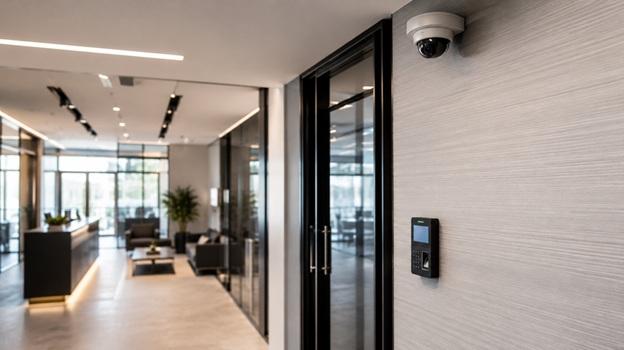
In most organizations, "security" has quietly become shorthand for cybersecurity. Budgets, headcount, and executive attention flow toward firewalls, endpoint protection, and threat detection — and rightly so. But this focus has created a blind spot. The physical layer of security, the cameras and access controls and alarms that protect the building itself, is too often treated as a facilities expense rather than what it actually is: a core component of operational resilience.
That framing matters. When a business thinks of physical security as a grudging cost, it underinvests, buys the cheapest option, and discovers the gaps only after an incident. When it thinks of physical security as operational infrastructure — on par with the systems that keep the business running — it makes better decisions. This guide makes the case for the second view and walks through what businesses should know.
Physical Security Is an Operational Risk, Not a Facilities Line Item
Every operational risk framework worth using accounts for disruption: what could stop the business from functioning, and how do you reduce that probability? A break-in, theft of equipment, vandalism, or unauthorized access to a sensitive area all map directly onto that question. A stolen server is a data breach and a downtime event. A compromised access door is both a safety issue and a liability exposure. An unmonitored loading bay is shrinkage that hits the bottom line every quarter.
Seen this way, a commercial security system isn't about catching the occasional intruder — it's about reducing the frequency and severity of events that interrupt operations. That's the same logic that justifies monitoring stacks, redundant infrastructure, and incident response plans. Physical security simply applies it to the physical plane. Businesses that get serious about this often bring in professionals for commercial security system installation precisely because a poorly designed system creates the illusion of protection without the substance — the operational equivalent of a monitoring tool that isn't actually alerting on anything.
The reframe is simple but consequential: stop asking "what's the cheapest way to put cameras up?" and start asking "what's the operational cost of the incidents this system is meant to prevent?"
The Components of a Modern Commercial System
A commercial security system is not a single product but an integrated set of layers, each addressing a different failure mode.
Access control governs who can enter which spaces and when. Modern systems have moved well beyond keys and even beyond keycards toward mobile credentials, PIN codes, and biometric options. The operational value is twofold: you prevent unauthorized entry, and you generate an audit trail of who accessed what and when — invaluable for both security investigations and compliance.
Video surveillance (CCTV) provides deterrence, live monitoring, and forensic evidence. The current generation increasingly includes AI-driven analytics that distinguish people from vehicles, flag unusual activity, and reduce the flood of false alerts that made older systems easy to ignore.
Intrusion detection — door and window sensors, motion detectors, glass-break sensors — covers the perimeter after hours and triggers alarms and notifications when something is breached.
Alarm monitoring connects the system to a response, whether that's an internal team or a professional monitoring service that can dispatch help. A sensor that detects an intrusion but alerts no one is theater, not security.
Environmental and life-safety integration is the layer businesses forget. Smoke, fire, water, and temperature sensors protect against disruptions that have nothing to do with crime but everything to do with continuity — a flooded server room or an undetected fire is as operationally catastrophic as any break-in.
Integration - Where Resilience Actually Lives
The defining feature of a modern commercial system is that these components don't operate in isolation. They integrate — with each other and, increasingly, with the organization's digital systems.
When access control, video, and intrusion detection share a platform, an event in one triggers intelligent responses across the others. An after-hours door breach can automatically pull up the relevant camera feed, log the event, and push an alert to the right people in seconds. That integration is exactly what operations teams already expect from their digital tooling: correlated signals, automated responses, and a single pane of glass rather than a dozen disconnected dashboards.
This is also where the long-standing wall between physical and digital security is coming down. Physical security devices are now networked endpoints — which means they're part of your attack surface and need the same discipline applied to any connected device. A poorly secured camera is both a physical security tool and a potential network vulnerability. Treating the two domains as one converged practice, rather than separate fiefdoms, is increasingly how resilient organizations operate.
What Decision-Makers Should Evaluate
When assessing a commercial security investment, a few criteria separate a resilient system from an expensive false sense of security.
Scalability. Your security system should grow with your footprint. Cloud-managed platforms make it far easier to add locations, users, and devices without ripping and replacing.
Reliability and redundancy. What happens during a power outage or network failure? Battery backups, cellular failover, and local recording ensure the system keeps working when conditions are worst — which is precisely when incidents happen.
Manageability. For organizations with multiple sites, the ability to manage access and monitor footage centrally and remotely is the difference between a controllable system and an administrative burden.
Compliance and audit. Depending on your industry, you may face requirements around access logging, data retention, and footage handling. The system should make compliance straightforward, not adversarial.
Total cost of ownership. The sticker price is the smallest part. Maintenance, monitoring fees, and the cost of downtime from a system that fails or can't scale all factor in. A cheap system that requires constant service or leaves gaps usually costs more over its life than a well-specified one installed correctly.
The Case for Professional Design and Installation
There's a meaningful difference between buying security hardware and deploying a security system. The hardware is increasingly commoditized; the value is in the design — assessing a specific site's vulnerabilities, eliminating blind spots, configuring integrations, and ensuring the system actually does what it's supposed to when tested.
This is the same reason organizations don't let their monitoring stack assemble itself. Expertise in architecture and configuration is what turns a pile of capable components into a resilient system. A professional assessment identifies the access points an owner overlooks, the camera angles that matter, and the integration logic that makes the whole greater than its parts. For a system protecting business continuity, that design discipline is where the return lives.
The Bottom Line
Physical security has earned its place in the operational resilience conversation. The cameras at the entrance, the credentials on the doors, and the sensors on the perimeter are not facilities overhead — they're infrastructure that prevents the disruptions a resilient business is built to avoid. Organizations that treat commercial security systems with the same seriousness they bring to their digital operations — evaluating risk honestly, prioritizing integration and reliability, and investing in proper design — get protection that holds up when it's tested. Those that treat it as a checkbox get hardware on the wall and a false sense of security. In operational terms, the difference shows up exactly when you can least afford it.