
Michael Burry Warns of Artificially Inflated Earnings

Image Source: depositphotos.com
On November 10, 2025, Michael Burry, the investor famous for predicting the 2008 subprime mortgage crisis and featured in the film "The Big Short," posted on X, accusing American big tech giants of inflating their earnings.
The criticism centers on a widespread accounting practice among companies that have invested in AI: the artificial extension of the useful life of IT equipment, primarily Nvidia GPUs, to mitigate the impact of depreciation on corporate balance sheets.
According to Michael Burry's calculations, this practice would lead to underestimating GPU depreciation by approximately $176 billion between 2026 and 2028. For example, with these estimates, earnings of a large player of the SP500 heatmap — Oracle — could be overstated by 27% and Meta's — by 21% within the next 3 years.
The mechanism is simple — companies "spread" the cost of GPU purchases over more years than their actual lifespan, lowering the company's real costs.
For instance, a company spends $30,000 to purchase a GPU. If the company expects that the GPU will last for 2 years before becoming outdated, the cost will be spread over 2 years and the company will record a liability of $15,000 per year. If instead they estimate the GPU to last for 6 years, then the company will only record $5,000 per year, significantly deflating costs and consequently inflating profits.
The paradox is that companies are depreciating GPUs over a 5-6 year period, suggesting they will be economically useful in 2028-2029 as well, while NVIDIA releases a new generation of processors approximately every two years:
- 2020: Ampere architecture (A100 GPU)
- 2022: Hopper (H100 GPU)
- 2024: Blackwell (B100/B200 GPU)
- 2026: Expected arrival of Rubin
It's as if a telecom company bought iPhone 12s in 2020, claiming it would remain productive until 2026. Evidence from the used market confirms the rapid obsolescence of these products.
All this occurs in a context where capital expenditures (capex) of companies investing in AI are increasing at record rates. JPMorgan projects up to $3 trillion in data center spending by 2028, with total investment in the AI sector reaching $7 trillion.
To justify this, AI companies would need to generate $2 trillion in annual revenue by 2030 — compared to the $20 billion they currently earn annually. Moreover, Big Tech's financing model has fundamentally changed, as for the first time, the companies are resorting to a large use of debt, amplifying risk in the event of an economic slowdown.
With massive corporate bond issuance, the coming months could be crucial for determining the market's direction. U.S. labor data or the Fed's inability to cut rates further may serve as a first catalyst for a market crash.
The following images show NVIDIA's earnings per share and revenue projections.
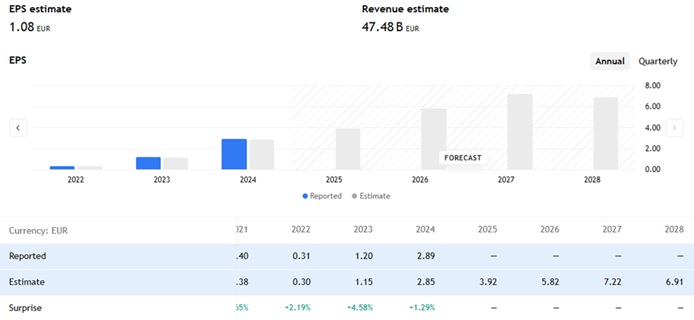
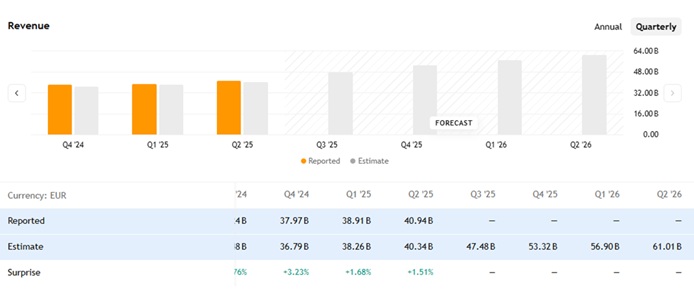
A decline in earnings could trigger what is called a "Metaverse Moment" — named after Meta’s loss of hundreds of billions of dollars in market value while continuing to invest in the metaverse without actual results. This occurs when an AI company announces greater investments, but its stock value continues to fall.
It’s the point at which investors stop believing the narrative and begin demanding real profits, potentially marking the bursting of the AI bubble — if we're talking about a bubble — or a significant stock price correction.
Michael Burry's statement, along with the full report scheduled for release on November 25, may prove pivotal. If his insights prove accurate, investors may begin to demand profitability guarantees and seek ways to exit their positions to protect themselves from a potential sector slowdown.