
Quantum Computing Security: Why Enterprises Need to Prepare Now

Most security teams assume their encryption will hold. That assumption has an expiry date. A 2025 ISACA poll of more than 2,600 professionals found that 62% expect quantum computers to break current encryption, yet only 5% of their organizations have a defined plan to respond. That distance between worry and action is the real exposure. Machines able to crack widely used encryption are no longer science fiction, and the data you guard today could be unlocked the moment they arrive. Here is what the shift means for your business, how much runway you actually have, and where a sensible response begins.
Key Takeaways
- Quantum computers can break the RSA and elliptic curve encryption that secures most digital systems.
- Attackers already steal encrypted data now to decrypt later, so long-life secrets are at risk today.
- Gartner expects asymmetric cryptography to turn unsafe by 2029, then open to full attack by 2034.
- NIST published quantum-resistant standards in 2024, giving enterprises a clear path to migrate.
- A cryptographic inventory plus crypto-agility form the practical first moves toward readiness.
Why Quantum Computing Security Is a Board-Level Concern
Quantum computing security refers to protecting data and systems against the code-breaking power of quantum machines. This is no longer a research curiosity, and mapping the full scope of quantum computing security risks is the first step toward a defensible plan.
A classical computer would need thousands of years to crack strong public-key encryption. A capable quantum computer could finish the job in hours. That single leap undermines the math behind secure web sessions, digital signatures, virtual private networks, and trusted software updates.
The most pressing danger is unfolding right now. Adversaries and nation-states are capturing encrypted traffic today and warehousing it, wagering they can read it once the hardware matures.
|
Harvest now, decrypt later: any secret with a long shelf life, such as health records, financial data, trade secrets, or classified files, is effectively exposed the day a working quantum computer exists, even if that day sits years out. |
Anything that must stay confidential for five, ten, or twenty years already sits in the danger zone. For directors, that reframes quantum from a distant IT project into a present risk decision, one that belongs beside every other pillar of modern network security.
How Quantum Computers Break Today's Encryption
Quantum machines defeat encryption by solving math problems that classical hardware cannot. Shor's algorithm lets a large quantum computer factor huge numbers and compute discrete logarithms with ease, which is precisely the difficulty that RSA, elliptic curve cryptography, and Diffie-Hellman depend on for their safety.
Not every algorithm collapses the same way. Symmetric ciphers such as AES face a milder attack from Grover's algorithm, which weakens them rather than shattering them. Doubling the key length restores their strength, so well-chosen symmetric encryption survives the transition.
The catch is that vulnerable algorithms are woven through everything. They sit inside browsers, VPN tunnels, payment systems, code-signing pipelines, identity providers, and countless embedded devices. Untangling that web is why experts describe the shift as a multi-year engineering effort rather than a quick patch.
The table below shows where the pressure actually lands.
|
Cryptography |
Type |
Quantum impact |
Recommended action |
|---|---|---|---|
|
RSA |
Public-key encryption and key exchange |
Broken by Shor's algorithm |
Replace with ML-KEM |
|
ECC / ECDSA |
Public-key signatures and key exchange |
Broken by Shor's algorithm |
Replace with ML-DSA |
|
Diffie-Hellman |
Key exchange |
Broken by Shor's algorithm |
Replace with ML-KEM |
|
AES-256 |
Symmetric encryption |
Weakened by Grover's algorithm |
Keep, use 256-bit keys |
|
SHA-256 / 384 |
Hashing |
Mildly weakened by Grover |
Keep, favor larger digests |
The federal response confirms the seriousness. In August 2024, the United States government published three finalized federal encryption standards built to resist quantum attacks, closing an eight-year search for replacements. Knowing which systems rely on the vulnerable algorithms is the groundwork for any cloud security checklist you build next.
How Much Time Do Enterprises Really Have?
The honest answer is that nobody knows the exact date, often called Q-Day, when a cryptographically relevant quantum computer arrives. What we do have is a set of credible planning markers from analysts and governments.
"By 2029, advances in quantum computing will make conventional asymmetric cryptography unsafe to use." Gartner, 2024
Gartner projects that asymmetric cryptography turns unsafe by 2029 and becomes fully breakable by 2034. The NSA sets a 2030 deadline for national security systems, the United Kingdom's cyber authority targets full migration by 2035, and Google has adopted an internal 2029 deadline, citing faster than expected progress.
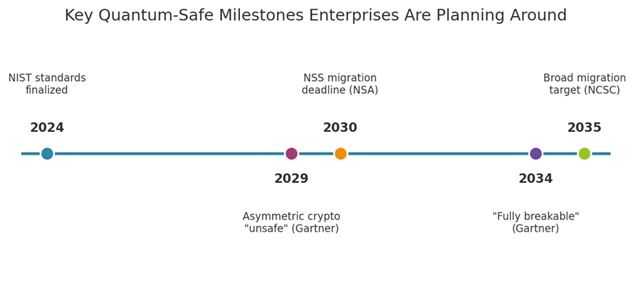
Milestones that enterprise roadmaps are already planning around.
Here is the trap. If the data you hold must stay secret for ten years, and your migration takes five, then a Q-Day even a decade away already overlaps your protection window. The cryptographer Michele Mosca framed this as a plain inequality: when secrecy time plus migration time exceeds the time to Q-Day, you are already behind.
What Post-Quantum Cryptography Changes in Your Stack
Post-quantum cryptography is a family of algorithms designed to resist both classical and quantum attacks while running on the hardware you already own. It needs no quantum computer to deploy, which is why the switch can begin immediately rather than someday.
The standards body finalized its first choices in 2024. Three algorithms anchor the change.
|
Standard |
Algorithm |
Purpose |
|---|---|---|
|
FIPS 203 |
ML-KEM (from CRYSTALS-Kyber) |
Quantum-safe key exchange and encryption |
|
FIPS 204 |
ML-DSA (from CRYSTALS-Dilithium) |
Primary digital signatures |
|
FIPS 205 |
SLH-DSA (from SPHINCS+) |
Backup hash-based signatures |
Few organizations will flip a single switch. The common route is hybrid cryptography, running a classical algorithm and a quantum-safe one side by side so systems stay compatible during the change. Just as vital is crypto-agility, the capacity to swap algorithms without rebuilding whole applications.
The new algorithms behave differently in practice. Their keys and signatures are larger, and some operations run slower, so performance testing in real workloads matters before any broad rollout. Building that flexibility now spares you a painful re-engineering project when standards evolve again.
[Video: "Post Quantum Cryptography" by Computerphile: https://www.youtube.com/watch?v=_MoRcYLN-7U]
This short explainer breaks down why the migration matters and how the replacement algorithms differ from the ones they retire. Larger teams often lean on managed security operations to coordinate testing and rollout across a sprawling estate.
For a structured starting point, national security agencies jointly published a quantum readiness roadmap that walks teams through inventory, prioritization, and vendor engagement.
How to Prepare for Quantum Computing Security
Preparation begins with visibility, not panic. You cannot protect cryptography you cannot see, so the opening move is a full inventory of where encryption lives across applications, certificates, private networks, cloud workloads, and third-party services.
After that, rank the inventory by how long each dataset must remain secret. Long-life, high-value information moves to the front of the queue, since it is the first prize when data stolen today gets unlocked years later.
The readiness gap is stark, and it is exactly where slower competitors fall behind.
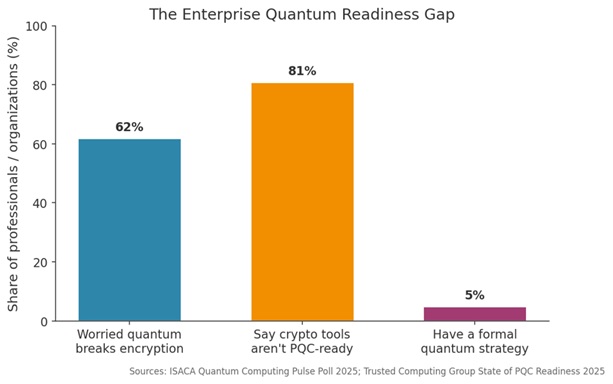
Awareness is high; genuine preparation is not.
|
Key stat: a late 2025 industry survey found that 81% of security professionals believe their cryptographic libraries and hardware modules are not yet ready for the switch, which shows how much groundwork still remains. |
Practical moves that pay off now:
- Build and maintain a living cryptographic inventory across every environment.
- Classify data by its required secrecy lifespan, then protect the longest-lived first.
- Demand post-quantum migration plans from every critical vendor and supplier.
- Choose crypto-agile architectures for all new systems and procurement.
- Assign clear ownership across security, IT, procurement, and risk.
|
Pro tip: treat quantum readiness as an ongoing program, not a one-off task. Fold it into existing governance so progress is tracked, funded, and reviewed like every other part of your security roadmap. |
That framing keeps momentum steady and makes the multi-year effort of protecting your digital assets feel manageable rather than overwhelming.
Frequently Asked Questions
What is quantum computing security?
Quantum computing security means defending data, communications, and systems against attacks from quantum machines. It centers on replacing encryption that quantum hardware can defeat with quantum-resistant algorithms before those machines become widely available.
Can quantum computers break encryption today?
Not yet. No public quantum computer can defeat strong encryption right now. The worry is future hardware paired with data being harvested today, where stolen encrypted files wait to be read once capable machines finally exist.
When will quantum computers threaten current encryption?
Estimates differ. Analysts at Gartner see asymmetric cryptography weakening around 2029 and breakable outright by 2034. Most government roadmaps target completed migration between 2030 and 2035, so preparation should start today.
What is post-quantum cryptography?
Post-quantum cryptography describes encryption and signature algorithms designed to run on ordinary computers while resisting quantum attacks. Standards bodies finalized the first three in 2024 for key exchange and digital signatures.
How should a business begin preparing?
Start with a cryptographic inventory that maps where encryption is used. Then prioritize data by secrecy lifespan, adopt crypto-agile systems, and ask every vendor for a clear post-quantum migration plan.
The Window to Act Is Open Now
The quantum era rewards early movers and punishes those who wait. The encryption shielding your most sensitive data was never built to survive what is approaching, and the migration ahead is measured in years, not weekends. Organizations that inventory their cryptography, prioritize long-life secrets, and design in crypto-agility will move through the change calmly. Those who hold out for Q-Day headlines will face a rushed, costly scramble that exposes the very information they were trusted to keep safe.
References
NIST, U.S. Federal Register, Announcing Issuance of FIPS 203, 204, and 205, 2024. https://www.federalregister.gov/documents/2024/08/14/2024-17956/announcing-issuance-of-federal-information-processing-standards-fips-fips-203-module-lattice-based
Gartner, Postquantum Cryptography: The Time to Prepare Is Now, 2024. https://www.gartner.com/en/documents/6199155
ISACA, 2025 Quantum Computing Pulse Poll (reported by The Quantum Insider), 2025. https://thequantuminsider.com/2025/04/28/organizational-quantum-readiness-remains-low-poll-finds-only-5-of-organizations-have-a-quantum-computing-roadmap/
CISA, NSA and NIST, Quantum-Readiness: Migration to Post-Quantum Cryptography, 2023. https://www.cisa.gov/resources-tools/resources/quantum-readiness-migration-post-quantum-cryptography
Trusted Computing Group, State of PQC Readiness, 2025. https://trustedcomputinggroup.org/91-of-businesses-do-not-have-a-roadmap-in-place-to-protect-against-quantum-threats-finds-new-industry-survey/
Fact Check: All statistics and data points in this article were verified against original sources as of July 6, 2026. Sources are listed in the References section.