
What Actually Saves Time in Link Building for Small SEO Teams

Image Source: depositphotos.com
Small SEO teams lose time before the first reply. They search for prospects, check sites one by one, hunt for contacts, write custom openings, send emails, set reminders, and rebuild reports at the end of the month.
Tools can shorten this process. The source research shows the largest gains in prospect discovery, contact finding, sequence sending, follow-ups, link monitoring, and reporting. The same research also shows a limit: tools do not judge fit, negotiate placements, write strong content, or build trust with an editor.
The useful question is not whether link building should be manual or automated. The useful question is where a small team should use software, where a person must stay in control, and when the subscription cost makes sense.
Bottom line: automate repeat work, not judgment. Use tools to collect, sort, send, remind, monitor, and report. Keep prospect fit, pitch angle, replies, negotiation, and content quality in human hands.
Teams that compare link building tools should judge each option by one metric first: how many verified hours it removes from a repeatable step without lowering link quality.
The real bottleneck in manual outreach
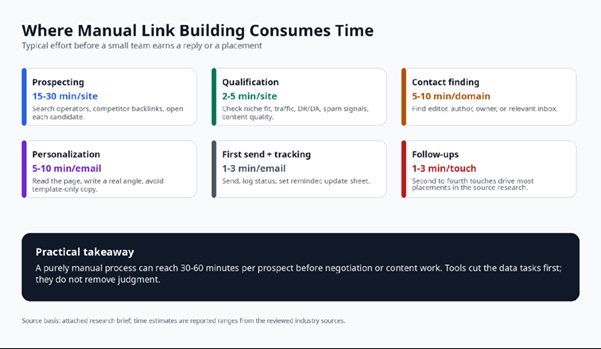
Manual outreach gives a team control. It also makes each prospect expensive. The research brief reports 15-30 minutes for manual prospect research and 30-60 minutes per prospect once qualification, contact finding, and first-email personalization are included. That estimate excludes negotiation and content work.
This time cost matters most for teams of one to five people. A solo SEO who spends ten hours a week on outreach can process only a small list if every step stays manual. A three-person team can scale farther, but it still loses hours to status updates, duplicate checks, inbox reminders, and monthly reporting.
Manual work that still earns its place
Manual work still pays off where quality decides the result. A person must decide whether the site fits the client, whether the page deserves a pitch, which angle gives the editor value, and how to respond when the prospect asks for a change. Software can prepare this work. It cannot own the decision.
What tool-assisted link building changes
A tool-assisted workflow removes repeated clicks. It turns research into exports, contact lookup into batch work, email sending into controlled sequences, follow-ups into scheduled logic, and reporting into a dashboard. The best workflow still adds manual gates before outreach and after reply.
The source research shows the clearest time savings in four areas: prospecting, contact finding, outreach sequencing, and follow-up handling. Mailshake vendor data in the research says one consultant sent 284 emails in 1.5 hours and saved about 17 hours on initial sends. The same case claims roughly 56 hours saved after follow-ups. Treat these as vendor-reported figures, not neutral benchmarks.
What tools do not solve
Tools do not solve weak targeting. They can produce a longer list of bad sites faster. They do not solve weak copy. A merge field does not equal personalization. They do not solve inbox reputation. More emails can increase bounces, spam complaints, and domain damage if the team skips verification and warm-up.
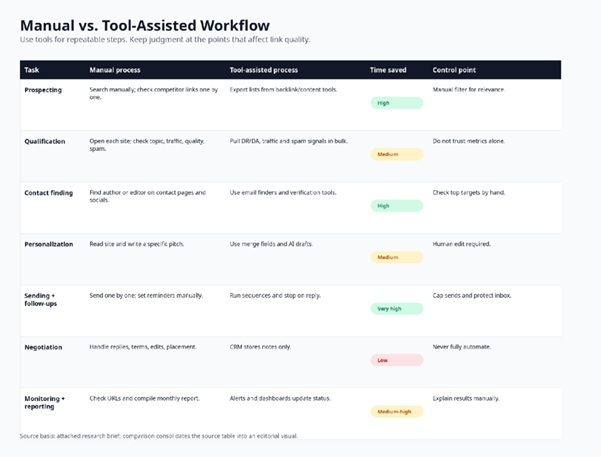
Manual versus tool-assisted work by task
The strongest small-team setup uses different automation levels by task. Data collection can be highly automated. Qualification needs software plus a manual check. Personalization can use drafts, but a person must edit the message. Negotiation should stay manual.
When a paid tool makes sense for a small team
A paid tool makes sense when the team already repeats a process often enough for the saved labor to exceed the subscription cost. The research brief uses a practical threshold: below roughly 10 links per month, spreadsheets and low-cost tools often work. Around 10-25 links per month, a CRM or email sequencing tool usually saves enough time to justify the price. Above 25 links per month, advanced platforms and custom dashboards can support volume.
The team should calculate cost per acquired link before it buys another platform. The formula must include labor, software, and content cost. It should not count only the outreach tool price.
Cost signals to watch
A tool is too early when the team sends fewer than 50-100 outreach emails per month, lacks a clean prospecting process, or has no standard rules for qualification. A tool is late when the team spends more than 10-15 hours per week on list building, reminders, manual tracking, and report assembly.
The tool should buy back time from repeat work. It should not force a small team to rebuild its process around features it does not need.
Benchmarks small teams can use
The attached research gives practical ranges rather than universal averages. Manual outreach often reaches 50-100 prospects per month and can earn 15-30% replies when the team writes highly specific messages. Automated outreach can reach 300-500 prospects per month, but the research reports lower reply rates of 1-5% for broad automated campaigns.
Follow-ups change the result. The research cites a finding that most successful placements come from emails two through four. This makes sequence automation useful. It also creates a risk: poorly written or excessive follow-ups can damage trust and deliverability.
Useful benchmark ranges from the research
- Manual prospect research: 15-30 minutes per site.
- Tool-assisted prospecting: 2-5 minutes per prospect after export and filtering.
- Manual full first-touch workflow: often 30-60 minutes per prospect before negotiation.
- Automated broad outreach: 300-500 prospects per month, often with lower reply rates.
- Manual personalized outreach: 50-100 prospects per month, often with higher reply rates.
- Safe email volume depends on inbox age, domain reputation, verification, and warm-up; the research cites examples around 20-25 cold emails per inbox per day.
Where automation creates hidden work
Automation can reduce visible labor while adding invisible cleanup. A bad export creates manual filtering. A weak finder creates bounce cleanup. A generic template creates low replies. A high-volume sequence creates deliverability work. A dashboard creates a false sense of progress if it reports sends and opens but not relevant links earned.
The worst false efficiency
The worst false efficiency is a large prospect list that nobody trusts. It makes the team feel productive, but every next step gets slower. Writers waste time on poor targets. Outreach managers send to weak contacts. The strategist cannot explain why those sites matter. Fix the list before you scale the sequence.
Recommended workflows by team size
Small teams should add tools by bottleneck. A solo SEO does not need an agency CRM first. A three-person team does need shared status and automated follow-ups. A five-person team needs stricter ownership, duplicate prevention, and link monitoring because several people can touch the same prospect.
A practical rollout plan
Start with a two-week audit before buying another platform. Count hours by task: prospecting, qualification, contact lookup, personalization, sending, follow-ups, reply handling, content coordination, monitoring, and reporting. Then automate the highest-repeat task first.
- Week 1: measure the current process. Track time per 25 prospects and mark where the team repeats the same action.
- Week 2: clean the qualification rules. Define minimum topical fit, traffic, spam signals, and disqualifiers.
- Week 3: add one tool to the largest bottleneck. Do not change the whole stack at once.
- Week 4: run a small campaign. Compare hours spent, replies, qualified opportunities, links earned, bounces, and complaints.
- Week 5: scale only if the list quality, inbox health, and reply handling stay under control.
Final answer: what actually saves time?
Small SEO teams save the most time when they automate prospect discovery, contact extraction, sequence scheduling, follow-up reminders, link checks, and recurring reports. These tasks are repeatable, structured, and easy to review.
Tools only appear efficient when they increase volume without improving qualified opportunities. A team that sends 500 weak emails has not saved time. It has moved work from research to cleanup, deliverability repair, and awkward reply handling.
Small teams should never fully automate prospect judgment, pitch angle, reply handling, negotiation, and content quality. These steps decide whether a link is worth earning. The best workflow uses software to reduce mechanical work and gives people more time to make the decisions that affect outcomes.