
What Is CIDR Notation? A Simple Explanation for Beginners

CIDR notation, short for Classless Inter-Domain Routing, is a way to allocate IP addresses and route traffic better. So, what is CIDR notation? It lets networks use IP addresses more flexibly, replacing the old rigid ways and is important for modern networks.
Summary
- CIDR notation optimizes IP address allocation by allowing variable length subnet masking, less address space waste.
- The CIDR block structure makes routing and address management easier, creates supernets that simplifies network management.
- Despite the benefits, CIDR can be complex, requires skilled network management to avoid address space fragmentation and compatibility with older devices.
What is CIDR Notation
CIDR, which stands for Classless Inter-Domain Routing, is a big improvement in IP addressing. Unlike the old classful IP addressing, CIDR notation is more flexible and efficient way to manage IP address space. At its core, CIDR notation is a prefix representing the network address and a cidr suffix representing the number of bits for the network identifier. This suffix appended to an IP address tells how many bits are used for the network part, makes IP address allocation more efficient by allowing variable length subnet masking. Understanding ip address classes is important for network management.
For example, in the CIDR address 192.0.2.0/24, the ‘/24’ means the first 24 bits is the network prefix, the remaining bits is for host addresses and host address bits. This compact format helps to summarize routes and address blocks, reduces routing tables complexity and optimizes network performance.
CIDR Blocks
CIDR blocks are the building blocks of this new IP addressing system. Each CIDR block is a network address and a prefix length that tells the number of bits for the network part. These blocks are collection of IP addresses that have the same network prefix, makes address allocation and routing easier. Multiple cidr blocks and CIDR addresses provides a more flexible way to manage these resources, including multiple ip address blocks and cidr ip address. Whoer ip helps you track and verify your IP addresses for better management and security. Also, CIDR blocks can be aggregated to form supernets, which combines multiple smaller networks into one larger network. This aggregation simplifies routing and management of IP address space, makes it easier to organize IP addresses and allocate them based on the specific needs of a network, including large cidr blocks.
Enables to divide IP address space into blocks of appropriate size, CIDR makes IP address allocation more flexible and efficient in the ip space.
How CIDR Works
CIDR works on the principle of Variable Length Subnet Masking (VLSM), which allows IP addresses to be allocated in arbitrary block sizes. This means network administrators can create subnets of different sizes without wasting IP addresses, optimize the use of the available address space. Allows various sized subnets, CIDR ensures each network segment gets the exact number of IP addresses it needs.
In essence, a subnet in CIDR context is a logical or physical subdivision of a network that has the same subnet routing prefix. This subdivision makes routing and address management easier, routers can direct packets based on the network prefix, reduces routing decision complexity. CIDR blocks uses variable length subnet masking, so address spaces can be sized according to the needs of the networks.
Also, CIDR’s approach to IP addressing optimizes traffic management by routing through appropriate sized subnets. This allows routers to route packets based on the specified subnets, improves overall network performance and management efficiency.
Benefits of CIDR Notation
The benefits of CIDR notation are many, from efficient IP address allocation to route summarization and network scalability. Using CIDR allows organizations to customize their addressing schemes, reduce routing table size and meet the demands of modern networks as stated by 1921681 .
Let’s go deeper into these benefits below.
Efficient IP Address Allocation
One of the biggest benefit of CIDR is its ability to provide flexible IP address allocation. Unlike the old classful addressing, CIDR allows network administrators to allocate IP addresses according to the actual needs of their networks. This flexibility is achieved through variable length subnet masking, makes better management of address space and prevent waste by allocating IP addresses more efficiently. Matching the number of addresses to each network segment’s requirements, CIDR reduces the chance of IP address waste. This not only maximizes the use of IP address space but also the efficiency of IP address allocation, so no addresses are left unused.
Route Summarization
CIDR notation is key to route summarization, which reduces the number of entries in routing tables. Summarizing multiple routes into one routing table entry, CIDR simplifies the routing system, makes it more efficient and manageable. For example, CIDR allows network administrators to combine contiguous IP address ranges into supernets, which aggregates multiple subnets under one network prefix. Also inter domain routing cidr is required for managing data flow between different networks.
This route summarization reduces network complexity by minimizing the number of routes advertised. As a result, routing tables have fewer entries, better performance and less overhead for network routers, all of which can be managed using a border gateway protocol.
Network Scalability
As networks grow and evolve, scalability of IP addressing becomes more important. CIDR helps in scalability by:
- Allowing extensive subnetting, to use IP address space efficiently.
- Managing both IPv4 and IPv6 addresses.
- Making subnet organization more efficient and adaptable to changing network demands.
Also CIDR supports network scalability by allowing multiple subnets within a single class c network, thus improving performance and management. This is important for internet service providers and large organizations that need to accommodate more devices and network segments.
Implementing CIDR in Networks
Implementing CIDR in ip networks involves using slash notation to define the size of network blocks. For example in IPv4, a /16 prefix means 65,536 addresses, a /24 prefix means 256 addresses. For IPv6, most ISPs allocate /48 network prefixes which means 65,536 separate local area networks (LANs) within a single site. This flexibility allows for IP address allocation tailored to the needs of different private network segments.
Transitioning to CIDR can introduce implementation complexity, requires additional training for network administrators. Configuring custom subnet masks and managing multiple subnets requires skilled planning and careful tracking of IP assignments. Although it’s complex, CIDR simplifies the integration of IPv6 with existing IPv4 networks, so no service disruption. Also network administrators must be knowledgeable in CIDR to manage and troubleshoot complex network configurations. This requires understanding of variable length subnet masking and designing efficient subnetting schemes that optimize IP address usage, network mask and network performance.
CIDR Challenges
While CIDR has many benefits, it also has some challenges. Managing large CIDR networks can lead to compatibility issues with older network devices and requires ongoing monitoring of IP address usage.
Let’s dive into these challenges.
Implementation Complexity
Configuring CIDR networks is more complex than classful addressing because of custom subnet masks and precise planning. This complexity requires network administrators to have deep understanding of binary representation and prefix length to manage IP address allocation. Tracking IP assignments across multiple subnets adds to the overhead, so it’s crucial to maintain accurate records and optimize routing.
Although it’s complex, proper subnetting can improve security, reduce management overhead, contain traffic and optimize routing. So while CIDR implementation requires more planning and management, the long term benefits makes it worth it.
Address Space Fragmentation
Address space fragmentation occurs when IP addresses are allocated in different sizes, resulting to inefficiencies in routing and management overhead. This fragmentation can cause downtime and impact network availability during consolidation. Ongoing administration is necessary to avoid these issues and ensure efficient address allocation.
Address space fragmentation can also cause IP address waste, as smaller fragmented blocks may not be used efficiently. To mitigate this, network administrators must continuously monitor and manage IP address usage, so address blocks are allocated and used efficiently to prevent fewer ip addresses, host portions and ip address waste.
CIDR and Subnetting
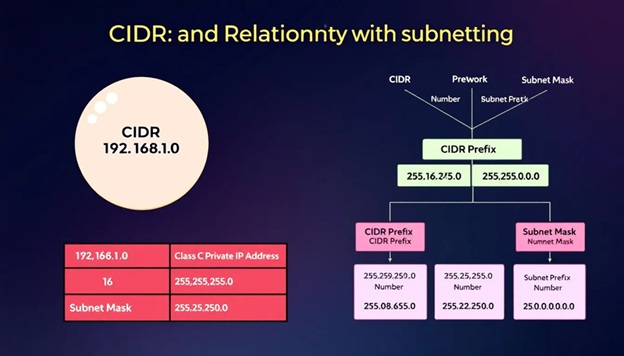
CIDR allows flexible subnetting with custom subnet masks, so network division and management is more efficient. For example a single CIDR block can be divided into multiple subnets, each tailored to specific network requirements. This is beneficial for large networks that needs extensive hierarchical addressing to manage IP allocation efficiently.
You can easily convert IP to CIDR using the free tool by 1921681.
Also CIDR supports supernets, which groups multiple subnets under one network prefix, making network management simpler. This simplifies large architecture networks and IP address organization.
CIDR in IPv6 Transition
CIDR is key to IPv4 to IPv6 transition, it allows for seamless integration and subnet management. Although IPv4 and IPv6 addresses are different in length and format, CIDR applies to both, so IP address allocation and routing using internet protocol is efficient.
But as networks are managed under CIDR, compatibility issues with older network devices may arise. Network administrators must address these challenges to avoid service disruption. CIDR’s ability to support both IPv4 and IPv6 addressing schemes makes it a valuable tool in the gradual transition to IPv6, so organizations can manage their IP address space.
Also CIDR’s flexibility in subnet management helps in allocating IPv6 addresses, so address blocks are used efficiently and network performance is optimized. This is important as IP address demand is growing in the ever expanding digital world.
More useful information about CIDR
IPv4 CIDR Chart