
Why Dechecker AI Checker Matters When Executives Review High-Stakes Content
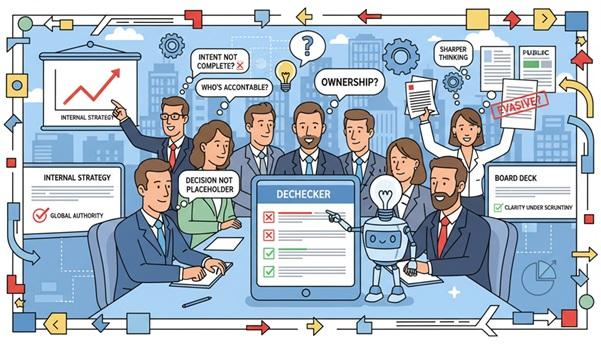
Executives rarely question whether AI was used. They question whether a document feels owned. In board decks, internal reports, or external statements, language signals responsibility long before facts are debated. Dechecker exists in that narrow space where leadership judgment meets written expression.
How Executives Actually Read Content
Decision-makers read for intent, not completeness
Senior leaders don’t read documents linearly. They skim for signals. What decision is being made? Who is accountable? What risk is being accepted? Content that explains too much or balances every possibility creates hesitation rather than clarity.
When leadership teams review drafts with an AI Checker, the flagged sentences often align with their instincts. These are lines that soften ownership, avoid commitment, or sound like placeholders instead of decisions. Detection doesn’t replace judgment, but it exposes where judgment was diluted.
Neutral language raises more questions than strong language
Executives expect constraint. They expect trade-offs. AI-generated phrasing tends to smooth those edges. Dechecker highlights exactly where language becomes overly safe. Revising those sentences often changes how an entire document is perceived, even if the underlying recommendation stays the same.
Internal Reports and Strategy Documents
When strategy sounds generic, confidence drops
Internal strategy documents are meant to guide action. AI-assisted drafts often summarize options instead of choosing one. Dechecker’s sentence-level detection shows where that pattern appears. Leaders don’t need more context. They need to see a direction taken.
Sentence-level clarity beats document-level polish
Executives don’t want rewrites. They want sharper thinking. Dechecker allows teams to focus on specific lines that weaken authority. Adjusting a handful of sentences often restores confidence faster than revising entire sections.
External Statements and Risk Sensitivity
Public-facing language carries implicit accountability
Press statements, investor updates, and policy documents are read as commitments. AI-generated balance can feel evasive. Dechecker flags phrasing that sounds detached from responsibility. Leaders can then decide whether to accept, revise, or remove those lines.
Transparency without overexposure
Executives don’t need to hide AI usage, but they do need to ensure authorship is clear. The AI Checker supports that by encouraging revisions that reflect intent rather than automation.
Multi-Language Executive Communication
Global leadership needs consistent authority
When documents are translated or drafted in multiple languages, tone drift becomes risky. AI translations often preserve structure but lose decisiveness. Dechecker’s multi-language detection helps teams identify where authority softened during localization.
Avoiding accidental hierarchy shifts
In some languages, AI defaults to formal phrasing that unintentionally changes power dynamics. Dechecker helps teams restore the intended voice, ensuring that leadership messages land as intended across regions.
Board Decks and Executive Presentations
Slides are read faster than they’re written
Board members skim slides aggressively. AI-generated phrasing often looks fine in isolation but collapses under rapid review. Dechecker surfaces sentences that slow comprehension or obscure decisions.
Clarity under scrutiny
When pressure is high, language needs to hold. Dechecker allows teams to stress-test phrasing before it reaches the boardroom. The AI Checker becomes part of pre-meeting preparation rather than post-meeting damage control.
From Meetings to Documents
Executive thinking often starts verbally
Many leadership documents begin as spoken discussions. Notes are recorded, transcribed, and expanded into drafts using an audio to text converter. Those early versions carry real decision logic. Excessive AI rewriting can flatten that logic.
Running the final draft through an AI Checker helps teams identify where spoken intent was replaced by a generic explanation. Reintroducing original phrasing often restores urgency and clarity.
Preserving decision context
Executives care about why something was decided, not just what was decided. Dechecker highlights where context was stripped away during automation. Revising those lines reconnects actions to reasoning.
How Leadership Teams Change Their Writing Habits
After leadership teams use Dechecker across enough high-stakes documents, the biggest change isn’t technical, it’s behavioral. Fewer documents trigger that quiet internal pause where something feels off, but no one can immediately explain why. Detection sharpens collective intuition. Writers start to recognize which sentences create distance, even before running a check. These are often lines that defer responsibility, over-contextualize decisions, or soften positions that leadership has already agreed on.
Over time, this awareness moves upstream. Teams stop relying on late-stage cleanups and begin drafting with clearer intent. Language becomes more deliberate earlier in the process. Instead of asking whether a sentence sounds “safe,” writers ask whether it accurately reflects a decision that’s already been made. The AI Checker becomes less visible as a tool and more influential as a habit-forming mechanism, shaping how leadership communication is constructed rather than corrected.
Discussions also change in tone. Feedback loops tighten. Instead of comments focused on wording discomfort, conversations shift toward strategy, risk tolerance, and execution timing. Meetings spend less time editing sentences and more time debating implications. That shift is subtle but meaningful. It signals growing trust in the written layer of decision-making. Documents start functioning as extensions of leadership judgment rather than buffers between people and decisions.
What Dechecker Does Not Replace
Leadership teams also become clear about what Dechecker cannot do. It does not make decisions. It doesn’t evaluate business risk, market timing, or organizational readiness. Those responsibilities remain squarely human. The AI Checker assumes leadership has already chosen a direction. Its role is to ensure that choice is expressed without dilution, hesitation, or unintended neutrality.
It also does not eliminate disagreement. Clear language does not guarantee alignment. Executives may still challenge conclusions, priorities, or framing. What changes is the nature of those disagreements. They become explicit debates about judgment rather than reactions to tone. Dechecker helps remove ambiguity around authorship so that when leaders push back, they are responding to a clearly stated position, not an anonymous-sounding draft.
Where Dechecker Fits in Executive Workflows
As a final integrity check
Most leadership teams use Dechecker at the end, just before distribution. It acts as a pause. Does this sound like something we stand behind?
Scaling communication without losing authority
As organizations produce more content, maintaining a voice becomes harder. Dechecker helps leadership scale output without diluting responsibility. The AI Checker doesn’t accelerate publishing. It preserves credibility.
Executives are judged by what their documents imply, not just what they state. Dechecker operates in that implication layer. The AI Checker doesn’t accuse content of being artificial. It reveals where human judgment needs to be unmistakable.