Operations | Monitoring | ITSM | DevOps | Cloud

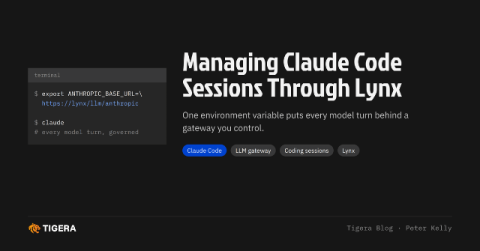
Managing Claude Code Sessions Through Lynx

At Tigera, we spend a lot of time thinking about agent security: identity, policy, runtime controls, and the record left behind after an agent acts. Coding agents create an interesting problem because, in most organizations, they didn’t arrive through the front door. Few companies ran a platform evaluation and rolled Claude Code out to 500 developers. Developers installed it themselves.
The Clearinghouse For AI Agents Has A Blind Spot

Jamin Ball’s recent piece, “Systems of Record Won the SaaS Era — Clearinghouses Will Win the Agents Era,” is the cleanest articulation I’ve seen of where the durable moat goes next. His argument is simple and, I think, correct: the SaaS era rewarded whoever owned the system of record, and the agent era will reward whoever owns the clearinghouse.

HITL for autonomous agents: Where does the human go?

Human approval is easy when you are sitting in front of the agent. For an agent running by itself in a cluster, almost none of that holds. You’re in a meeting and your agent is running in a cluster. It has a service account, it has been asked to keep a service healthy, and it has just worked out that the right fix is to roll back a database migration. Nobody is watching it. That was rather the point of deploying it. You want to get notified to approve such an important action.

AI Agents on Kubernetes 101: From Laptop Script to Production Pod

In short, this is a beginner’s guide to deploying an AI agent on Kubernetes. You will containerize an agent, store its API key as a Kubernetes secret, write a deployment with health probes and resource limits, expose it with a service, and lock down its network egress, in that order, with a working manifest at every step. On a local kind cluster the whole walkthrough takes about an hour.