Operations | Monitoring | ITSM | DevOps | Cloud

Cursor Cloud Agents Are Incredible - Until You Need Production Governance

Cursor Cloud Agents are the best AI coding environment for individual developers. But for enterprises that need AI-written code to ship through staging to production with audit trails, RBAC, and compliance - there's a gap. Romaric founded Qovery to make Kubernetes accessible to every engineering team. He writes about platform strategy, developer experience, and the future of cloud infrastructure.
Lovable, Bolt, and Replit Are Wonderful - Until Your CISO Finds Out

Non-technical teams are building apps on Lovable, Bolt.new, and Replit with company data and zero governance. Here's why that's a compliance nightmare - and what enterprise platform teams should deploy instead. Romaric founded Qovery to make Kubernetes accessible to every engineering team. He writes about platform strategy, developer experience, and the future of cloud infrastructure.
AI DevOps in 2026: How AI Coding Tools Are Breaking Your CI/CD Pipeline (and How to Fix It)

AI coding tools turned every engineer into a 10x developer. Now your CI/CD pipeline is the bottleneck. Learn how to handle 10x more deploys per engineer with Qovery's dual deployment model. Romaric founded Qovery to make Kubernetes accessible to every engineering team. He writes about platform strategy, developer experience, and the future of cloud infrastructure.
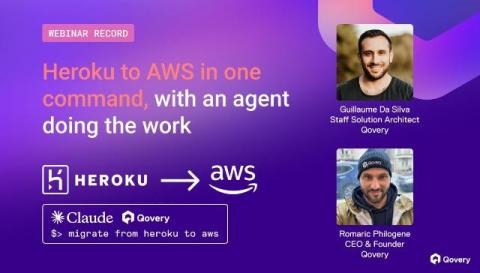
Build with Claude Code, Deploy with Qovery

AI coding tools eliminated the 'writing code' bottleneck. But deploying that code? Still a mess. Here's how Claude Code + Qovery Skill lets you go from idea to production in a single prompt - with enterprise-grade guardrails. Romaric founded Qovery to make Kubernetes accessible to every engineering team. He writes about platform strategy, developer experience, and the future of cloud infrastructure.
Shadow IT Is Back - And Vibe Coding Made It 10x Worse

AI coding tools are the new Shadow IT - but instead of rogue Trello boards, they have OAuth access to your code repos, cloud accounts, and production databases. Here's what's already gone wrong, and how platform engineering fixes it. Romaric founded Qovery to make Kubernetes accessible to every engineering team. He writes about platform strategy, developer experience, and the future of cloud infrastructure.
7 best AI deployment platforms for production Kubernetes workloads in 2026

Training a model in a notebook is easy. What breaks teams is the step after, serving it reliably without haemorrhaging cloud budget or burying your SREs in YAML. The common trap: picking a platform that handles the model but not the surrounding stack. An AI deployment platform should orchestrate the full application graph (inference endpoints, vector databases, caching layers, and frontends) inside a single VPC, with GPU autoscaling that doesn't require a dedicated platform engineer to babysit.

How to automate environment sleeping and stop paying for idle Kubernetes resources

Scaling your deployments to zero is only half the battle. If your cluster autoscaler does not aggressively bin-pack and terminate the underlying worker nodes, you are still paying for idle metal. True environment sleeping requires tight integration between your ingress layer and your node provisioner to actually realize FinOps savings.

10 best practices for optimizing Kubernetes on AWS

Optimizing Kubernetes on AWS is less about raw compute and more about surviving Day-2 operations. A standard failure mode occurs when teams scale the control plane while ignoring Amazon VPC IP exhaustion. When the cluster autoscaler triggers, nodes provision but pods fail to schedule due to IP depletion. Effective scaling requires network foresight before compute allocation.