Announcing Cycle's Internal API
We’re proud to announce the availability of the fresh, new “internal API” to our users. This API is only accessible from within a running instance on the platform.
Don’t let the title mislead you, we love DevOps here at Cycle. Without proper DevOps processes, building and scaling cloud-based applications can become a nightmare for maintainability. A proper DevOps plan brings together an organization’s developers, QA support, and operations teams to pursue the goal of delivering software more predictably. An admirable goal for any team and something that can be immensely helpful for even small teams to become more efficient.
Whether you’re new to development or a seasoned developer, containers have proven to be game-changing in building, testing, and deploying applications. This article is meant as a quick introduction to the world of containers. To get started, you’ll need to install Docker to follow along with the examples. If you haven’t installed Docker yet, head over to their website to get it installed. There are free versions available for all major operating systems.
With the release of the WordPress REST API (version 4.7 circa 2016), WordPress developers started deploying the application as a headless CMS. As the WordPress community started to embrace this architecture, more and more developers are starting to use it in production. Now thanks to the growing number of plugins, WordPress as a headless CMS is starting to become the go-to deployment strategy.
The recent public release of Cycle’s API has already seen all sorts of innovative uses, from automating the deployments of medical applications, to creating customized monitoring services to track specific performance metrics. Everything you can do in the portal can also be accomplished via the API — it’s actually the exact same API we used to build the portal!
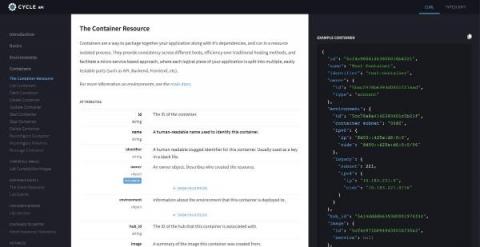
Cycle’s API docs are live, and with it a whole new suite of tools to automate the management of containers across cloud providers. This is the same API that Cycle’s portal is built upon, meaning you have near full capability to do anything programmatically that you can do through the interface.
Cycle aims to give you maximum flexibility with how you architect your application. By marking a container as ‘stateful’, you’re declaring that the container and its instances should be treated more like pets than cattle, but more on that analogy below. The need to maintain state should never be a deciding factor when considering whether or not to containerize as containers are simply portable code packages.
Updating information held on container volumes, debugging a running instance, backing up files locally, or just making sure everything is where you expect it to be… remote access is an integral part of any system.
Secure access to your own private registry helps control who has access to your images. Compared to usage-based services such as Docker Hub and Quay, a Cycle hosted private registry only consumes the resources you give it access to, yielding a more cost-effective deployment. Let’s take a look at how simple it is to deploy a private Docker registry on Cycle.
Moving your WordPress Site to Cycle is incredibly fast and easy. Let’s take a look at what we’ll need to follow along with this tutorial. If you don’t have that set up, take a moment now to do that so you can follow along. For assistance reach out to us directly on our public slack channel, or visit the Cycle documentation.