
AI-Driven DevOps: How Artificial Intelligence is Reshaping Software Delivery
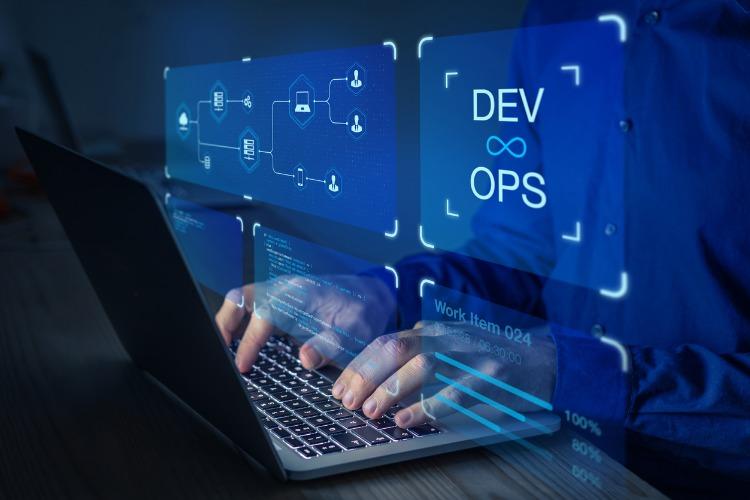
DevOps (development and operation) has dramatically changed processes of management in tech companies. This method or, as they say, religion, introduced new philosophy into development and operations. Earlier, when only the waterfall method was used, all deployments were really painful: if something went wrong you had to look for the reason on every stage, in every team. Every change in development had an impact on operations and vice versa. After the introduction of DevOps method the interaction between development and operations prevented a lot of mistakes and made deployment much easier.
With the invention of Artificial Intelligence, one of the main tasks of DevOps can reach its new level: automatisation and effective deployment can become even faster.
Integration of AI into DevOps
AI-based instruments in both Development and Operations can optimise, for example, testing, monitoring and analysing the infrastructure of the product. This way, teams can prevent or avoid some mistakes on early stages of deployment.
The most common testing solutions for DevOps are coming from Selenium platform and frameworks related to it. A lot of companies started using AI in their frameworks around 5 years ago but now we can observe the result of their hard work. AI-driven instruments like Testim or Mabl can generate tests automatically and make them self-healing. Also they have smart locators and results analysis options respectively.
We can also observe rapid growth of AIOps technologies, mostly in monitoring and analysis options. Datadog presents a lot of useful AI-based features: for example, you can use Datadog’s generative AI to query data from Datadog products like APM, Log Management, Cloud Cost Management, Real User Monitoring, and more, and surface key insights like faulty deployments, log and trace anomalies from Watchdog, and Security Signals — all in one place.
Changes that AI brings in CI/CD
CI/CD (continuous integration, continuous delivery) — is one of the main processes in the DevOps framework, because it can be possible only with sensible cooperation between backend and frontend. Integration of AI in the process of product delivery has brought huge improvement.
For example, predictive analysis AI-tools make it possible to recognise problems and failures before they have an impact on UI. Thanks to AI it has become possible to create dynamic self-optimisating and self-recovering CI/CD pipelines. Compared to a human DevOps engineer, AI tools can monitor immense amounts of data, analyse incidents and create strategies based on conclusions 24/7.
Changes in DevOps-engineer tasks and new skills
The inventors of DevOps framework always stressed that the main thing in their philosophy is culture, not tools. But still, the implementation of DevOps under modern conditions requires certain AI-related skills. For example, to use AI-tools a professional DevOps engineer should understand how ML (machine learning) works. Moreover, correct analysis interpretation plays a big role in cooperation of frontend and backend engineers.
Future career prospects in DevOps and Cloud
Now DevOps engineers can face some employment challenges: AI tools are moving forward rapidly and already can automatically analyse logs, for example. Soon the whole deployment can be performed through AI-based platforms. We can see the process of changing with the invention of new IT-positions: AI-enabled SRE, AI Cloud Automation Engineer.
The easiest way for development is to start studying ML and AI-based monitoring tools like Datadog. You have to understand the business logic of your product to implement efficient solutions, so development of soft skills is also appreciated. Data transition onto Cloud bases requires a clear understanding of platforms like Kubernetes.
DevOps engineers who will adapt to changing conditions and combine DevOps philosophy, AI, automation, Cloud platforms and high level of security will not have any problems with employment in the future.
Conclusion
AI is not dangerous for professional DevOps engineers because they are masters of compromise Development and Operations. They know exactly how to adapt to changing conditions and create the best environment for smooth CI/CD. For them, AI tools will be a helping hand, not an enemy.