
What Is Helium Used For? Key Applications and Concentration Monitoring
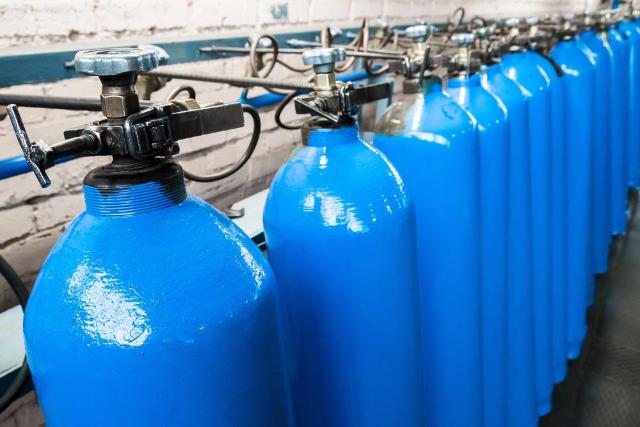
Image Source: depositphotos.com
Most people encounter helium in party balloons, yet balloons account for only a small share of its use. The bulk of this gas goes into medicine, microelectronics, science, aerospace and welding. For many of these tasks, helium has no equivalent substitute, because no other gas offers the same combination of properties.
Helium is extracted from a limited number of deposits, and it is expensive. As a result, more and more companies collect used helium, purify it and return it to the process. Such systems need to know how much helium the collected and purified gas stream contains. For continuous monitoring, a helium gas analyzer installed directly in the line can be used.
This article looks at the properties that make helium indispensable, where and in what quantities it is used, where it comes from and how its concentration is monitored in industrial settings.
What Makes Helium Indispensable
Helium is a noble gas. Its range of applications is defined by five properties.
-
The lowest boiling point of all elements. Liquid helium boils at 4.2 K (about −269 °C). It is used to cool superconducting magnets and equipment that requires cryogenic temperatures of a few kelvin.
-
Chemical inertness and non-flammability. Helium hardly reacts with other substances and does not burn. This matters for protective atmospheres, purging and work alongside reactive materials.
-
Low density. Helium is considerably lighter than air, which is why it is used as a lifting gas.
-
Small atomic size and high diffusivity. Helium passes through extremely small leak paths. Leak testing with helium as a tracer gas is based on this property.
-
High thermal conductivity. Among gases, only hydrogen conducts heat better. This property is used for cooling and for measuring helium concentration.
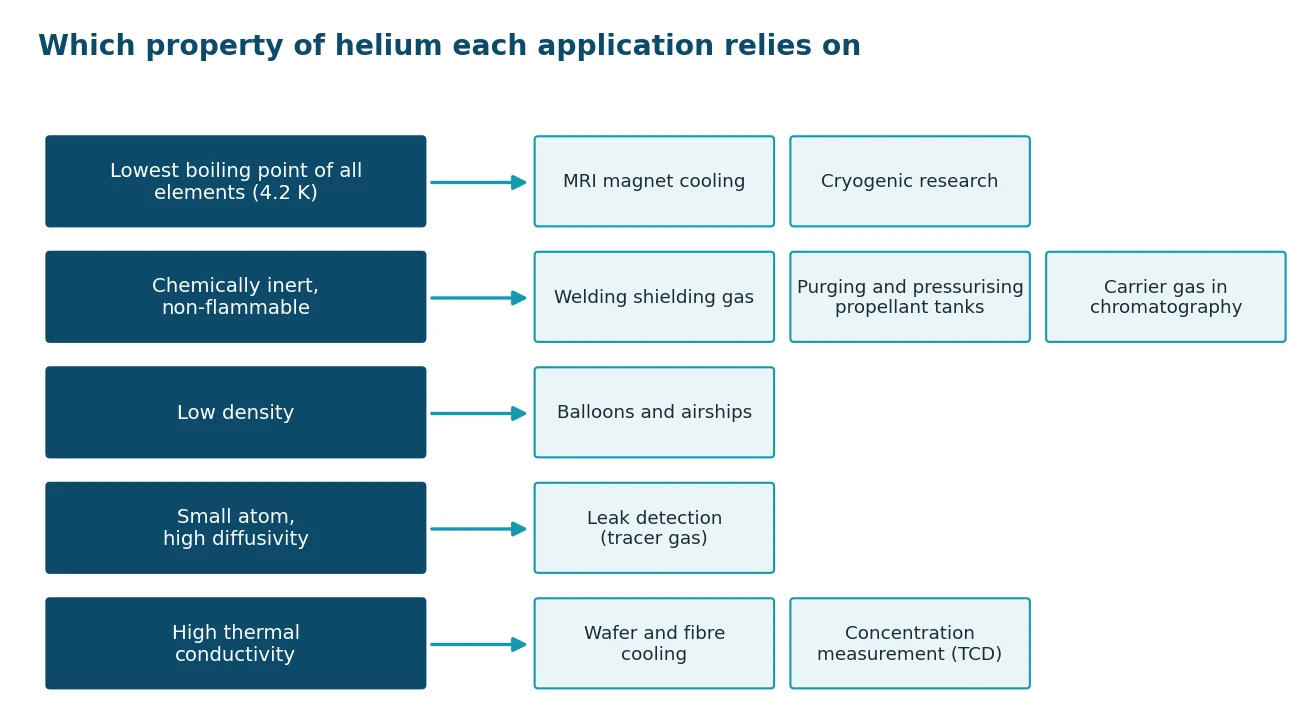
Fig. 1. Each major application of helium relies on one of its physical properties.
Where Helium Is Used: Main Applications
Data from the U.S. Geological Survey (USGS) for the United States in 2025 give a good picture of how helium is consumed. The largest shares go to analytical, engineering, laboratory, science and specialty gas applications (22 %); controlled atmospheres, fibre optics and semiconductors (17 %); lifting gas (17 %); and magnetic resonance imaging (15 %). These are followed by aerospace (9 %), welding (8 %), diving (5 %) and leak detection (5 %).
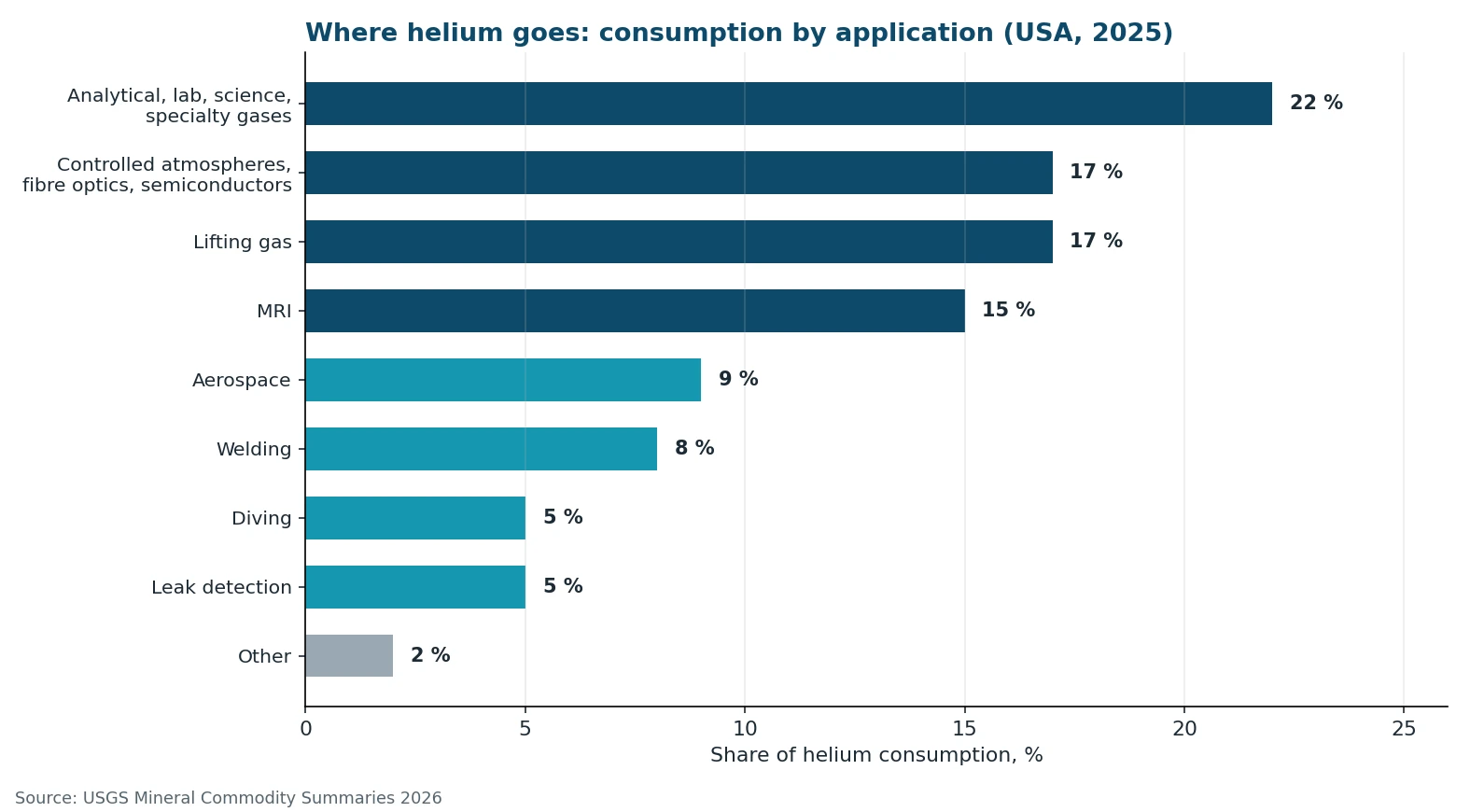
Fig. 2. Helium consumption by application in the United States in 2025. Source: USGS Mineral Commodity Summaries 2026.
Analytical Work and Research
In gas chromatography, helium serves as a carrier gas. It is chemically inert and works well with common detectors. In low-temperature physics and nuclear magnetic resonance spectroscopy, liquid helium cools superconducting magnets and samples. Laboratories need high-purity gas, because impurities distort analytical results.
Semiconductors, Fibre Optics and Controlled Atmospheres
In chip manufacturing, helium is used to cool wafers during certain process steps and as an inert atmosphere. In optical fibre production, it is used in preform manufacturing and to cool the fibre during drawing. Purity requirements are high and consumption is substantial, which is why helium recovery systems are particularly common in this sector.
Lifting Gas
Weather and research balloons, airships and party balloons all rely on helium's low density. Unlike hydrogen, helium does not burn, which makes it safer to handle.
Medical Imaging
The superconducting magnets in MRI scanners operate at liquid helium temperature. Modern low-loss systems with closed cooling circuits consume less helium than earlier designs. Even so, healthcare remains one of the largest consumers.
Aerospace
Helium is used to purge and pressurise propellant tanks and feed lines in launch vehicles. It stays gaseous at the temperatures of cryogenic propellants and does not react with them.
Welding
In arc welding, helium or helium–argon mixtures shield the weld pool from the surrounding air. Thanks to its high thermal conductivity, helium increases heat input, which is useful, for example, when welding thick sections and materials with high thermal conductivity.
Diving
In breathing mixtures for deep dives, helium partly replaces nitrogen. This reduces nitrogen narcosis and the work of breathing at depth.
Leak Detection
Helium is used as a tracer gas in leak testing: it is applied either inside or outside the test object, and a mass spectrometer leak detector registers any helium passing through leak paths. This method is used to test refrigeration circuits, vacuum systems, battery housings, fuel systems and many other products.
Applications at a Glance
|
Application |
Property used |
Form |
Typical requirement |
|
Analytical work, laboratories |
inertness, cryogenic temperatures |
gas, liquid |
high purity |
|
Semiconductors, fibre optics |
thermal conductivity, inertness |
gas |
high purity, stable supply |
|
Lifting gas |
low density |
gas |
moderate purity |
|
MRI |
boiling point of 4.2 K |
liquid |
minimal losses |
|
Aerospace |
inertness, gaseous at cryogenic temperatures |
gas |
purity, large volumes |
|
Welding |
inertness, thermal conductivity |
gas, mixtures with argon |
stable mixture composition |
|
Diving |
inertness, low solubility |
gas in breathing mixtures |
precise mixture composition |
|
Leak detection |
small atomic size |
gas, mixtures with nitrogen |
known tracer gas concentration |
Where Helium Comes From and Why It Is Conserved
On an industrial scale, helium is extracted from natural gas, where it is usually present in low concentrations. It is separated cryogenically, so helium production is tied to large gas processing facilities. Industrial production and helium resources are concentrated in a limited number of countries.
Once released into the atmosphere, helium is lost for good: it is so light that it gradually escapes from the Earth's atmosphere. Because production is geographically concentrated, outages at individual plants or trade restrictions affect availability. In 2024, for example, the EU introduced restrictions on helium imports from Russia.
This explains the growing interest in recovery. The USGS notes that helium used in large-volume applications is still seldom recycled, although some low-volume and liquid boil-off recovery systems are in operation. For high-consumption sites, returning helium to the process is becoming a question of both cost and supply security.
Helium Recovery: Where Concentration Monitoring Is Needed
A recovery loop typically comprises collection of the spent gas, compression, purification, storage and return to the process, topped up with fresh helium. The collected gas almost always contains impurities such as air, nitrogen, moisture and sometimes argon or other components. Their proportion depends on the process and on the tightness of the loop itself.
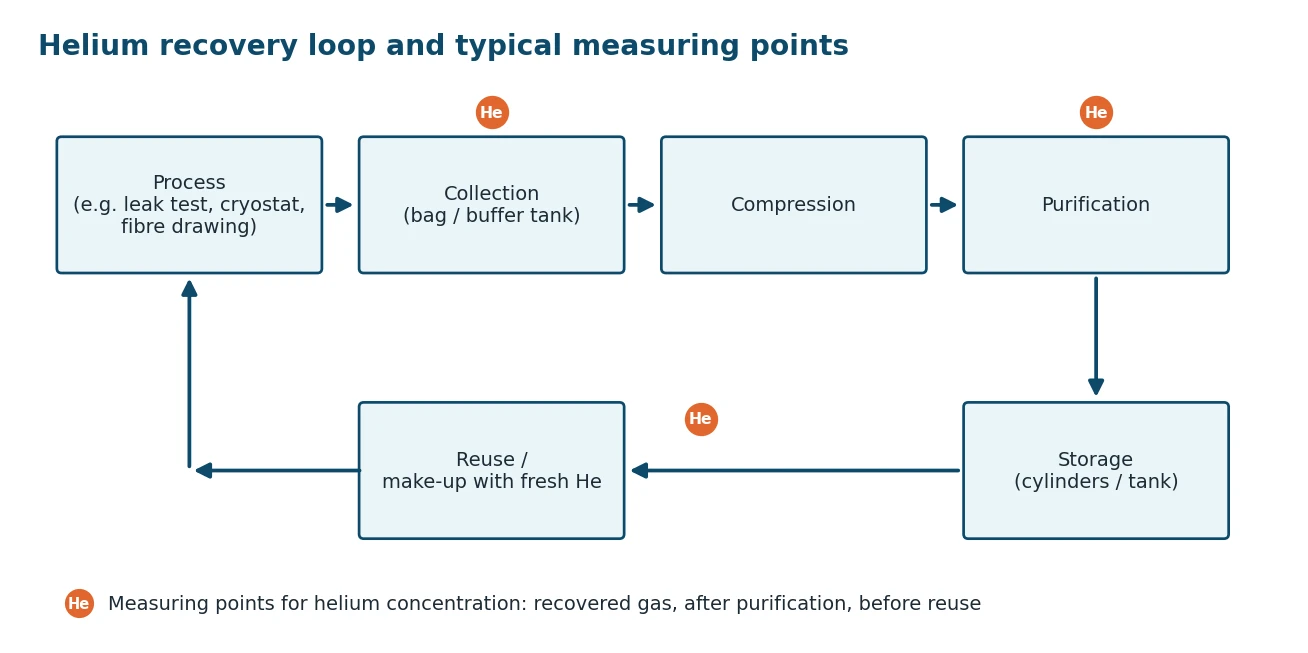
Fig. 3. A typical helium recovery loop. The marked points show where helium concentration is monitored: in the collected gas, after purification and before reuse.
Measurements in the loop serve several purposes.
-
Assessing the collected gas. The helium concentration at the inlet shows how effective collection is and whether air is being drawn in.
-
Monitoring purification. The concentration downstream of the purifier shows whether the required purity has been reached.
-
Release for reuse. Gas is returned to the process only if its composition meets the requirements.
-
Controlling make-up. Concentration data make it possible to meter fresh helium into the loop.
How Helium Concentration Is Measured
Helium is harder to measure than many other gases. Because it is inert and barely interacts with sensor surfaces, the electrochemical and catalytic sensors widely used in gas analysis are unsuitable. Helium does not burn, and as a monatomic gas it has no absorption bands suitable for conventional optical methods.
In practice, three groups of methods are used for helium.
Thermal conductivity detection (TCD). Helium's thermal conductivity is considerably higher than that of nitrogen, argon and air, so its concentration in a mixture can be determined from the heat drawn away from a heated element. No reaction with the gas takes place. Depending on the sensor design, gas pair and calibration, the method covers tasks from low helium concentrations up to pure gas and is suitable for continuous inline measurement. Its limitation is fundamental: the method is designed for binary and quasi-binary mixtures, such as helium in nitrogen, argon or air. Pressure fluctuations affect the result, so the pressure at the measuring point is either stabilised or its influence is compensated.
Mass spectrometry. This method is selective and sensitive and is used for leak detection and laboratory analysis. It requires a vacuum system and gas sampling.
Gas chromatography. A chromatograph separates and quantifies several components of a mixture, including impurities in helium. The analysis is accurate but discontinuous and requires sampling.
|
Method |
Typical task |
Limitation |
|
Thermal conductivity (TCD) |
continuous inline measurement of helium concentration, recovery, purity monitoring |
binary and quasi-binary mixtures only, pressure must be taken into account |
|
Mass spectrometry |
leak detection, laboratory analysis |
vacuum system, sampling |
|
Gas chromatography |
detailed impurity analysis |
discontinuous cycle, sampling |
Leak Detector or Concentration Analyzer: What Is the Difference?
Helium leak testing and measuring helium concentration in a process line may seem like similar tasks, but they are performed by different instruments.
A leak detector answers the question of whether helium passes through the wall of a component, and at what rate. It registers very small flows of tracer gas, usually by mass spectrometry.
A concentration analyzer answers the question of how much helium a gas stream contains. It is needed to monitor the mixtures used to fill test objects, to assess the gas in a recovery loop and to check helium purity after purification. A single leak testing station often needs both instruments.
How to Choose a Method for Monitoring Helium
-
What do you need to know: whether there is a leak, the concentration in a stream or the purity? The answer determines the type of instrument.
-
What is the background gas, and how stable is its composition? For thermal conductivity measurement, this is the decisive question.
-
What concentration range is required? Low helium levels in air, mixtures with nitrogen or nearly pure gas.
-
Is a continuous signal needed, or is periodic analysis sufficient? Monitoring a recovery loop usually calls for continuous measurement.
-
What are the pressure and temperature at the measuring point, and is the pressure stable? This determines whether inline installation is possible and whether compensation is needed.
-
How will the signal reach the control system? Via an analog output, a digital interface or both.
-
How will calibration be carried out? Calibration gases must match the configured gas pair.
Frequently Asked Questions
What can replace helium?
Only in part. According to the USGS, hydrogen can replace helium in some lifting gas applications, and argon or hydrogen can be used in diving. For cooling superconducting magnets and a number of other tasks at temperatures around 4 K, helium remains essential.
Is helium dangerous?
Helium is non-toxic and non-flammable, but in enclosed spaces it displaces oxygen. Leaks in rooms containing liquid or compressed helium pose a risk of asphyxiation, which is why such rooms are ventilated and their oxygen levels are monitored.
Can one analyzer measure helium in different background gases?
With thermal conductivity measurement, calibration is tied to a specific gas pair. Some industrial analyzers store several calibrations and can switch between them via software, for example for helium in air and helium in nitrogen.
Why do laboratories collect evaporating helium?
Liquid helium gradually evaporates even in well-insulated vessels. Collecting the boil-off gas and reliquefying it reduces the need for purchases and dependence on supply.
Does pressure affect helium concentration measurement?
Yes, with the thermal conductivity method. If the pressure at the measuring point fluctuates, it is either stabilised or its influence is compensated using readings from a pressure sensor.
Conclusion
Helium is used wherever its properties are difficult to replace: for cooling superconducting magnets, in analytical work, in semiconductor and optical fibre production, in aerospace, welding, diving and leak detection. Helium resources are limited and production is concentrated in a few countries, so companies increasingly collect and reuse the gas. Monitoring such a loop requires information on the helium concentration in the gas stream. Thermal conductivity measurement is particularly well suited to continuous inline monitoring when helium is present in a binary or quasi-binary mixture and the pressure at the measuring point is stabilised or accounted for.