
Operations | Monitoring | ITSM | DevOps | Cloud

Shipped: Log and track Insights from your AI assistant

Insights are how your team tracks interesting observations, analysis and optimization work in CloudZero. Each one records the opportunity and its status, so the work gets sized, assigned, and closed out. Teams now do a lot of this work in an AI assistant. For example, you can ask Claude which instances sat idle last month, and it will tell you. But if you have to switch to CloudZero and fill out a form to log that finding, some findings won’t get logged.

AI cost per customer: measure it and protect your margins

AI cost per customer is each customer's attributed share of your AI spend: API tokens, inference infrastructure, and per-seat AI tools, measured against that customer's revenue. It matters because AI usage is wildly uneven across customers, so healthy blended margins can hide individual customers you serve at a loss. It's cost to serve, not acquisition cost. Cost per customer is the metric CloudZero was built around.

CloudZero in 3 Minutes: See What Your AI and Cloud Spend Actually Buys

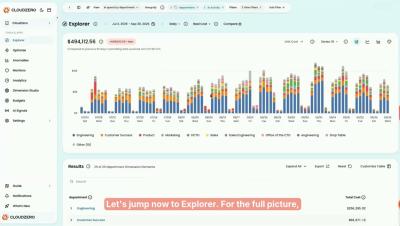
Cloud and AI spend in one place, tied to the teams, products, and customers behind it. Your bill tells you what you spent. CloudZero tells you why, and whether it paid off. This quick tour shows how CloudZero pulls cost from AWS, Azure, GCP, Kubernetes, Snowflake, OpenAI, Anthropic, and more, then allocates it to what your business actually cares about. No perfect tagging required.

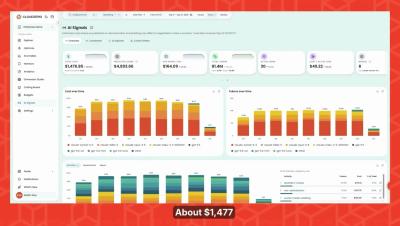
AI Signals Demo: See Exactly What Your AI Spend Is Buying | CloudZero

See who’s spending on AI, on which models, for what work, and what you got for it. Most companies can tell you what they spent on AI last month. Very few can tell you what it bought. In this demo, we show how AI Signals captures AI usage as it happens and ties every dollar to the person, team, and work behind it, across every model and provider.

AI cost per query: how to calculate and optimize it

AI cost per query is your total AI serving spend divided by the number of queries served over the same period. It combines model API charges (input and output tokens), retrieval and orchestration overhead, and shared infrastructure. Most production text queries cost between $0.0005 and $0.02. It's the base unit of AI unit economics, and the number finance needs before any ROI claim holds up.

Shipped: Azure cost totals that match your invoice

Azure cost exports sometimes fail with a server error and then succeed on the next try. Some reports cover only part of the month. Large tenants get rate-limited when they request a lot of data at once. Each of these things can leave a gap in your Azure history. You normally find the gap when finance compares the Azure total in CloudZero to the Microsoft invoice.

Shipped: AI dimensions, organized around how your team works

AI Signals adds a standard set of AI dimensions to your dimension picker, plus custom dimensions built from your own data. Not every team needs all of them. The ones you don’t use make the ones you want harder to find. Cleaning that up used to require an engineer to run a script every time an account team needed a change. We identified the bottleneck and automated it, so account teams can manage dimensions themselves and engineering stays focused on product work.

Shipped: See which billing connections stopped sending data, and why

Every number in CloudZero comes from a billing connection. When a credential expires or a permission changes, that connection stops sending data, and your reports show less spend than you actually have. If you catch it early, you can fix the connection before month-end close. You also need to know what broke. For Azure and Snowflake connections, CloudZero now tells you which check failed, so you can send the fix to the right person without opening a support ticket.

How much does it cost to train an AI model? Frontier figures, graded [2026]

Training an AI model costs anywhere from a few hundred dollars to several hundred million, depending entirely on what “train” means. Fine-tuning an existing model: tens to thousands of dollars. Pretraining a small model from scratch: tens of thousands to millions. A frontier run in 2026: hundreds of millions, with Epoch AI projecting the largest runs will pass $1 billion by 2027.

Adding friction to your AI spend isn't saving money. It's costing you growth.

Enterprises are putting hard ceilings on AI spend. Accenture now centrally funds $29 a month per person for Claude and charges anything above that to a project budget code. Uber used up its 2026 AI budget in four months and restricted access. A cap stops waste and useful work at the same rate. The alternative is seeing AI cost by team, by project and by outcome, then funding what returns. Companies spent the past year telling employees to use more AI. Now a lot of them are putting a lid on it.

Shipped: Slice AI spend eight ways in AI Explorer

You can already break down cloud spend by team, product, or customer in Explorer. But AI spend has been harder to decompose. Which models is each team running? What activity is driving the cost growth you saw this month? Before AI Explorer, answering those questions meant exporting raw event data and building your own breakdowns, or waiting days for reconciled billing to land in Explorer.

Capping the AI free-for-all? Know what each dollar returns first.

Most companies gave everyone AI access and thought they’d sort out the costs later. Engineering, support, product, marketing, and finance all got licenses to the best models. The early results looked good, and for a while it didn’t matter there wasn’t an explicit business case. Let’s call the first half of 2026 the free-for-all period for many companies. AI adoption spread across the org fast, people and teams loved it, and then the invoices started coming in.

Shipped: Create a Jira ticket from a cost spike, with status synced both ways

When Monitors flags a cost spike, the fix usually belongs to an engineering team, and that team might track their work in Jira. Now you can hand the incident to them from CloudZero in one click. The Jira ticket and the CloudZero incident stay in step. When the engineer resolves the ticket, the incident resolves too. You track the work in one place, and the status you see in CloudZero matches what the team is doing.

Shipped: Views now save your full Explorer state

Many CloudZero users ask the same few questions. What did my team spend this month? How is our AI spend trending over the last 30 days? What does one MCP tool call cost? Now you can save the exact Explorer setup behind each answer as a View and get back to it instantly. It’s not just filters and grouping anymore, but the full picture. You can share a link with a teammate or finance and they see the same View, filtered to the spend their role allows.

Shipped: Break down AI spend by your projects and teams, within minutes

Your company talks about AI spend in its own terms, like projects, teams, and products. Now AI Signals can show AI spend in those terms, too. Write a CostFormation rule in CloudZero that groups AI spend by categories you care about, and the new breakdown appears in AI Signals the same day you decide to track it. There’s no waiting for a full processing cycle.

ChatGPT Enterprise pricing in 2026: seat costs, minimums, and the new token rate card

ChatGPT Enterprise has no public list price. Reported 2026 contracts average about $60 per user per month within a $45 to $75 range, with 150-seat minimums and annual prepayment, putting the floor near $108,000 a year. Newer eligible agreements add usage-based billing under OpenAI's published token rate card.

Shipped: See who changed a cost monitor, and when

A cost monitor is only useful if people trust its settings. When a threshold moves or a monitor goes quiet, the team needs to know who made the change and when. Every monitor in CloudZero keeps that record. You can check it yourself in a few seconds, confirm a change was intended, and put a setting back if it wasn’t.

Enterprise AI ROI: proving returns at scale

Enterprise AI ROI is the return on AI investment measured across a portfolio: dozens of initiatives, multiple business units, shared platforms, and one board asking for the total. It fails differently than single-project ROI, usually because baselines and unit costs were never established, and it's proven with per-initiative denominators rolled into portfolio-level reporting.

How CFOs can control AI spend and prove AI's value

Neil Sawyer, Senior Vice President and Managing Director for HP Europe, Middle East and Africa, recently published “Scaling AI Without Losing Control” in Forbes Business Council. His starting point will be familiar to any finance leader. AI pilots looked affordable on pay-per-token and pay-per-query pricing, and that same pricing can get far more expensive at enterprise scale. Gartner forecasts worldwide AI spending will reach $2.7 trillion in 2026, up 49.5%.

AI infrastructure costs in 2026: what the stack is, what each layer costs, and how much to commit

AI infrastructure costs span four buying tiers in 2026: API-only teams spend hundreds to tens of thousands per month on tokens, GPU renters typically pay $2 to $10 per GPU-hour by chip class, committed-capacity buyers sign six-to-eight-figure reservation contracts, and owners spend millions per rack. The stack has six layers, and most budgets underestimate everything below the GPU line.

Best open-source LLMs in 2026: ranked by cost to run

The best open source LLMs by family: DeepSeek V4 for frontier reasoning under MIT, Qwen3.8 and Gemma 4 for clean Apache 2.0 licensing, GLM-5.3 for coding, Kimi K3 for long context, Llama 4 for single-GPU scale. The real ranking depends on your deployment lane and token volume, and this guide prices all three lanes. At CloudZero, Bill Buckley, our SVP of Engineering, gives every engineer a $5,000 monthly AI token budget and published the math behind it.

Shipped: Find the GCP buckets with high cross-location read charges

You can now see which of your Multi-Region Cloud Storage buckets have cross-location read charges worth acting on, and start with the ones where a cache would save the most. It runs automatically for every organization with GCP Cloud Storage, so there’s nothing to set up. Google bills network data transfer when a Google Cloud service in one location pulls data from a Multi-Region bucket in another.

Shipped: Drill into your cloud bill up to eight levels deep

Most cost questions have more than one layer. Which team spent the most, which services drove it, and which accounts were behind those services? Previously, following that path meant changing dimensions, adjusting filters, and re-running the query at every step. Multi-dimensional drill-down has been one of the most-requested features in Explorer. The team shipped two-level group-by earlier this year, collected feedback, and kept going. Now the path goes eight levels deep.

Your AI Economics Pulse for October 2026

Across a same-store panel of 422 CloudZero customer organizations, AI reached 3.02% of the median company's cloud bill in September 2026, up 37 basis points from 2.66% in August, the largest monthly gain since we began tracking. The 75th percentile rose to 12.55%. The share of organizations spending at least $1,000 a month on AI barely moved, to 68.0%. Companies already spending drove the growth. Last month we called the median the least informative number in this report. September proved us wrong.

Shipped: Period-by-period costs in Explorer, no spreadsheet required

Finance teams reconcile cloud spend period by period. They want each month, week, or day in its own column, so they can scan across a row and see how a service or team changed over time. Explorer’s Aggregate view already answers “what changed and by how much.” But when the question is “what did we spend in June, July, and August, line by line,” that summary needs to become a grid.

Kimi API pricing in 2026: the K3 ladder, the August retirement, and what Moonshot really charges

Kimi API pricing, per million tokens: the flagship Kimi K3 costs $3 input and $15 output with a $0.30 cache-hit rate and 1M context. Kimi K2.6 and the coding-tuned K2.7 Code both run $0.95/$4.00 on 256K context. Kimi K2.5 and the legacy V1 family were retired August 31, 2026.

Shipped: Project this month's AI cost before the invoice closes

The question comes up on the 10th, the 15th, and again on the 25th. Where is AI spend going to end up this month? The invoice won’t tell you until it’s closes, and by then there’s nothing left to forecast. “If I’m looking at this on the 15th, I want to know where we’re going to land.” That’s how a finance lead put it during a persona session in September, and it’sthe whole job. You have half a month of real usage behind you.

Claude Opus pricing in 2026: every model, every rate, and whether it's worth it

Claude Opus pricing is $4 per million input tokens and $20 per million output tokens on Claude Opus 5.5, the current model, with cache reads at $0.20 and batch jobs at $2/$10. Opus 5 and the legacy 4-series bill at $5/$25. The 1M context window carries no surcharge. Every Opus model Anthropic shipped in 2026 held the same line: $5 in, $25 out, per million tokens. Opus 4.6 in February, 4.7 in April, 4.8 in May, Opus 5 in July. Four releases, one price. On September 22, 2026, the line broke.

Shipped: Views now work for every access level

Most people who open CloudZero care about one slice of the spend, like their team, their product, or their region. A View gives them that slice in one click, with the grouping and filters already set, so nobody has to rebuild the same Explorer query every week. Views now work for everyone in your organization, including people with scoped access.

Shipped: See what your AI spend is actually paying for

Most AI spend comes in with no tags and no owner attached. Your provider console shows total spend, maybe broken out by API key or model. It won’t tell you that the sales team spent $1,700 on Claude this week, let alone what the work was. And the problem is growing. McKinsey found that 56% of organizations now use AI in three or more business functions. More teams means more spend, and most companies respond with a spending cap. Set it too low and you slow down the work you wanted AI to help with.

Shipped: Start every session where your work lives

Most people who use CloudZero spend their time in one or two places. For some it’s AI Signals, and for others it’s Optimize or Anomalies. If Explorer isn’t one of those places, every sign-in starts with a click to get where you need to be. Dates and numbers are another friction. A date like 04/07 means April 7 in the US and July 4 in much of Europe. When the platform shows a format your team doesn’t use, you end up having to convert each value before you can work with it.

Shipped: Get alerted when AI spend spikes, with the cause attached

AI spend now comes from every department, and it can double in a week without anyone deciding it should. The invoice arrives after the month closes. By then the usual response is a spend cap, which slows every team, including the ones getting real work done with AI. You need to know about spend that breaks its normal pattern while there’s still time to act. The alert should reach the person who can act on it, with proper context and detail.