Operations | Monitoring | ITSM | DevOps | Cloud

Platform engineering unplugged: What nobody tells you about platform engineering at scale

Most platform engineering stories are told in hindsight, with the rough edges smoothed out. On June 17th, we are doing it differently. Join us for Platform Engineering Unplugged, a frank conversation with a practitioner who has navigated the real challenges of building and scaling platform engineering. What worked, what didn't, and what they would do differently. If you lead engineering teams and are thinking seriously about platform engineering, this is the session for you.

How to build a secure AI agent sandbox with relaxAI and Claude Code

AI agents are powerful. They're also unpredictable, non-deterministic, and capable of doing things you didn't ask them to do, as the Rome Alibaba and Claude Mythos case studies make very clear. The answer isn't to avoid agentic AI. It's to run it properly. In this demo, Ben Norris, founding engineer at relaxAI, shows how to build a fully sandboxed AI agent environment from scratch, an ephemeral Civo VM provisioned via Terraform and GitHub Actions, locked down with egress policies, an unprivileged Linux user, and hard resource caps, running a Claude Code session pointed at the relaxAI API.

Lock-in is not theoretical: What UK organizations told us about cloud exit barriers

For years, vendor lock-in has been discussed as a theoretical risk. A concern to acknowledge in architecture reviews. A box to tick in compliance frameworks. A future problem that might need addressing. Our latest research reveals something more urgent. For UK organizations, lock-in isn't theoretical anymore. It's structural. It's measurable. And it's preventing organizations from acting on their own strategic priorities.

Why developer teams are rethinking their cloud provider this year

The default cloud choice for technically literate teams has shifted. It hasn't shifted dramatically; the major hyperscalers aren't going anywhere, and their enterprise position is still strong, but the conversation that used to start with "which hyperscaler" now genuinely starts with "what do we actually need." That's new.

How to monitor and optimize GPU utilization in the cloud

GPU utilization is one of the most expensive metrics in cloud infrastructure to get wrong. A GPU running at 30% utilization costs the same as one running at 90%, but it's doing a third of the useful work. For workloads measured in tens of thousands of GPU-hours, the difference between average utilization in the 30s and average utilization in the 70s is hundreds of thousands of dollars across the life of the workload.

How to run self-hosted AI on your own infrastructure with Konstruct

Civo Platform Engineer M R Rishi demonstrates how to go from zero to self-hosted AI in minutes using Konstruct. While most teams are stuck managing thousands of configuration values across multiple models and tools, Rishi shows how Konstruct eliminates that complexity with GPU cluster provisioning, GitOps catalog deployments, and production-ready infrastructure on day zero.

Who really controls your data?

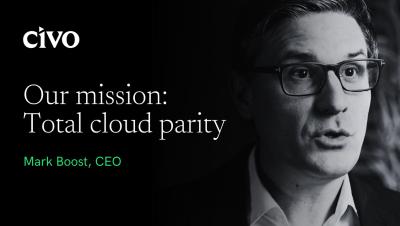
Digital sovereignty has moved from buzzword to boardroom priority. But most organisations are still asking the wrong question. Civo CEO Mark Boost cuts through the noise. Digital sovereignty isn't about marketing; it's about jurisdiction, accountability, and operational certainty. And it starts with where your data is hosted and how it's processed. Civo's UK Sovereign Cloud delivers public cloud, private cloud, and AI services, hosted and operated exclusively within the United Kingdom, under UK legal authority, with no exposure to foreign control.

Sovereign GPU cloud: Data residency across training, inference, and model weights

Sovereign cloud conversations usually center on where customer data sits at rest. The provider points at a UK data center, the contract gets signed, and procurement marks the box. For most workloads, that's a defensible position. For GPU workloads, it isn't.

GPU cloud for AI inference in production: How infrastructure requirements change after training

Training a model is a project with an end date. Inference is what happens for the rest of the model's working life. The two workloads share GPUs, frameworks, and a lot of vocabulary, but the infrastructure decisions that make sense during training are usually the wrong ones in production. Teams that treat inference as "training, but smaller" tend to discover the gap somewhere around their first traffic spike.

5 questions you should be asking about cloud dependency

Cloud infrastructure has become the backbone of modern business operations. But as organizations deepen their reliance on cloud providers, a critical question often goes unasked: just how dependent are we, and at what cost? For years, the cloud adoption narrative focused on agility, scalability, and cost efficiency. Those benefits remain real. But the landscape is shifting.

AI inference vs. training: What they are and how they differ

AI inference and training are terms you'd run into if you have been around software engineering or even just scrolled through the news. Both are integral to delivering the AI-powered experiences we have come to expect from many of the applications we use daily. According to McKinsey, by 2030 inference will overtake training as the dominant workload in AI data centers, making up more than half of all AI compute and roughly 30-40% of total data center demand.

21 AI concepts every beginner should know before their first interview

If you’re prepping for your first AI or MLOps interview, the hardest part usually isn’t always the hands-on element. For me, it’s the vocabulary. Interviewers sometimes lob single-word concepts at you (“what’s quantization?”) and watch how far you can carry the thread. The questions sound clear-cut, but each one is really a doorway into a bigger topic, and the interviewer is judging how cleanly you walk through it.

Blackwell sold out in weeks. Here's what Rubin demand will look like.

"Blackwell sales are off the charts, and cloud GPUs are sold out. Compute demand keeps accelerating and compounding across training and inference, each growing exponentially. We've entered the virtuous cycle of AI." Jensen Huang, CEO, NVIDIA When NVIDIA's CEO makes that statement in a quarterly earnings release, it is not marketing language.