Operations | Monitoring | ITSM | DevOps | Cloud

From Alerts to Action: How Agentic AI Will Transform ITOps

What if your IT systems could go beyond detecting issues to resolving them autonomously? This white paper explains how Agentic AI enables IT operations to shift from reactive monitoring to intelligent, self-driven execution. Explore use cases, challenges, and how observability data powers AI-driven actions.

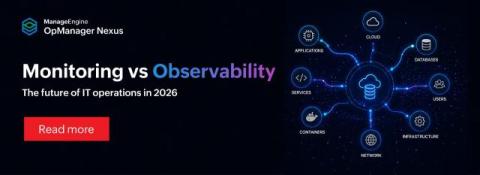
From event correlation to autonomous IT: Why observability isn't enough anymore

Most IT war rooms have plenty of data, but not enough time or clarity to find the real answer. Dashboards are crowded, alerts keep piling up, and the real issue gets lost in all the noise. Ever dealt with this situation? You’re not alone, and there’s a simpler way to deal with it. OpManager Nexus closes this gap by moving beyond visibility to help teams actually diagnose and fix problems faster.

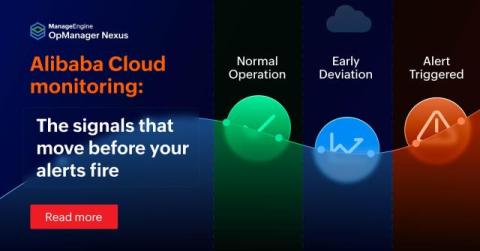
Alibaba Cloud monitoring: What changes when scale, speed, and cost collide

Alibaba Cloud monitoring isn't AWS or Azure monitoring with a different logo. The way its services scale, absorb load, and send early warning signals follows its own logic and if you're watching the wrong things, you'll find out too late. Cloud monitoring conversations often follow patterns set by AWS and Azure. The metrics are familiar, dashboards look the same, and operational playbooks are built around expected infrastructure behavior.

Tencent Cloud: When systems start reacting to themselves

Distributed systems don't just fail. They adapt. Services in Tencent Cloud environments are tightly interconnected. Compute, load balancing, databases, and networking layers continuously respond to each other based on changing conditions. Under normal load, this coordination stays in the background. As pressure builds, the behavior shifts. The system does not degrade in a straight line. Instead, it starts adjusting itself.

Color-coded log monitoring for simplified log analysis

Modern production environments generate massive volumes of logs every day. As systems become more distributed and cloud-native, that volume only increases. The real challenge isn’t collecting logs—it’s identifying what matters fast enough to act using effective log visualization. Most log views fail at this point. Every entry looks the same, forcing engineers to scan them manually and interpret lines under pressure.
Sponsored Post

How APM fits into the modern observability stack

Most engineering teams don't have a data problem. They have an interpretation problem. Prometheus is running, logs are shipping to the aggregator, dashboards are green-and then a latency spike hits and the root cause takes 45 minutes to isolate. The data was there but the answer wasn't. That gap is where application performance monitoring (APM) operates. This article explores what APM adds to a modern observability stack, why relying on standalone tools leaves critical blind spots, and how teams can unify infrastructure data with application context for a complete operational picture.

Escaping the Diderot effect: How to avoid tech-driven spending

Top Tips is a weekly column where we explore emerging trends in technology and share practical ways to stay ahead. This week, we're looking at how technology can nudge us into unnecessary spending—and how to avoid it. Have you ever bought one thing and then felt the need to buy several more to match it? If so, you've experienced what is known as the Diderot Effect. The term comes from the life of Denis Diderot, a famous French philosopher who spent much of his wealth in a matter of months.

Microsoft DNS management in OpUtils: One console for complete control

For network administrators, managing DNS has traditionally meant juggling zones and records across separate server interfaces, manually tracking changes, and responding to resolution failures after they’ve already caused disruption. We’re excited to introduce Microsoft DNS management in ManageEngine OpUtils, bringing DNS zone and record administration directly into the same console you already use for IP address management (IPAM).