Operations | Monitoring | ITSM | DevOps | Cloud

Grafana Tutorial: Simple Synthetic Monitoring for Applications

Often there’s a focus on how a service is running from the perspective of the organization. But what does service health monitoring look like from the perspective of a user? There are many metrics that indicate the overall health of a container, vm, or application, but independently they do not indicate if the system is functioning correctly. Often these metrics (CPU, disk, memory) are too narrow, and they can be poor indicators. High CPU may be desirable or bursts of memory usage may be normal.

How Grafana Labs is Democratizing Metrics Now

Metrics for all – and all for metrics. At Grafana, we not only strive to give people a “single pane of glass” to unify observability metrics. From the very start, our mission has been to advocate for the democratization of metrics, which is the idea that the paradigm needs to shift between who can store data, why they need to store it, and, ultimately, what they’re able to with it. And Grafana users are a great example of how vast and varied the needs are for data access.

An Open Technology Stack for Industrial IoT

AMMP Technologies runs monitoring for energy systems, usually off mini-grids in Africa. The company uses Grafana to monitor interface with physical objects that are not servers or containers. “It’s interesting how a toolkit for visualizing essentially internet/computer/server metrics is so well-suited to working with real-life streaming data,” AMMP Cofounder Svet Bajlekov said during his talk at GrafanaCon L.A.

How PostgreSQL and Grafana Can Improve Monitoring Together

TimescaleDB is an open source database packaged as a Postgres extension that supports time series, but “it looks as if it were just Postgres,” said Timescale’s Head of Product, Diana Hsieh. “So you can actually use the entire ecosystem. You can use all of the functions that are enabled in Postgres – like JSON indexes, relational tables, post JSON – and they all work with Timescale.”

Grafana Labs at KubeCon: Awesome Query Performance with Cortex

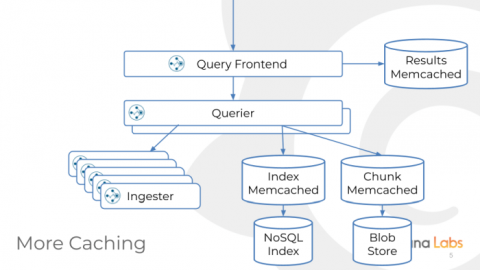
At KubeCon + CloudNativeCon in Barcelona last week, Weaveworks’ Bryan Boreham and I did a deep-dive session on Cortex, an OSS Apache-licensed CNCF Sandbox project. A horizontally scalable, highly available, long term storage for Prometheus, Cortex powers Grafana Cloud’s hosted Prometheus. During our talk, we focused on the steps that we’ve taken to make Cortex’s query performance awesome.

Grafana Labs at KubeCon: Foolproof Kubernetes Dashboards for Sleep-Deprived On Calls

We’ve all been in the situation where suddenly you are the lone developer on call while everyone is out of pocket. Or in the case of Grafana Labs Director of UX David Kaltschmidt, his then business partner, Grafana Labs VP of Product Tom Wilkie, was checking out for a weekend music fest. “Tom and I founded a company a couple of years ago, and I’m more of a frontend person. Tom did all the backend and devops stuff,” explained Kaltschimdt.

Grafana Labs at KubeCon: What is the Future of Observability?

The three pillars of observability – monitoring, logging and tracing – are so 2018. At KubeCon + CloudNativeCon EU last week, Grafana Labs VP Product Tom Wilkie and Red Hat Software Engineer Frederic Branczyk, gave a keynote presentation about the future of observability and how this trifecta will evolve in 2019 and the years to come.