Operations | Monitoring | ITSM | DevOps | Cloud

How reliability testing and load testing are complementary

How can you tell if your systems are reliable when under load? A common answer is to open your observability dashboards, wait for a high-traffic event (like Black Friday), and cross your fingers. While this approach is certainly effective, it's far from ideal. Without proactive reliability and load testing, we have no idea if a system will hold up to real-world usage patterns, which could mean a production outage at the worst possible time.

How to identify and map service dependencies

Modern applications are a web of interdependent services. As applications grow in size and complexity, and as more engineering teams adopt service-based architectures like microservices, this web becomes deeper and denser. Eventually, keeping track of the interdependencies between services becomes a complex and time-consuming task in and of itself. In addition, if any of these dependencies fails, it can have cascading impacts on the rest of your services and on the application as a whole.

Managing and improving reliability using Gremlin's Reliability Dashboard

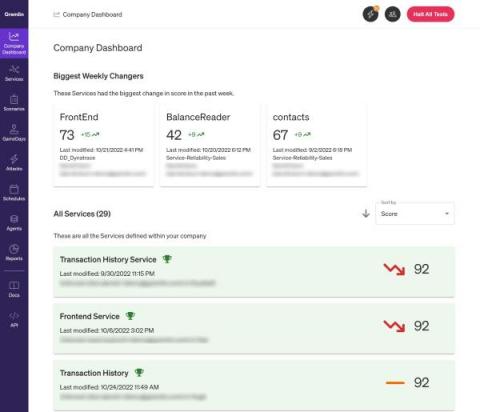
Part of a successful reliability program is being able to monitor and review your progress toward improving reliability. Being able to run tests on services is a big part of it, but how can you tell you're making progress if you can only see your latest test results? There should be a way to track improvements or regressions in your reliability testing practice across your organization in a way that's easy to digest. That's where the Reliability Dashboard comes in.

Setting better SLOs using Google's Golden Signals

To many engineers, the idea that you can accurately and comprehensively track your application's user experience using just a few simple metrics might sound far-fetched. Believe it or not, there are four metrics that aim to do just that. They're called the four Golden Signals and should be a core part of your observability and reliability practices.

What are the four Golden Signals?

When it comes to building reliable and scalable software, few organizations have as much authority and expertise as Google. Their Site Reliability Engineering Handbook, first published in 2016, details their practices to maintain reliability as Google scaled. But when you have over a million servers running thousands of services across more than twenty data centers, how do you monitor them in a consistent, logical, and relevant way?

Four tests to measure and improve reliability: what matters and how it works

Legendary race car driver Carroll Smith once said, "until we have established reliability, there is no sense at all in wasting time trying to make the thing go faster." Even though he was referring to cars, the same goes for technology: no amount of code optimization or new features can replace stable systems. Unfortunately, much like race cars, it's hard to know that a system is unreliable until it blows a tire, the brakes stop working, or the steering wheel comes off the column.

How to add a Golden Signal to a service in Gremlin RM

In this video, we show you how to add a Golden Signal to a service. Gremlin uses your Golden Signals to ensure your services are still healthy and responsive during reliability tests. You can configure Golden Signals to use an existing monitor in your observability tools, such as Datadog, New Relic, or Prometheus. We recommend adding all four Golden Signals to each of your services to ensure comprehensive coverage.