Operations | Monitoring | ITSM | DevOps | Cloud

How to mitigate the challenges of data growth

Over the last decade, I’ve rarely met a data professional whose organization wasn’t experiencing data growth and making more demands of their data. We build and deploy new applications faster than we retire old ones, and new data is accumulating dramatically faster on our existing systems than our ability to decide to delete older information. Additionally, the ever-growing number of users and devices interacting with that data increases the strain on the infrastructure underpinning it.

Why Andy Warhol would like - and dislike - AI

In a series of blog posts about AI, I’ve been looking at how intelligent ChatGPT is, how good ChatGPT and Bing are when you employ them as a technology writer, and how the engineering team at Redgate is using GitHub Copilot to aid with writing code. Now it’s time to take a look at image creation tools, and where better to start than Andy Warhol? I like Andy Warhol.

SQL Server Terms Translated into PostgreSQL

The rise in popularity of open-source RBDMs has encouraged many organizations to adopt PostgreSQL, but as a DBA or Developer, it can be challenging when exploring new database platforms, no matter how experienced you are. When looking at SQL Server, it has many similarities to PostgreSQL, but there are several big differences too.

How using a database monitoring tool helps DBAs create value for the whole organization

As the size and complexity of database estates increases, with more workloads and data being hosted on more platforms, both on-premises and in the cloud, so the appeal of third-party database monitoring tools has also grown. Their ability to provide a holistic view of an entire estate and monitor multiple databases and platforms from a single dashboard has been shown to save DBAs and IT teams many hours of time when compared to home-grown solutions.

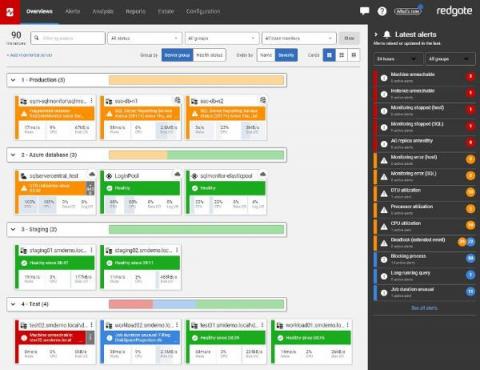
Why monitoring server estates from a single pane of glass is key

The last few years have seen a big change in the size, make-up, and nature of database estates. Data is growing both in volume and complexity, it is now normal to have workloads as well as data in multiple public clouds, and organizations are increasingly using different kinds of databases for different use cases.

Managing the challenge of migrating to the cloud

Migrating to the cloud has many advantages … until you’re the one tasked with making it happen. For many data professionals, this will be a first step from the traditional, predictable challenges of managing on-premises servers to the many and varied databases and platforms in the cloud. As many have discovered, it’s not simply a case of ‘lift and shift’.

The promise - and the perils - of GitHub Copilot

There’s been a lot of talk about GitHub Copilot recently, loudly touted as Your AI pair programmer. According to GitHub, Copilot for Business brings the power of generative AI to engineering teams, accelerating the speed of software development and innovation. At the back end is OpenAI Codex, a modified version of the GPT-3 Large Language Model (LLM) used in ChatGPT. At the front end it integrates with code editors like Visual Studio and JetBrains to automatically generate code.

How We Ate Our Own Dog Food To Level-Up Internal Testing with Redgate Clone

Most applications have large and complex databases at the back end, making it hard for developers to adequately test their work before it goes out. Having a fast, repeatable process to deliver data on demand is an essential part of an effective software development lifecycle, ultimately leading to improved customer satisfaction.

7 Essential Factors for a Successful Cloud Migration: A Non-Technical Guide

Are you looking to modernize and migrate your data but have questions about the complex organizational challenges? We recently hosted the webinar: Overcoming Organizational Challenges in Data Modernization and Cloud Migration: A Guide for Senior IT Leaders.

Enterprise businesses that adopt Database DevOps save an average of $4.3M per year

If treated well, the database can be a major accelerator in your business’s efficiency. It can be the star performer in your migration to the cloud, in your move to micro services and other change initiatives. If the right factors aren’t in place, though, the database can become a business risk. You could be at risk of losing new and existing customers to the competition due to poor UX, downtime or outages. It can also increase your vulnerability to data breaches. Find out how the database can be the hero in your digital transformation or change initiative.