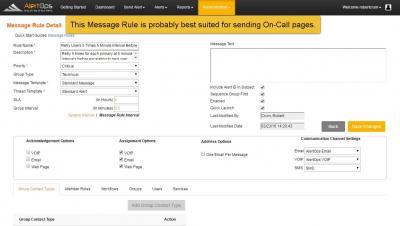
A few customers mentioned they were looking at moving away from services such as Slack for their notifications and wanted to use Microsoft Teams instead, due to the integrated nature of the Office 365 platform. It sounded like a good thing for us to offer, so we now integrate with Office 365 and Microsoft Teams.
As product managers, you’re ultimately the one held responsible for the entire product. So the last thing you want to assume is that someone else has got monitoring and alerts covered. In the first days of a release, all eyes are on the new product or latest feature. Just a few months later, when you introduce a brand new feature, the old one might break in the process. At times like these, you want to be ahead of your users, and not hear from your users that something isn’t working.
Why could a spike itself not always be good news? Why is it so important to find the relationships between time series metrics at scale?
As a long-time security professional, I’m always interested to hear about how companies like Datadog are keeping up with the changing security landscape. I can recall when the security organization was solely responsible for security, and we were focused on protecting the perimeter of our business. However, with the advent of the cloud, mobile, and web applications, that perimeter has disappeared.
Congratulations, VictorOps! OnPage would like to congratulate our contenders at VictorOps for their acquisition by Splunk. This acquisition of VictorOps validates the growing need for incident management and alerting platforms. As technology advances with sensors technology (IOT), and monitoring system utilizing AI, automation is necessary to achieve improved productivity and business resiliency. Therefore, incident management and alert automation is essential.
If you’re part of a large enterprise, you’re probably in the throes of digital transformation. If you’re in IT, you’re supporting your business by rolling out new services and apps weekly (or even daily). Meanwhile, your users expect 24×7 availability and performance. So your IT operations team is having to sift through ever-increasing data pouring out of myriad specialized and fragmented monitoring tools, hybrid clouds, legacy systems and virtual infrastructure.