

Operations | Monitoring | ITSM | DevOps | Cloud

The Future of Retail: Transforming Customer Experiences with IoT and Mobile Integration

Did you know that by 2023, the global Internet of Things (IoT) market in the retail industry is projected to reach a staggering $11.98 billion? This surprising statistic highlights the immense impact that IoT and mobile integration are having on the future of retail. As customer expectations continue to evolve, retailers are turning to these innovative technologies to deliver seamless, personalized experiences that enhance customer satisfaction and drive business growth.
Standout Exhibits at Embedded World 2024

Earlier this month, I had the pleasure of traveling to Nuremberg, Germany to attend Embedded World. If you have not heard about it before, Embedded World1 is the largest trade show in the embedded systems industry. This year, over 35,000 people attended and 1,100 businesses exhibited at the Nuremberg Messe.

Practical Zephyr - Devicetree practice (Part 5)

In the previous articles, we covered Devicetree in great detail: We’ve seen how we can create our own nodes, we’ve seen the supported property types, we know what bindings are, and we’ve seen how to access the Devicetree using Zephyr’s devicetree.h API. In this fifth article of the Practical Zephyr series, we’ll look at how Devicetree is used in practice by dissecting the Blinky application.

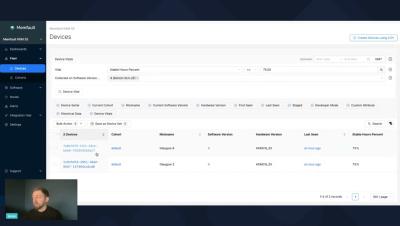
Embedded Device Observability data collected via Bluetooth Low Energy - Blecon and Memfault demo

In this demo we show an example of how Memfault's Observability solution can work seamlessly with Blecon's Bluetooth technology to get devices connected and sending data to the cloud with ease. In this case the device is running a Nordic nRF52.

Diving into JTAG - BSDL (Part 4)

In the previous article of this series, we briefly touched on how.bsd files written in Boundary Scan Description Language (BSDL) describe the structure of the boundary scan chain and the instruction set. In this article, we will examine this language’s syntax more closely before seeing how.bsd files are leveraged in JTAG testing in the next article.

Diving into JTAG - Debugging (Part 3)

In the third installment of this JTAG deep dive series, we will talk in-depth about JTAG Boundary-Scan, a method used to test interconnects on PCBs and internal IC sub-blocks. It is defined in the IEEE 1149.1 standard. I recommend reading Part 1 & Part 2 of the series to get a good background on debugging with JTAG before jumping into this one!

Major Improvements Coming for Linux Users

Linux®-based operating systems are becoming increasingly common among software developers. A whopping 45 percent were using Linux in 2022, according to Statista, which is not far behind Windows. Over the last months we have been focusing on improving the Tracealyzer experience for Linux users and the upcoming v4.9 release will bring major improvements.