Operations | Monitoring | ITSM | DevOps | Cloud

From Visibility to Real Savings: Turning FinOps Insights into Measurable Cost Reduction

FinOps programs are maturing, and most organizations have better visibility into cloud spend than ever before. Dashboards are full of data. And yet costs keep climbing. The problem isn’t the data. It’s the gap between knowing where the waste is and actually eliminating it. In this joint session, Tangoe and Kubex come together to bridge that gap. Tangoe brings deep expertise in spend management and FinOps discipline, while Kubex delivers infrastructure-level optimization across cloud, Kubernetes, and the AI and GPU workloads that are rapidly becoming the next frontier of cost pressure.

FinOps KPIs for IT Infrastructure: A Practical Field Guide for Cost Visibility

Infrastructure cost visibility has become a critical part of IT decision-making. Performance still matters, but for many infrastructure leaders, that’s no longer the full conversation. Leadership teams increasingly want clarity around cost movement, upgrade exposure, underutilized resources, and whether infrastructure decisions are financially defensible. That creates a different requirement for operations teams: visibility that connects technical behavior to business impact.

Top-Down FinOps: Align Cloud Spend with Real Business Strategy

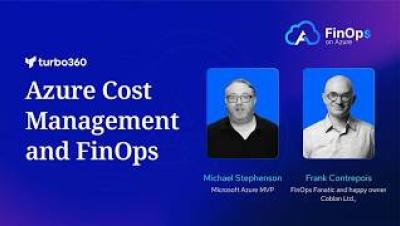
In this episode of FinOps on Azure, Michael Stephenson sits down with Frank Contrepois, independent FinOps voice and co-host of The FinOps Guys podcast — to explore what it really means to manage cloud costs from a business-first perspective. Frank has been in the FinOps space for nearly a decade and brings a genuinely different angle to the conversation. His background in commodity trading at Strategic Blue (a Morgan Stanley spinoff) shaped how he thinks about reserved instances, commitment strategies, and why most teams approach cost management the wrong way round.

How to Align CloudOps and FinOps for Better Azure Cost Management

The rapid migration to the cloud has brought unprecedented agility to modern enterprises, but it has also introduced a significant challenge in the form of cloud sprawl. As engineering teams provision resources at breakneck speed to support new applications and AI-driven workloads, financial departments often struggle to keep track of the escalating costs. This disconnect between operational execution and financial oversight is a primary driver of wasted cloud spend. To truly harness the power of scalable infrastructure without breaking the budget, organisations must bridge the gap between CloudOps and FinOps. Aligning these two disciplines ensures that technical performance and financial accountability work hand in hand to deliver sustainable business value. For companies heavily invested in Microsoft ecosystems, this alignment is even more crucial. Unchecked deployment can lead to massive end-of-month bill surprises, turning what should be a strategic advantage into a financial burden.

How Any FinOps Practitioner Can Use AI Right Now To Save 3-4 Hours/Week Of Tedium

Make AI do the dirty work while you focus your energy on strategy. CloudZero's Ryland Bowles shows you how. Every FinOps engineer is worried that AI is going to steal their job. I’ve worried about it. But I’ve also experimented extensively with AI, and I’ve got a pretty clear sense of what it can and can’t do in a FinOps context.

Putting FinOps theory into practice with SquaredUp

The public cloud has revolutionized IT by making infrastructure on-demand, scalable, and self-service. However, this convenience comes at a price. In the cloud, engineers can instantly spin up resources and spend company money with the click of a button or a line of code, bypassing traditional procurement and finance approval processes.

FinOps Roles And Responsibilities: Building Your Cloud FinOps Team (2026)

Quick answer: FinOps roles and responsibilities typically span four core functions: FinOps analyst (hands-on cost analysis and anomaly detection), FinOps engineer (resource tagging, automation, and rightsizing), FinOps architect (process design and optimization frameworks), and FinOps lead (program ownership, C-suite alignment, and cross-team accountability).

Your Cloud Architecture Has a Personality - Mastering Cloud Cost Profiles & FinOps

Most teams treat cloud cost like something to clean up later. In reality, it is already baked into how your system behaves. Every workload has a personality. Some spike with concurrency. Some quietly run all day and never shut off. Some look efficient until scale hits and then costs accelerate. And some charge you every time they run, every query, every scan, every execution. This episode is about recognizing those patterns early. Once you understand how your architecture behaves under load and over time, you stop reacting to cost and start shaping it.

FinOps Leaders Who Will Win The AI Era Are Already Experimenting

Engineering teams are shipping faster than ever. AI coding tools like Claude Code and OpenAI’s Codex have quietly removed some of the biggest friction points in the development cycle — and the result is that FinOps teams are being asked to keep up with a pace most practitioners haven’t fully reckoned with yet. That acceleration has a cost consequence. More shipping means more services, more experiments, more infrastructure spun up without review cycles.

FinOps In Action Playbook For Engineering Personas

In 2025, many teams built strong FinOps foundations: These practices created visibility and control. Now it’s time to elevate. FinOps in Action is a three-part series focused on applying that foundation in real engineering scenarios. Each post highlights a different persona and shows how to move from visibility to operational discipline. Today, we focus on Engineering. Engineering teams influence cost through architecture decisions, scaling policies, and workload design.