Sysdig Secure: Overview of Policies
Review of Policies in Sysdig Secure for runtime protection in a container based environment.


The latest News and Information on Containers, Kubernetes, Docker and related technologies.
Today Enterprise IT does not question the value of containerized applications anymore. Given the move to adopting DevOps and cloud native architectures, it is critical to leverage container capabilities in order to enable digital transformation. Google’s Kubernetes (K8s), an open source container orchestration system, has become the de facto standard — and the key enabler — for cloud native applications, and the way they are architected, composed, deployed, and managed.
kube-proxy is a key component of any Kubernetes deployment. Its role is to load-balance traffic that is destined for services (via cluster IPs and node ports) to the correct backend pods. Kube-proxy can run in one of three modes, each implemented with different data plane technologies: userspace, iptables, or IPVS. The userspace mode is very old, slow, and definitely not recommended! But how should you weigh up whether to go with iptables or IPVS mode?
Kubernetes, like a lot of other tools, can be noisy. Errors and warnings often go completely unnoticed in the event stream. Or sometimes they are noticed, but are hard to understand in the context of what else is happening in the cluster. Sentry, unlike a lot of other tools, works to eliminate that noise as much as possible, including Kubernetes-related noise.
In this post, we will walk through how to connect GitLab’s Auto DevOps feature with a Rancher-managed Kubernetes cluster, making use of a feature introduced in Rancher v2.2.0 called Authorized Cluster Endpoint. Readers can expect to walk away with an understanding of how GitLab integrates with Kubernetes and how Rancher simplifies this workflow with Authorized Cluster Endpoint.
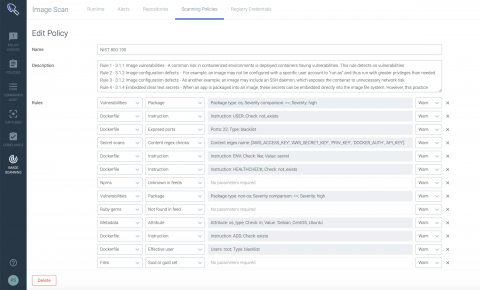
In September 2017, the National Institute of Standards and Technology (NIST) released Special Publication (SP) 800-190, Application Container Security Guide. NIST SP 800-190 explains the security concerns associated with container technologies and recommendations for the image details and container runtime security. It provides prescriptive details for various sections including image, registry, orchestrator, container and host OS countermeasures.
Containers have rapidly become a necessary part of the modern data center. Containers can be built on any of a number of operating system foundations — so how do you choose one over another?
With over 48,000 stars on GitHub, more than 75,000 commits, and with major contributors like Google and Red Hat, Kubernetes has rapidly taken over the container ecosystem to become the true leader of container orchestration platforms. Kubernetes offers great features like rolling and rollback of deployments, container health checks, automatic container recovery, container auto-scaling based on metrics, service load balancing, service discovery (great for microservice architectures), and more.