Operations | Monitoring | ITSM | DevOps | Cloud

The latest News and Information on DevOps, CI/CD, Automation and related technologies.

Measuring Developer Productivity: Can, How, and Should You Do It?

Productivity is a big topic. We all want to be more productive — and software developers in particular get put under the microscope. Interestingly, their work is also particularly difficult to measure and assess what “productive” even is. But we need to do it because we want developers to be more productive — and happier — because we want to achieve business goals together, better.

Building great developer experience at a startup

At incident.io, our number one priority in engineering is pace. The faster we can build great product, the more feedback we can get and the more value we can deliver for our customers. But pace is a funny thing. If you optimise for pace over a single month, you’ll quickly find yourself slowed down by the weight of your past mistakes.

Kubeflow 1.6 on Kubernetes 1.23 and beyond

Kubeflow is an open-source MLOps platform that runs on top of Kubernetes. Kubeflow 1.6 was released September 7 2022 with Canonical’s official distribution, Charmed Kubeflow, following shortly after. It came with support for Kubernetes 1.22. However, the MLOps landscape evolves quickly and so does Charmed Kubeflow. As of today, Canonical supports the deployment of Charmed Kubeflow 1.6 on Charmed Kubernetes 1.23 and 1.24.

Kubernetes alternatives to Spring Java framework

Spring Cloud and Kubernetes both complement each other to build a cloud native platform and run microservices on the Kubernetes containers. Kubernetes provides many features which are similar to Spring Cloud and Spring Config Server features. Spring framework has been around for many years. Even today, many organizations prefer to go with Spring libraries because it provides many features. It's a great deal when developers have total control over cloud configuration along with business logic source code.

Reimagining nmon Using InfluxDB

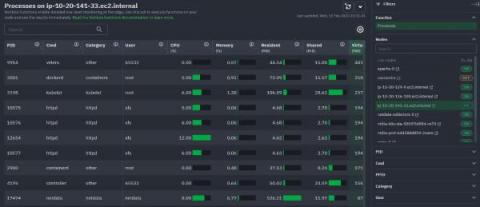
IBM engineer Nigel Griffiths built nmon in the 1990s to monitor operating system performance data for AIX. Since its original launch, Griffiths revisited and revamped nmon. For example, he built an open-source version for Linux. Despite drastic change in the very nature of computing and exponential growth in storage, memory, and compute power, it wasn’t until 2018 that Griffiths sought to completely re-write the tool and bring it into alignment with modern computer systems.

The Monitoring Problem: Too Many Tools + Too Much Time = No Room for Innovation

Continuous availability and unceasing innovation are prerequisites for today’s digital businesses. So it makes sense that business leaders invest heavily in teams and tools to monitor digital apps and services. In theory, these tools should also free up time for engineers to push new functionalities that wow customers. But do these investments actually result in more uptime and customer-delighting innovations?

An Introduction to gRPC

gRPC is an inter-process communication protocol used in high-performance applications in cloud computing, Internet of Things (IoT), mobile computing, and microservices environments. This article examines how gRPC works, how to use it, and how it compares to other popular API architectures. It also discusses a unique use case where gRPC excels.

Meet Epinio: The Application Development Engine for Kubernetes

Epinio is a Kubernetes-powered application development engine. Adding Epinio to your cluster creates your own platform-as-a-service (PaaS) solution in which you can deploy apps without setting up infrastructure yourself. Epinio abstracts away the complexity of Kubernetes so you can get back to writing code. Apps are launched by pushing their source directly to the platform, eliminating complex CD pipelines and Kubernetes YAML files.