Operations | Monitoring | ITSM | DevOps | Cloud

The Place Where Modern Operations & Technology Come Together

The latest News and Information on Log Management, Log Analytics and related technologies.


Creating Spring-based gRPC microservices managed by Prometheus and Grafana
Create microservices with gRPC with Spring, and leverage Managed Service for Prometheus and Grafana for monitoring and observability.

Microsoft Defender Endpoint Logs and Cribl Stream - Quick Start Guide
Microsoft Defender offers everyone comprehensive threat prevention, detection, and response capabilities—from individuals looking to protect their families to the world’s largest enterprises. Microsoft Defender allows IT and Security teams to prevent, detect, and respond to attacks across devices, identities, apps, email, data, workloads, and clouds. Have you ever wondered if you can use Cribl Stream to help manage your Microsoft Defender for Endpoint logs? The answer is Yes (plus benefits)!

Docker Logging: Effective Strategies for Docker Log Management
Docker is a platform that makes creating, deploying, and running containerized applications easier. Containerization is a lightweight and portable application deployment technique involving packaging an application and its dependencies inside a container. A container is a standalone, executable software package that includes everything needed to run a piece of software, including the code, runtime, system tools, libraries, and settings.

What happens when you can afford to ingest all your log data?
Sit down with Joe Kim, Sumo Logic's CEO, and Michael Cucchi, VP of Product Marketing, for a fireside chat (minus the fire) about Sumo Logic's new flex licensing plan. They'll discuss how removing the cost of ingesting log data across an enterprise: Tune in for a 20-minute chat about what happens when you can finally log everything with $0 ingest.
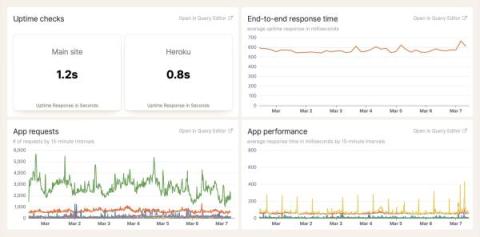
Introducing Honeybadger Insights
I'm pleased to announce a new feature that we've been building for over a year: Honeybadger Insights. Insights is our take on logging and performance monitoring, helping application developers gain deeper visibility into what's happening with their applications. It goes beyond application monitoring and responding to exceptions and downtime. Insights lets you drill down into the details and step back to see patterns in your data.

Meet the Splunk AI Assistant for SPL
Experience an IT analyst exploring new possibilities with the new Splunk AI Assistant for SPL. Get help to write custom SPL or learn more about your organization's existing queries with detailed explanations of complex SPL queries in natural language available right within your Splunk workflow.

TCP/IP: What It Is & How It Works
Network protocols are necessary for data transmission and networking over different devices. One of the most common protocols is the TCP/IP framework, which builds connections through our internet. In fact, if you check email, watch Netflix, or stream music from Spotify, you’re relying on TCP/IP in the background. In this article, you’ll learn about the TCP/IP protocol layers and how they function.

Emerging trends in observability: GAI, AIOps, tools consolidation, and OpenTelemetry
See the results of our 2024 survey of over 500 observability decision-makers to find out where the industry is headed As technology evolution continues at its rapid pace, so does observability. Observability is becoming critical to driving positive business outcomes, and we wanted to understand how users are evaluating trends and their impact over the coming years.

Best Method to Monitor Your ELK Stack Using Telegraf and MetricFire
The ELK stack, which stands for Elasticsearch, Logstash, and Kibana, is a powerful suite of tools used for searching, analyzing, and visualizing log data in real time. Within a software company's infrastructure, this stack can be utilized in several key areas to improve operational efficiency, debug issues, and gain insights into user behavior. The ELK stack provides a centralized platform for aggregating logs from various sources.