Operations | Monitoring | ITSM | DevOps | Cloud

The Place Where Modern Operations & Technology Come Together

The latest News and Information on Log Management, Log Analytics and related technologies.


Splunk for Financial Services Payment Rails
See how Splunk delivers end-to-end visibility across payment rails — monitoring transaction flows in real time to catch failures, latency, and anomalies before they hit customers. Learn how financial institutions use that insight to protect uptime, reduce fraud risk, and keep every payment moving.

Why AURA Scratchpad Is Rad: Bound the AI SRE Agent Context Window
A big tool result does not have to be a big context cost. AURA moves it to disk and hands the model a pointer plus the tools to navigate what is there. A large MCP tool result can consume or overflow an agent's context window, and on a third-party server you do not control how much comes back. Scratchpad breaks the link between how big a tool result is and how much context it costs: the full output goes to disk, and only the slice the model asks for ever enters the window. Errors always pass through inline, so the model can react to them.

Air-Gapped AI SRE Agent: Run AURA on a Local LLM with llama.cpp
The model, the serving layer, and the agent asking questions all sit on local hardware. The first thing it debugs is the AI stack it is running on. No external inference provider in the path.

7 lessons for IT leaders on using observability to monitor AI applications
What it takes to prove AI value with LLM observability Over six months, the Elastic IT team ran internal AI applications that returned $2.5 million in operational time to the business.1 A conversational support assistant moved us from zero digital resolution, where anything complex became a ticket, to 30% of support interactions closing without one.

Multi-Agent Orchestration for SRE: AURA Runs a Model per Specialist
Give one agent every tool and every incident is a question of trust. This one hands each job to a worker that can only reach what that job needs. One AURA configuration defines a coordinator and three specialist workers. Qdrant stores the runbooks, Prometheus measures workload health, and Kubernetes provides inspection and remediation, and each of the three is wired to one worker.

On Release Days We Wear Teal for release 4.19.1
In this episode, Leon explores some of the new features, functions, updates, and improvements in release 4.19.1, which includes private links, setting a region per workspace, choosing a release channel per workspace, and a look at Output Routers, an incredibly useful (but unfortunately under-loved) feature that’s been around for a hot minute.
Cribl App for AI Observability
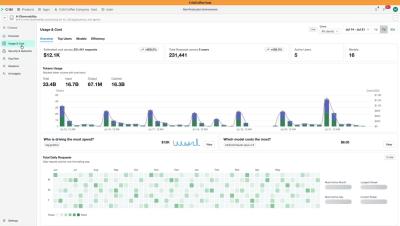
See how Cribl's AI Observability App gives teams one place to search, investigate, and report on AI telemetry across models, tools, and environments. In this 5-minute demo, we tackle cost, quality, security, and governance blind spots. Start treating AI observability as a telemetry problem. Collect once, use everywhere, no lock-in.

From retrieval to agents: 5 takeaways on production architecture for AI agents
How context engineering creates production-ready agentic AI What if the AI strategy you spent the past year building is already being measured by a completely different set of rules? I recently joined Amy Machado, senior research manager at IDC and Jim Malone, senior contributing editor at CIO Marketing Services, for a webinar where we explored how buyer expectations, architectural requirements, and evaluation criteria are shifting as enterprises move from search-driven experiences to agentic AI.
Olly says Hi: Scheduled tasks now report to Slack and email
An agent that only speaks when spoken to is a tool you have to remember to use. Olly has run on a schedule for a while now, working a saved prompt hourly, daily, weekly, or monthly and writing its findings into a chat with its own run history. Those scheduled tasks are now wired into the Coralogix Notification Center, so Olly delivers that output itself, allowing Olly to reach out to Slack or email, out of the box.