Operations | Monitoring | ITSM | DevOps | Cloud

The latest News and Information on Log Management, Log Analytics and related technologies.

What Is Anomaly Detection in Log File Analysis?

Logging is vital to the success of any IT project. With solid logging practice, you can troubleshoot errors, find patterns, calculate statistics, and communicate information easily. With the size and complexity of modern systems, performing these actions involves various analysis activities. One of these important analysis activities is anomaly detection. What is anomaly detection, and where does it fit in all of this? That’s what this post is about.

Shipping AWS S3 CloudWatch Metrics to Logz.io

AWS S3 buckets are an indisputably powerful—and extremely well-organized—DevOps tool. Standing for “simple storage service,” the S3 is the lowest tier offered for AWS storage, but it is also the most indispensable. S3 buckets store data for immediate recall, the most active components in Amazon’s arsenal of storage options. They can store a variety of developer applications and up to five terabytes of data each.

Work from home better with secure and reliable enterprise service

Today, we are facing an unprecedented situation. The COVID-19 pandemic is affecting everything we know -- our families, our businesses, our communities, and our way of life. In these tough times, many organizations have resorted to mandatory remote working for employees so they can still be productive and safe. Saas productivity tools like Zoom, Slack, G-Suite and Office 365 became seemingly mandatory in this new distributed workplace.

Alcide kAudit Integrates with Sumo Logic

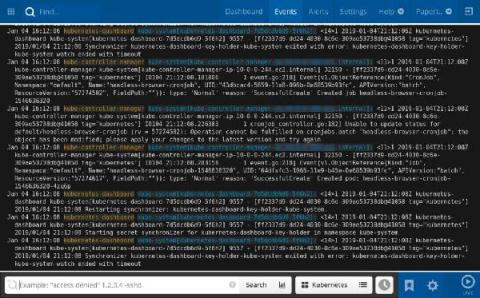
Alcide recently introduced Alcide kAudit, an automatic tool for analyzing Kubernetes Audit logs. This tool focuses on detecting non-compliant and anomalous behavior of users, automated service accounts and suspicious administration operations. Alcide’s recent integration with Sumo Logic enables users to gain full access to insights and real-time alerts from Alcide kAudit.

Does Observability Throw You for a Loop? Part Two: Close with Controllability

In part one, we introduced the duality of observability, controllability. As a reminder, observability is the ability to infer the internal state of a "machine” from externally exposed signals. Controllability is the ability to control input to direct the internal state to the desired outcome. So observability is a loop problem. And we need to stop treating it as the end state of our challenge in delivering performant, quality experiences to our users and customers.

Adapting to The New Normal in IT Operations

The waves of change are certainly upon us and businesses are being forced to adapt at a record pace. Current world events have caused a jarring shift in all aspects of our lives, accelerating major changes in how we live and work. An unprecedented number of people are now working from home. Those of us working in IT Operations are no exception. Many companies are implementing a Distributed IT Operations Center (D-NOC) approach to address this new reality.

Use Cloud Infrastructure Data Model to Detect Container Implantation (MITRE T1525)

A unified cloud infrastructure data model is fundamental for enterprises using multiple cloud vendors. Enterprise customers prefer to use multiple cloud vendors as a way to prevent being locked in and dependent on specific platforms. According to Gartner the top vendors for cloud infrastructure as a service in the years 2017-2018, are Amazon 49.4%, Azure 12.7% and Google with 3.3%.

How Logz io Engineers monitor their multi tenant SaaS offering with Logz io

Logz.io is a Cloud Observability Platform that helps engineering teams quickly identify and resolve production issues using the best open source for metrics and log monitoring available: Elk and Grafana. In this webinar, one of the engineers who built the product, Roi Ravhon, showed how the Logz.io engineering team uses Logz.io to deliver more reliable, performant, and secure services to our customers.

Tutorial: Shipping Docker Metrics to Logz.io

Docker is an essential bridge in modern DevOps. Despite Kubernetes overtaking Docker on orchestrating containers, the Docker container itself remains the standard and likely will for the foreseeable future. We developed the Docker Metrics collector to operate as its own container that will run Metricbeat using the modules you are running in real time. Now, in addition to the Docker module, we are now releasing an AWS module for operations in the cloud.