Operations | Monitoring | ITSM | DevOps | Cloud

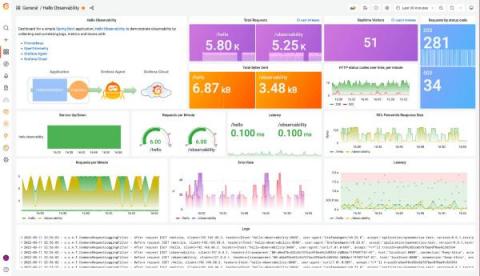
Set up and observe a Spring Boot application with Grafana Cloud, Prometheus, and OpenTelemetry

Spring Boot is a very popular microservice framework that significantly simplifies web application development by providing Java developers with a platform to get started with an auto-configurable, production-grade Spring application. In this blog, we will walk through detailed steps on how you can observe a Spring Boot application, by instrumenting it with Prometheus and OpenTelementry and by collecting and correlating logs, metrics, and traces from the application in Grafana Cloud.

Peering, edge computing, and community with Grant Kirkwood | Network AF Episode 16

Chief Technology Officer and Co-founder of Unitas Global, Grant Kirkwood, joins Network AF to discuss motivations for starting the company and where they're at currently. Avi and Grant talk about what it is like to be a service provider and a solution provider (MSP) in one, and how it plays into what Avi calls the APIfication of networks and IT strategy.

Using AI & ML for Application Performance (APM)

Today, IT and site reliability engineering (SRE) teams face pressure to remediate problems faster than ever, within environments that are larger than ever, while contending with architectures that are more complex than ever. In the face of these challenges, artificial intelligence has become a must-have feature for managing complex application performance or availability problems at scale.

Cloud Log Management Strategy & Best Practices

For IT Operations and Site Reliability Engineering (SRE) teams, logging is nothing new. In fact, collecting and analyzing logs is one of the oldest cornerstones of performance management. Logs have been part and parcel of APM workflows for decades. Yet the logging strategies that worked in eras past often fall short today. That’s thanks to the advent of cloud-native computing, which has ushered in fundamental new challenges in the way teams aggregate, analyze, and manage logs.

Collaboratively author retrospectives with our new Google Docs integration

When it comes to learning from incidents, your tools should adapt to the way your organization works. Many of you conduct your retrospectives in rich-text document editing tools, like Google Docs. That’s why we’ve introduced the option to export your retrospectives to Google Docs. Retrospective export to Google Docs can be automated as part of your incident management process with a Runbook step.

Are You Curious? Announcing the Launch of Cribl Curious: A Q&A Site for the Cribl-Inclined

Our amazing user community is growing so fast that we want to give you more resources to learn and share your knowledge and experience with others. So…today we launch Cribl Curious! Curious is a Q&A site for asking and answering technical questions about Cribl Stream, Cloud, Edge, Packs, and AppScope. Goat a question about how something works in Cribl? Come on over to see how your peers have solved similar problems. Checked the docs and it’s just not clicking for you?

What Are The Different Types of Authentication?

The goal of authentication is to confirm that the person attempting to access a resource is actually who they say they are. As you can imagine, there are many different ways to handle authentication, and some of the most popular methods include multi-factor authentication (MFA) and Single Sign On (SSO). However, these methods just skim the surface of the underlying technical complications. In order to implement an authentication method, a business must first establish an authentication protocol.