Operations | Monitoring | ITSM | DevOps | Cloud

The Place Where Modern Operations & Technology Come Together

The latest News and Information on APIs, Mobile, AI, Machine Learning, IoT, Open Source and more!


AI Found 18 OpenSSL Vulnerabilities. Now Your Team Has to Patch Them.
On June 9, 2026, the OpenSSL project released patches covering 18 vulnerabilities across its supported releases. The headline flaw, CVE-2026-45447, is rated high severity and has the potential for remote code execution. Not too long ago, a security advisory with 18 vulnerabilities would have been routine. Microsoft’s Patch Tuesday provided a predictable cycle, and organizations operated with the expectation of a meaningful remediation window. That model is under pressure.

Context is King #5 - Building Safe AI Agents
As AI agents gain more autonomy, safety can't be an afterthought. In this talk from Context is King in London, Jonatan von Martens (AI Safety Engineer at ElevenLabs) shares what it actually takes to build agents that behave reliably in production. Context is King is a meetup series co-organized by Flow AI and Aiven for engineers shipping AI agents in production. No pitches — just real implementation stories.

Context is King #5 - A Semantic Layer for the Agentic Era
Agents are only as good as the queries they can run. In this talk from Context is King in London, Egor Kraev (Co-Founder & CTO of Motley) breaks down how a well-designed semantic layer becomes the connective tissue between natural language intent and reliable data retrieval. Context is King is a meetup series co-organized by Flow AI and Aiven for engineers shipping AI agents in production. No pitches — just real implementation stories.

Context is King #5 - Ontologies as Executable Context for AI Agents
Can a knowledge graph do more than store facts — can it actually run your agent? In this talk from Context is King in London, Teodoro Baldazzi (Principal AI Engineer at Prometheux) makes the case for ontologies as executable context: structured knowledge that doesn't just inform AI agents, but actively shapes how they reason and act. Context is King is a meetup series co-organized by Flow AI and Aiven for engineers shipping AI agents in production. No pitches — just real implementation stories.

MCP for PostgreSQL, Kafka, OpenSearch by Aiven
Want to build context-aware AI agents with production-ready databases? In this video, we dive into the brand-new Aiven MCP (Model Context Protocol) and show you how to instantly connect your AI assistants to fully managed PostgreSQL and Apache Kafka with zero custom code!

Why Your Agentic Workflow Succeeds and Still Gets It Wrong
Agentic workflows are reshaping how engineering teams operate, fetching context, synthesizing decisions, and shipping results across systems without human intervention. But the same design that makes them powerful adds risk in production. Agents do not crash when they hit bad data; they synthesize around it, substituting a stale value, an empty page, or a missing field for the result they were supposed to capture.
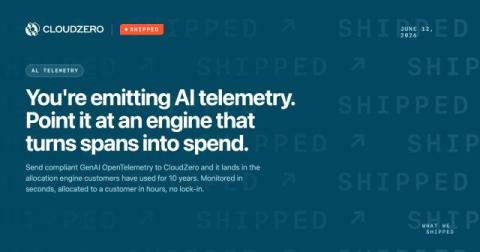
Shipped: You're emitting AI telemetry. Point it at an engine that turns it into allocated spend.
Your AI calls already emit OpenTelemetry: your LLM gateway exports it, and it’s the open standard your own services can speak. But you don’t have anywhere to turn those spans into spend you can allocate to an outcome. Now you can. CloudZero exposes an OpenTelemetry endpoint that doesn’t care what’s on the other end.

The Manufacturing ERP Paradox: Standardization vs Operational Reality
Despite being an integral part of modern manufacturing, standardized ERP processes often conflict with the realities of a plant's day-to-day operations. As a result, manufacturers are forced to rely on manual workarounds and spreadsheets to close operational gaps. What they really instead is a system that's: Modular ERP systems check all of these boxes, balancing standardization with flexibility to put complete operational control back into the hands of manufacturers.
UK Public Sector AI ambitions hindered by fragmented IT environments
New SolarWinds data highlights widespread fragmentation and infrastructure challenges, limiting AI's impact and scalability across public sector services.