Operations | Monitoring | ITSM | DevOps | Cloud

The latest News and Information on Continuous Integration and Development, and related technologies.

Building a real-time AI autocomplete app with Next.js and Vercel AI SDK

Over the past ten years, Azure has become one of the most prominent cloud computing platforms available, rivaled only by AWS. Part of Microsoft’s suite of Azure services, Azure web apps provide a packaged environment for hosting web applications built in many languages. Because this environment is fully managed by Azure, developers have limited options for control.

Getting started with Jenkins dashboards

Jenkins is an open-source automation server widely used for continuous integration and continuous delivery (CI/CD), enabling developers to automate the building, testing, and deployment of software projects. Jenkins requires a good layer of visualization as it provides real-time visibility into pipeline performance, build statuses, test results, and deployment progress.

Streamline your LangChain deployments with Langserve on GCP

Deploying Large Language Model (LLM) applications can transform ideas into valuable services. But, deployment challenges can slow down even experienced developers. In this tutorial, you will build and deploy a LangChain application using LangServe and CircleCI on Google Cloud Run. You will create a text summarization tool powered by Google’s Gemini model. You will use Langserve to expose it as an API. You will automate testing and deployment to Google Cloud Run using CircleCI.

Use AI to resolve CI test failures with zero guesswork

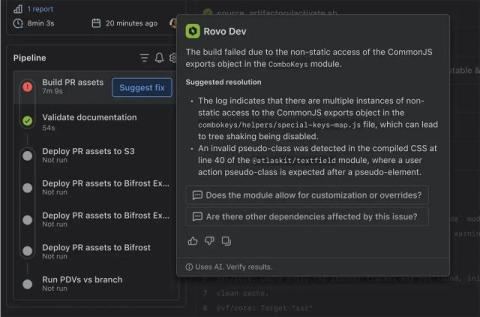
Test failures are inevitable. A broken condition, a missed edge case, or a last-minute refactor can trip up even the most careful changes. That’s part of shipping software. What shouldn’t be part of the job is spending half your afternoon parsing logs and chasing down the root cause. Now, there’s a faster way. This guide shows how to use the CircleCI MCP server to identify, understand, and resolve failing tests in a CI/CD build without ever leaving your editor.

Enterprise Policy Management with Cloudsmith

Enterprise Policy Management (EPM) is a programmable policy-as-code layer that controls the security, compliance, and flow of artifacts across the software supply chain. Teams can codify rules once and apply them continuously across repositories. With Cloudsmith’s platform, organizations extend policy enforcement across teams, environments, and geographies without introducing friction, including the open source packages that the chain depends on.

Enterprise Policy Management Example: Quarantine Packages Using Policy as Code

Cloudsmith built Enterprise Policy Management (EPM) on Open Policy Agent (OPA) and uses Rego to define policies as code. These policies control how packages move through your systems. They're versioned, reviewable, and enforceable. EPM is in early release, but it already draws on extensive metadata Cloudsmith collects from your artifacts: format, version, tags, license, vulnerability, malware scan results, and digital signatures.

Data governance frameworks for distributed microservices applications

Implementing robust data governance in microservices architectures presents unique challenges and opportunities. As organizations decompose monolithic applications into distributed services, traditional centralized data management approaches no longer suffice. Each microservice may manage its own data store, creating potential inconsistencies, compliance risks, and security challenges.

Microservices versus monoliths

Monolithic and microservices architectures represent two fundamentally different approaches to software design. By understanding the benefits and drawbacks of each architectural style, developers can make informed decisions about which approach best fits their application needs. While monolithic architecture bundles all application functionality into a single deployable unit, microservices architecture breaks the application into smaller, independently deployable services.

Strangler pattern implementation for safe microservices transition

Moving from monolithic applications to microservices represents a significant architectural transformation. The Strangler Pattern offers a controlled, incremental approach to this migration, enabling organizations to gradually replace functionality while keeping systems operational throughout the transition. This methodology substantially reduces risk compared to complete rewrites, making it an invaluable strategy for organizations with business-critical applications.

Measuring success in microservices migration projects

Microservices migrations represent significant investments for organizations seeking greater agility, scalability, and development velocity. Yet without clear metrics to guide the journey and measure outcomes, these initiatives risk delivering technical change without meaningful business impact. Establishing appropriate success measures ensures that migration efforts stay aligned with organizational goals while providing visibility into progress and value delivery.