
Operations | Monitoring | ITSM | DevOps | Cloud

The latest News and Information on Cloud monitoring, security and related technologies.

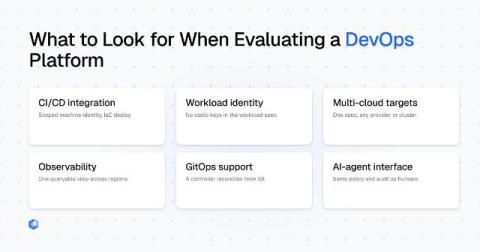
What to Look for When Evaluating a DevOps Platform

DevOps platform feature lists increasingly look alike. CI/CD, multi-cloud, observability, GitOps, and AI-friendly automation can all appear as checkboxes while the implementation burden still falls on your team. The useful signal appears when you ask how each capability actually works, what evidence a vendor can show, and which parts your team still has to build. Can pipelines authenticate with a scoped machine identity? Can workloads reach cloud APIs without static keys?

Making Shared GPUs Even Safer with Kubex and HAMi-core

Table of Contents A few months ago, we introduced Kubex support for the KAI Scheduler to improve GPU sharing for production inference workloads. The basic model is simple: The KAI Scheduler handles placement and GPU sharing. Kubex continuously observes usage and adjusts those allocations as demand changes. KAI provides the scheduling foundation. It lets multiple workloads share a GPU while accounting for the amount of GPU each workload requests. Kubex then closes the loop.

Shipped: Self-serve your MCP server credentials

Enterprise agent platforms need a client ID and client secret in hand before they will connect to anything. An admin with the Modify MCP Settings permission can now issue that pair directly in Settings, connect the platform, and manage the credential lifecycle on whatever schedule your security policy requires. No support request, no wait.

The case for preview environments with production data

Before he joined Upsun, Andrew Kester spoiled the biggest sale of a client's year. He was one of two or three web developers at a creative agency that did branding, logos, print, and websites. A design boutique was about to run its annual trunk show, and the discounts and featured brands were meant to stay secret until the reveal on Tuesday at noon. The client asked for a preview. The preview reached production.

If We're Not Up, The Checkout Breaks

Kintsugi puts sales tax compliance on autopilot for 7,300 companies selling into 110 countries, and its tax engine sits inside other companies' checkouts. The answer has to arrive before the shopper finishes paying. "Typically, a customer's expectation is that we are returning the sales tax estimate on the invoice within 100 milliseconds." The cost of missing is not abstract: "For every minute that our sales tax API, if it ever goes down, our customers are not able to collect roughly $4 million in sales tax that they should be collecting.".

Railway vs Render vs Your Own Cloud Account: What Actually Fits a Scaleup Outgrowing Managed PaaS

An honest 2026 comparison of Railway, Render, Fly.io and deploying into your own AWS, GCP, Azure or Scaleway account - with the six measurable signals you have outgrown managed PaaS, a priced cost model, and a four-step framework with if-then verdicts. Romaric founded Qovery to make Kubernetes accessible to every engineering team. He writes about platform strategy, developer experience, and the future of cloud infrastructure.

Shipped: Rightsize Kubernetes workloads without leaving your MCP client

Changing a Kubernetes resource request takes two numbers: what the workload requests, and what it uses. The CloudZero MCP server now returns both, by cluster, namespace, or workload. This gives you a number you can defend. Usage comes back as P95 over the date range you query, 30 days by default. When an engineering lead asks whether a service runs on a smaller request, that is the figure that settles it. Over-provisioning and under-provisioning show up on the same query.

LLM token cost: pricing per token explained

LLM token cost is the price a provider charges per token a model reads or writes, quoted in dollars per million tokens. Input and output bill at separate rates, with output priced at roughly 5x input. As of September 2026, published rates range from under $0.10 to more than $180 per million tokens on top-end reasoning tiers. In late 2025, Hardik Sonetta of Thomson Reuters Labs published a warning about the most common prompt caching mistake in production.