Sysdig Usage Report Finds Shifting Container Security Left is Not Enough
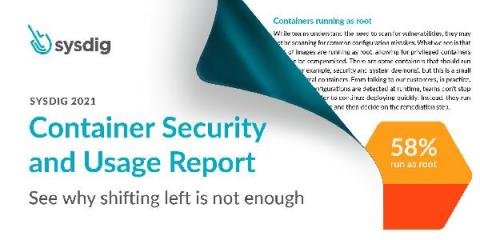
74 percent of customers 'shift left' by scanning images during the build phase, 58 percent of containers are running as root, which increases runtime security risk.


The latest News and Information on Containers, Kubernetes, Docker and related technologies.
The fourth annual Sysdig container security and usage report looks at how global Sysdig customers of all sizes and industries are using and securing container environments. By examining how and when organizations are implementing security in the development lifecycle, we have been able to uncover some interesting data points in this year’s report. For example, we can see that 74% of organizations are scanning container images in the build process.
As an AWS Advanced Technology Partner with AWS Containers Competency, Tigera is thrilled to announce that Calico and Calico Enterprise are both now available as AWS Quick Starts. If you’re unfamiliar with the concept, an AWS Quick Start is a ready-to-use accelerator that fast-tracks deployments of key cloud workloads for AWS customers.
In this tutorial, we will discuss InfluxDB and its Python client. We will deploy InfluxDB inside a Kubernetes cluster and then use the InfluxDB Python client to send data to InfluxDB.
Today, Red Hat announced its intent to acquire Stackrox. This is a very exciting development in the world of cloud-native security! First and foremost, congratulations to Stackrox, an early participant in the container security space. This acquisition is a great outcome for Stackrox given their nascent scale and on-premises offering.