The latest News and Information on Containers, Kubernetes, Docker and related technologies.
Kubernetes makes it easier in certain ways to manage reliability. But incident response teams and SREs must also be prepared to handle the unique reliability challenges that K8s creates.
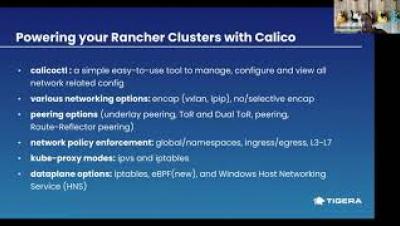
We are thrilled to announce the availability of Calico Enterprise 3.5, which delivers deep observability across the entire Kubernetes stack, from application to networking layers (L3–L7). This release also includes data plane support for Windows and eBPF, in addition to the standard Linux data plane. These new capabilities are designed to automate, simplify and accelerate Kubernetes adoption and deployment. Here are highlights from the release…
The CVE-2021-25735 medium-level vulnerability has been found in Kubernetes kube-apiserver that could bypass a Validating Admission Webhook and allow unauthorised node updates. The kube-apiserver affected are: You are only affected by this vulnerability if both of the following conditions are valid: By exploiting the vulnerability, adversaries could bypass the Validating Admission Webhook checks and allow update actions on Kubernetes nodes.
Today, I am excited to share that we secured $188M in a new funding round, at a valuation of $1.19B (read more here). At the outset, I want to thank our employees, partners, investors and most importantly, our customers for this important milestone. The funding follows a year of unmatched innovation that led to accelerated revenue growth, installed base growth, and rapid community adoption of our open source projects.
Codefresh is excited to partner with Atlassian on their new Open DevOps launch. Codefresh is offering native support for connecting the two platforms and giving better visibility on deployments and features of each deployment for our mutual customers. At the heart of this integration is the Codefresh App; which can be found on the Atlassian Marketplace. Simply define Codefresh as the CI/CD partner that will connect to Atlassian’s DevOps API.
As applications move from monolithic architectures to microservices-based architectures, DevOps and Site Reliability Engineering (SRE) teams face new operational challenges. Microservices are updated constantly with new features and resource managers/schedulers (like Kubernetes and GKE) can add/remove containers in response to changing workloads. The old way of creating alerts based on learned behaviors of your monolithic applications will not work with microservices applications.