Ringside at KubeCon with Hewlett Packard Enterprise
Pete Smails from Rancher catches up with Ka Wai Leung and Michael Mattsson from Hewlett Packard Enterprise at KubeCon NA in San Diego.


The latest News and Information on Containers, Kubernetes, Docker and related technologies.
Looking back over 2019 it's been a huge time of change for us as a company. When I co-founded Civo four years ago we were aiming to be an IaaS (Infrastructure-As-A-Service) provider, focusing on small developers and teams rather than huge corporate hosting requirements. The developer experience was really important to us, but trying to carve out a niche in such a crowded market was really challenging.
Experience Kubernetes OOM kills can be very frustrating. Why is my application struggling if I have plenty of CPU in the node? Managing Kubernetes pod resources can be a challenge. Many issues can arise, possibly due to an incorrect configuration of Kubernetes limits and requests. In this article, we will try to help you detect the most common issues related to the usage of resources.
When an application in a Docker container emits logs, they are sent to the application’s stdout and stderr output streams. The container’s logging driver can access these streams and send the logs to a file, a log collector running on the host, or a log management service endpoint. In this post, we’ll explain how the driver you choose—and how you configure it—influences the performance of your containerized application and the reliability of your Docker logging.
In any rapidly emerging market, consultants can be a great source for vendor-neutral insights, as they typically work with multiple technologies to help their customers make informed decisions. In that vein, Derya (Dorian) Sezen of kloia, a new-era consulting organization that provides services toward transition of legacy workloads to frontline technologies in Cloud, DevOps and Microservices, recently wrote a blog summarizing his experience with Rancher and Red Hat OpenShift.
Sysdig, an industry leader for monitoring and security of cloud-native workloads, and IBM have joined forces to bring a fully Integrated powerful platform that delivers the security and performance that enterprises need in today’s multi-cloud world. Sysdig Secure and the IBM Cloud Pak for Multicloud Management (MCM) can help you accelerate Kubernetes and cloud adoption by addressing security and regulatory compliance from the start on enterprise hybrid cloud environments.
I remember when it used to take me several hours to deploy my JHipster application. Setting up the required services (DNS, CDN and the database) for a modern web application took time. Here's how to put online a JHipster application in less than 15 seconds now. See the result here Enjoy! :)
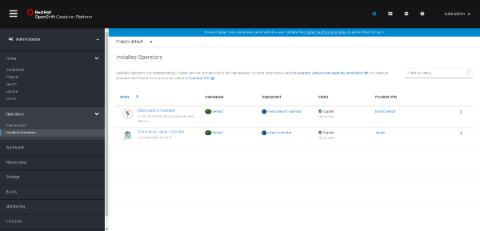
In this article, we are going to look at deploying Jaeger on Kubernetes and OpenShift with Elasticsearch storage using operators. We will go through the configuration (custom resources) and also see what benefits OpenShift offers over vanilla Kubernetes.