Operations | Monitoring | ITSM | DevOps | Cloud

The latest News and Information on DevOps, CI/CD, Automation and related technologies.

How to Create an Azure Monitor Alert

Azure Monitor gathers performance metrics from your various Azure resources and allows you to explore those metrics through visualizations. It also allows you to manually create alerts that will notify you when a metric crosses a predefined threshold. In this blog post, we’ll cover how to create an alert in Azure Monitor.

We're Honored: Bank of America Recognizes JFrog for Enterprise DevOps Innovation

Being innovative is like being handsome. It only counts when others think so. When Bank of America honors you for being innovative and improving how their 30,000 developers perform, it’s a very handsome compliment. At the 11th Bank of America Technology Innovation Summit, JFrog was recognized for industrial leadership and excellence in providing global business solutions. This year, JFrog was one of only two technology companies honored for its strong partnership with the firm.

Meet Root Cause Changes from BigPanda - IT Ops, NOC and DevOps Teams' Best friend For Supporting Fast-Moving IT Stacks

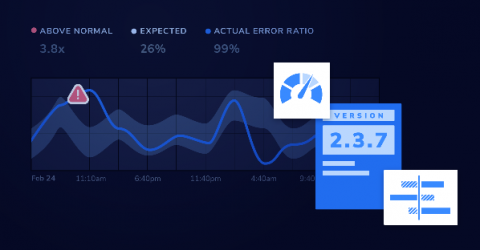
TL;DR: Fast-moving IT stacks see frequent, long and painful outages. Thousands of changes – planned, unplanned and shadow changes – are one of the main reasons behind this. Until now, IT Ops, NOC & DevOps teams didn’t have an easy way to get a real-time answer to the “What Changed?” question – the answer that can help reduce the duration of outages and incidents in these fast-moving IT stacks. Now, with BigPanda Root Cause Changes, they do.

Collecting Amazon MQ metrics and logs

In Part 1 of this series, we saw how Amazon MQ routes messages between services in a distributed application, and we looked at some of the key metrics that describe the performance of the message broker and its destinations. Now that we’ve introduced the metrics and their meaning, we’ll look at some tools you can use to collect and query metrics from Amazon MQ:

Analyzing Amazon MQ performance with Datadog

In Part 2 of this series, we showed you how to use CloudWatch to monitor metrics and logs from Amazon MQ. With CloudWatch, you can easily create ad-hoc graphs to visualize the performance of your messaging infrastructure and other AWS services you use (such as EC2, Lambda, and S3). But to monitor your Amazon MQ brokers, destinations, and clients alongside the rest of your applications and infrastructure, you need a monitoring platform that easily integrates with your whole technology stack.

Monitor your Fargate container logs with FireLens and Datadog

To centralize logging from your entire stack—from traditional infrastructure to serverless components—Datadog is announcing native support for the launch of FireLens for Amazon ECS. FireLens streamlines logging by enabling you to configure a log collection and forwarding tool such as Fluent Bit directly in your Fargate tasks. We’ve partnered with AWS to provide built-in Fluent Bit support for Datadog so that you can now seamlessly route container logs from AWS Fargate.

Upgrading Kubernetes Without Upgrading Rancher

Prior to version 2.3, new versions of Kubernetes came out with point releases of Rancher and required an upgrade to Rancher before they were made available for use. Rancher 2.3 changes that pattern and now makes it possible to update the metadata store for available Kubernetes versions, disconnecting the Rancher server upgrade process from the Kubernetes cluster upgrade process.

Tanya Gordon - How Atlassian software supports HP on its LPPD journey

Atlassian was chosen as the technical partner to introduce and apply the LEAN methodology at HP. LEAN is not just a buzzword or a quick fix, but rather a strategy: a new way of thinking and running a company, which is beneficial for both line workers and the CEO. The ultimate goal was to create the most value for the customers while minimizing resources, time, energy and reducing waste.

Tim Pouyer - Promoting Kubernetes CI/CD to the Next Level

Many companies and organizations have adopted CI/CD processes in order to help deliver applications running on Kubernetes quickly, transparently, and with automated tests. While this is a desirable goal, it gets more complex when developing a management layer on top of k8s, especially when both images and Helm charts are involved.