Operations | Monitoring | ITSM | DevOps | Cloud

June 2026 Early Warning Signals

June 2026 saw major outages across ecommerce, AI, developer tools, and business applications. StatusGator’s Early Warning Signals surfaced many of these incidents before providers updated their official status pages. Of the 1,067 incidents detected by StatusGator in June, only 191 (17.9%) were eventually acknowledged by providers.

Introducing relationships for Service Monitors

Understanding a service outage is easier when you can see what it’s connected to. That’s why we’re introducing Relationships for Service Monitors, one of the most requested features from StatusGator’s hundreds of enterprise IT teams. You can now explore related services directly from the Service Details page by opening the Relationships dropdown.

Why compliance audits keep slowing your engineering team down

If you've shipped software in fintech, healthcare, or government, you probably know the specific dread of an upcoming compliance audit. Not because the software isn't secure, but because proving it is requires reconstructing a paper trail for decisions that were made in Jira tickets, Slack threads, and pull request comments over the last six months. The software is fine. The documentation of the software is the problem.

You Can't Detect What You Never Collect: Telemetry Coverage in the Agentic SOC

Every detection rule, every threat hunt, every AI agent you deploy rests on one silent assumption: that the data describing an attack actually reached your tools. When it doesn’t, nothing above it can save you, and no one gets an alert that the data was missing. Security teams invest heavily in the sharp end of the stack: detection content, threat intelligence, response playbooks, and increasingly, AI agents to triage and investigate at machine speed.

Prepare for the EU AI Act with Harness AI Security | Harness Blog

Harness AI Security provides a unified control plane for AI discovery, risk visibility, and runtime protection, helping organizations operationalize key requirements of the EU AI Act. Instead of relying on manual audits or fragmented tooling, teams get continuous insight into how AI systems are built, exposed, and used, along with the evidence needed to demonstrate compliance.

Could vs. Should: The First Year Managing an SRE Team

As of today, I’ve drafted this post upwards of 10 times – it’s old enough that the version I first started working on was called “Reflections on 1 Year of SRE Management” (I’m currently at 2.5 years). But everything I learned during that first year became critical for the next.

Monitor Your PHP Applications with AppSignal

Good news for PHP developers: AppSignal monitoring is now available for PHP applications. Our new package brings traces, metrics, and logs from your PHP app into AppSignal, with auto-instrumentation for frameworks like Laravel and Symfony and a foundation built on OpenTelemetry. Already using AppSignal's PHP package and want the latest updates? Migrating is straightforward: remove your current OpenTelemetry setup and follow our new install guide.

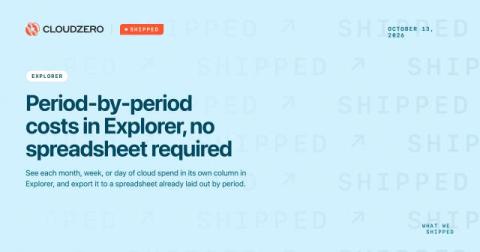
Shipped: The Fastly spend that was hiding in plain sight

CDN and edge spend is easy to lose track of. Fastly bills on its own, off to the side of your cloud invoice – real money, often significant, sitting where none of your cost tooling reaches. So it stays its own island: a lump sum with no easy way to tie it back to the teams, products, and customers driving the traffic.

OpenAI API cost calculator: estimate your GPT spend before it estimates you

This OpenAI API cost calculator (also an AI inference calculator for o3/o4-mini thinking tokens) estimates your monthly OpenAI API pricing bill from three inputs: model, request volume, and average tokens per request. Toggle between standard, batch, and cached pricing and get your number in seconds. It also shows what the same workload costs on Claude and Gemini. For the full per-model rate card, see CloudZero's OpenAI API pricing guide.

VDI Monitoring: How to Ensure High-Performance Virtual Desktop Infrastructure

Remote and hybrid work turned virtual desktops from a niche IT choice into a core way employees get their jobs done. When a desktop lives in the data center or the cloud, every logon, click, and screen refresh depends on infrastructure the user never sees. That shift is why VDI monitoring matters: it protects the end-user experience when the desktop is no longer local. The challenge is that a single slow session can have dozens of causes—across compute, storage, network, and the broker layer.