Operations | Monitoring | ITSM | DevOps | Cloud

Introducing Spike's new look: designed to scale.

Today, we are introducing Spike’s new logo, a new website, and honestly, a new identity from the ground up. This is very exciting day for all of us at Spike. More companies are being built today than at any other point in history. Small teams are making big products. And no matter the size of the team, every single one of them needs reliability. Reliability should not be a second-class citizen for any company, no matter where they are in their journey.
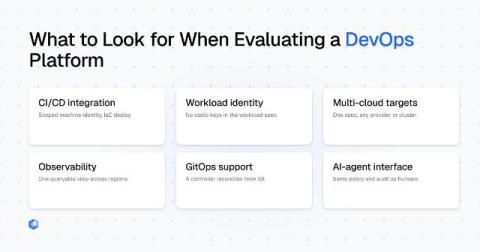
What to Look for When Evaluating a DevOps Platform

DevOps platform feature lists increasingly look alike. CI/CD, multi-cloud, observability, GitOps, and AI-friendly automation can all appear as checkboxes while the implementation burden still falls on your team. The useful signal appears when you ask how each capability actually works, what evidence a vendor can show, and which parts your team still has to build. Can pipelines authenticate with a scoped machine identity? Can workloads reach cloud APIs without static keys?

Reliability Is the Test Agentic NetOps Has to Pass

It is 2:14 a.m. An agent has correlated a latency spike to an asymmetric routing condition and is ready to reroute traffic away from the affected path. The plan looks right. The only question that matters to the on-call SRE is whether to let it run, and that question is not really about the agent. It is about whether the picture the agent reasoned from is complete enough to trust at 2 a.m. with production on the line.

Introducing Swarm Investigation from BigPanda: Autonomous, multi-agent IT incident investigation

When a major incident opens, the opening minutes often become a race across disconnected tools and competing theories. One engineer checks a monitoring tool. Another scrolls through change records, looking for the one line that explains everything. A third pings Slack, asking if anyone has seen this before. While these are reasonable steps, taken one at a time, in sequence, they are far too slow.

How to verify your Azure Application Gateway is zone-redundant

Having a redundant failsafe is one of the best things you can do to ensure high availability in the cloud. It’s rare for cloud regions to go offline, but it can happen, even on major platforms like Azure. While you might not have control over your provider’s reliability, you do have control over your own, and redundancy is a key part of that. Here’s how you can check if your Application Gateways are availability zone (AZ) redundancy, and how to verify redundancy using active testing.

Help Desk Software for Schools: Managing IT Support Across Campuses

How many support requests reach school IT staff each week without ever becoming a ticket? A teacher stops a technician in the corridor about a projector that will not connect. An office administrator sends a direct email about a locked account, and a student tells the librarian their laptop stopped charging during second period. Help desk software for schools collects those requests into one queue, routes them by site and category, and keeps a record of what was done.

Agent vs Agentless Monitoring and How to Decide What Goes Where

Why does half the infrastructure end up returning no monitoring data? The standard plan is to install collection software on everything, which moves quickly across servers and stops dead at the first device running closed firmware. Storage arrays, firewalls, and switches will never accept an install, and the rollout stalls there. That plan usually gets set once for the whole environment, with a single collection model applied to hardware it was never suited for.

The Customer Left Months Ago. Renewal Data of Technology Distribution Channels Just Haven't Caught Up.

Most technology distribution leaders can show stable renewal performance. That number rarely tells the full retention story. According to Forrester, current customers account for 61% of B2B revenue through renewal and expansion. Retention is a revenue-protection issue, not a dashboard metric reviewed after the quarter closes. Beneath those numbers, a quieter problem builds across the channel ecosystem.

AI cost calculator: estimate your total spend

An AI cost calculator for the whole wallet adds four lanes: seats and subscriptions, API and token usage, cloud AI services, and GPU infrastructure. Average 2026 totals run $25 per employee per month at light adoption, $100 to $150 at active adoption, and $300 or more at AI-heavy companies. Getting to your number takes four lane subtotals and three corrections.

GPT-6 Astra pricing: What OpenAI's new flagship costs in 2026

GPT-6 Astra is OpenAI's flagship reasoning model, released September 3, 2026. It costs $10 per million input tokens and $50 per million output tokens on the standard API tier, with cached input at $1 and cache writes at $12.50. That is 2.5 times GPT-5.6 Sol's promotional rate and matches Anthropic's Fable 5.1 on both headline numbers. Batch and Flex halve those rates, Fast mode doubles them, and any prompt past 272K input tokens reprices the entire request.