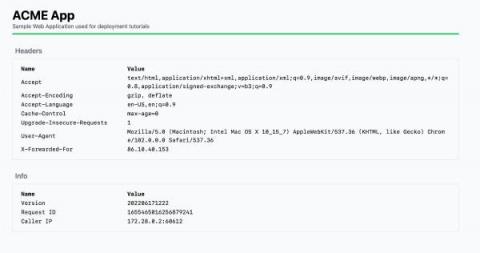

Last week, I showed you how to build and deploy a Go Web application (or API backend for a frontend framework like React or Vue) to a cloud provider, using Docker as a process manager. In this post, which is part of two of this series, I will show you a second method of deploying a Go Web app or backend to any cloud, using Docker Swarm.
Go has emerged as a popular option to develop web applications, especially for API backends, used by a React or Vue frontend. This post is the first of a multi-post series on the deployment of a web application to a cloud provider, starting with the simplest form of deployment, all the way to using Kubernetes for your web apps.
Time and resource consumption have become the driving forces of developing modern applications. While building cloud-native applications, it’s important to ensure that you have the most optimized code in place, and oftentimes that means leveraging concurrency. While writing concurrent code may sound overwhelming at first, Golang makes it extremely easy to get a handle on.
Bringing the best software solutions to market as quickly as possible requires using automation to facilitate repetitive tasks (e.g., testing) so you can spend more time writing high-quality code. This is one of the main reasons why today’s top-performing dev teams build continuous integration (CI) and continuous delivery or continuous deployment (CD) pipelines, which enable them to ship new releases faster.
In this tutorial, you will learn how to work with the gRPC Golang library for microservice communication by creating a simple note-taking application. APIs and service-to-service communication are what make modern microservice architecture possible. REST is generally the preferred implementation pattern, but if you only use REST, you could miss out on the significant performance gains that gRPC can offer. gRPC can provide better speed and efficiency than REST APIs.
Oftentimes, people starting their journey in the field of software development don’t understand the importance of testing, including Golang app testing, until late in their careers. It’s essential to think about testing as an integral part of the software development lifecycle (SDLC) not only in theory but in practice, too. When building cutting-edge software, you need to make sure that the version being upgraded is error-free and that almost all of the failure cases have been considered.
Here at incident.io, we provide a Slack-based incident response tool. The product is powered by a monolithic Go backend service, serving an API that powers Slack interactions, serves an API for our web dashboard, and runs background jobs that help run our customers incidents. Incidents are high-stakes, and we want to know when something has gone wrong. One of the tools we use is Sentry, which is where our Go backend send its errors.
Go, an open-source programming language backed by Google, makes it easy to build simple, reliable, and efficient software. Go’s efficiency with network servers and its friendly syntax make it a useful alternative to Node.js. All network applications need well-tested features, and those developed in Go are no different. In this tutorial, we will be building and testing a simple Go blog.