
Operations | Monitoring | ITSM | DevOps | Cloud

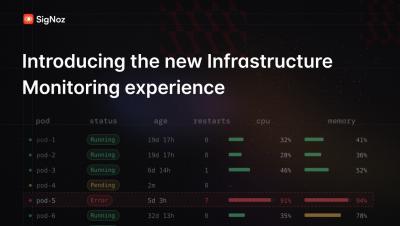
We Upgraded SigNoz Infrastructure Monitoring for Deeper Visibility and Faster Troubleshooting

A quick walkthrough of the new infrastructure monitoring experience in SigNoz Cloud. We’ve made several additions to give you more visibility into your infrastructure health and help you troubleshoot faster. Here’s what’s new,

GitHub Copilot Monitoring & Observability with OpenTelemetry

Learn how to implement end to end monitoring and observability for GitHub Copilot Chat using OpenTelemetry and SigNoz. In this video, we walk through enabling the OpenTelemetry exporter built into the Copilot Chat extension in VS Code, collecting a trace for every agent turn, and visualizing everything in SigNoz to gain real time visibility into model calls, tool executions, token usage, prompt cache savings, latency, and failures. Copilot Chat ships its own OTLP exporter, so there is no instrumentation library to install and no collector to run.

Grok Build Observability with OpenTelemetry

Learn how to implement end to end observability and monitoring for Grok Build, xAI's terminal coding agent, using OpenTelemetry and SigNoz. In this video, we walk through turning on Grok Build's native OpenTelemetry exporter, collecting metrics and structured session events, and visualizing everything in SigNoz to gain real time visibility into token usage, sessions and turns, tool calls and their outcomes, error categories, and startup latency. Grok Build ships its own exporter, so instrumenting it is a matter of configuration, with no library to install and no collector to run.

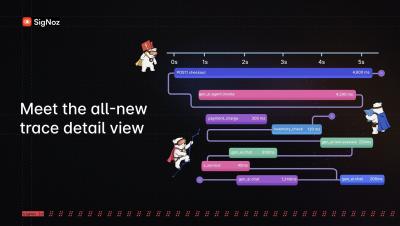
We Redesigned the SigNoz Trace View for Million-Span Traces

A quick walkthrough of SigNoz Cloud's new trace detail view, with a flame graph that renders 100,000 spans in a single load. AI and agent workloads are producing traces with much higher span counts. We rebuilt the trace detail view in SigNoz Cloud to make investigating large traces faster. Here's what's new.

SigNoz Cloud Dashboard Schema Is Now Built for AI Agents

A quick walkthrough of SigNoz Cloud's new dashboard schema, redesigned to make dashboard operations by AI agents faster, more reliable, and lighter on tokens. AI agents are increasingly creating and editing observability dashboards. We redesigned the SigNoz Cloud dashboard data model with a structured, strictly validated schema so agents can work against defined fields and paths instead of inferring the dashboard structure.

How SigNoz MCP Helped MSI Find 20 Unnecessary Operations

Taylor Mattison explains how SigNoz MCP helped surface wasted work inside MSI's sales-order workflow. Warning checks were firing on user actions that had nothing to do with any warning they could raise. By comparing telemetry across the workflow, Taylor could point to unnecessary operations that were wasting API calls, database time, and server capacity. This clip is part of our MSI customer story on using SigNoz MCP with Claude to debug slow sales orders across the stack.

Langflow Observability with OpenTelemetry and SigNoz

Learn how to implement end to end monitoring and observability for Langflow using OpenTelemetry and SigNoz. In this video, we walk through instrumenting Langflow workflows, collecting traces, metrics, and logs, and visualizing everything in SigNoz to gain real time visibility into flow execution, LLM requests, tool calls, token usage, latency, failures, and performance bottlenecks. Langflow ships with built in OpenTelemetry support, making it easy to export telemetry to SigNoz with minimal configuration.

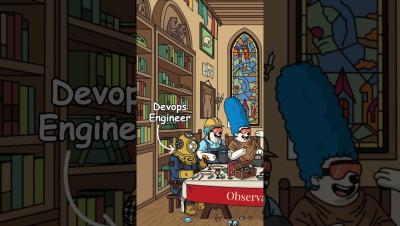
If You Are Building a Startup from a Vibe-Coded App, Don't Skip This #devops #programming #ai

Everyone is vibe coding products right now. But most applications are missing one crucial thing: Observability. In this video, I talk about: You can literally start this weekend: If you are turning your vibe-coded app into a real startup, observability should not be an afterthought.

Your AI App Is Lying to You - Here's How to Fix That #devops #observability #programming

You shipped your AI app. But do you have all the answers? Do you actually know which model ran, how many tokens it consumed, or why it stopped? This is what LLM observability gives you, and most AI engineers are skipping it entirely. I built an SOS detection app and used OpenTelemetry to get full visibility into every single call. Token usage, model version, finish reason, and cost per call all in one place, standardised across any provider. Check out the OpenTelemetry GenAI docs in the link below; there is a lot more you can track than you think.