
Operations | Monitoring | ITSM | DevOps | Cloud

Introducing Cost Meter - Proactive Observability Cost Control with Per-Hour Granularity

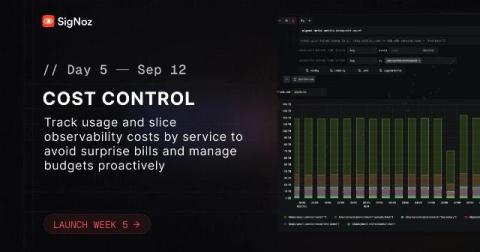
The irony isn't lost on us - observability platforms are built to be proactive about system health, yet when it comes to managing observability costs themselves, teams are forced to be reactive. Today, that changes with Cost Meter, now live in our platform. Cost Meter transforms observability spend management from a monthly billing surprise into a proactive, data-driven process with hourly aggregated metrics that give you complete visibility into your telemetry ingestion patterns.

Understanding OpenTelemetry Spans in Detail

Debugging errors in distributed systems can be a challenging task, as it involves tracing the flow of operations across numerous microservices. This complexity often leads to difficulties in pinpointing the root cause of performance issues or errors. OpenTelemetry provides instrumentation libraries in most programming languages for tracing.

Breaking Free from SQLite - Why We Added PostgreSQL Support to SigNoz

"Let us support different relational databases apart from SQLite. Nobody likes to run SQLite in production." This was one of the most requested features from our community. Your requests have been heard, and we've added support for different relational databases, starting with PostgreSQL. If you're self-hosting SigNoz, you no longer need to worry about SQLite's limitations. Let's dive into what we've built and why it matters for your production deployments.

Query Builder v5 - Two Years of Technical Debt, 80 Closed Issues, and a Fundamental Rethinking

In 2022, we had three different query interfaces. Logs had a custom search syntax with no autocomplete. Traces only had predefined filters - no query builder at all. Metrics had a raw PromQL input box where you'd paste queries from somewhere else and hope they worked. Each system spoke a different language. An engineer debugging a production issue had to context-switch not just between data types, but between entirely different mental models of how to query data.

Interactive Dashboards - Click Any Panel to Start Debugging

Your dashboard shows a latency spike. To investigate it, you copy the query, open logs in a new tab, paste and modify the query, lose your dashboard filters, and repeat for traces. By the time you find the issue, you have 15 tabs open. Starting today, you can click any panel and investigate right there. All your filters and variables carry over. No more tab juggling.

Interactive Dashboards | SigNoz Launch Week 5.0 | Day 1

Interactive Dashboards eliminate the current workflow of opening new tabs and manually recreating queries every time you need to investigate a spike or anomaly. Click directly on any data point to drill down and explore. ​What you can do: ​Built for developers who need to debug production issues efficiently, not juggle with multiple tabs.

Monitoring Claude Code Usage with OpenTelemetry and SigNoz

In this video, we’ll walk you through how to monitor Claude code activity using OpenTelemetry and SigNoz. You’ll learn how to instrument your usage, capture telemetry data, and visualize it with SigNoz to get better insights into your system performance. Whether you’re exploring observability for AI workloads or looking for an open-source solution to monitor your llm activity, this guide will help you get started.

Bringing Observability to Claude Code: OpenTelemetry in Action

AI coding assistants like Claude Code are becoming core parts of modern development workflows. But as with any powerful tool, the question quickly arises: how do we measure and monitor its usage? Without proper visibility, it’s hard to understand adoption, performance, and the real value Claude brings to engineering teams. For leaders and platform engineers, that lack of observability can mean flying blind when it comes to understanding ROI, productivity gains, or system reliability.