Operations | Monitoring | ITSM | DevOps | Cloud

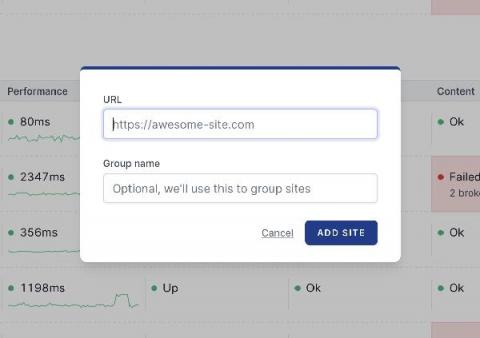
Sites can now be grouped

Our users sometimes have a large number of applications that are being monitored by Oh Dear. Some of these applications are related to each other. Think for instance of a marketing site and an API that are part of the same application. To better emphasise that some of the things that are monitored are related, you can now use groups. When you start monitoring a site at Oh Dear, you can now optionally specify a group name.

Introducing advanced user management for large teams

If we look at the number of sites that our users monitor, we can split our user base into two large groups. Teams in the first group only monitor one or a couple of sites. The second group monitors 30 or more sites. We've just launched new features that make user management more flexible for large teams. In this blog post, we'd like to tell you all about it.

Model-driven audit trail infrasructure

Graylog is one of the most popular tools for opensource monitoring and log management in telco environments. We will show how Charmed OSM with the help of juju eases its deployment and integration with MongoDB, elastic search, and other charmed telco network function elements. The same goes for a basic LMA stack with Prometheus and Grafana.

Shared Services Teams For Great Customer Experiences

Have you ever considered integrating shared services teams into your organization’s existing operation? If you are committed to driving efficiency across your organization, there has never been a better time to explore the utilization of shared services teams for improved customer experiences. In this guide, we will break down the potential benefits of shared services teams. There is an undeniable link between customer satisfaction and organizational structure.

CostOps: The Overlooked Developer Responsibility

Developers are the kingmakers. Millions of decisions made by tens of thousands of developers are ultimately responsible for the triumph or tragedy of IT. Developers for commercial vendors, open-source projects, cloud and software as a service (SaaS) solutions, managed service providers (MSPs), and internal teams make most technology decisions far upstream from IT pros. This essentially defines ops’ role as the crew who finds a way to make washing machines fly in formation.

Overcoming Fear, Anxiety, and Mistrust to Gain Stakeholder Alignment

Most of us have encountered a situation like the following at some point in our careers: something either isn’t working right or could be working better. You’ve been through the process to understand the problem and identify solutions. (Check out my blog post “4 Steps to Efficiently Solve Problems” if you’re still working on understanding the problem.) Now it’s time to pick a solution—and you can’t get stakeholders to agree on one.

How to Connect the Dots: Creating Complex CI/CD with JFrog Pipelines

As software gets more complex, so do software builds. With applications being composed of multiple services — often developed by separate teams — it can be challenging to automate a unified continuous integration process. JFrog Pipelines is unique among DevOps CI/CD solutions in empowering developers to create highly complex DevOps Pipeline workflows. Pipelines can be defined with multiple paths, trigger points and trigger types.

[Report] The 2021 State of Digital Operations Management

It’s no secret to anyone working in technology that IT’s operating world is becoming more demanding and complex. Digital transformation, hybrid working, exponentially increasing data volumes, greater security risks, and expanding global regulations are all driving up business demands and expectations for reliable and robust technology operations.

5 fixes for the customer experience quandary

Customers expect products and services to work. When they don’t, customers want fast, permanent solutions. But delivering against that expectation is easier said than done. Multiple barriers stand in the way of your organization delivering the seamless experiences customers expect. Let’s explore five ways to improve customer service.