Another major outage on the Internet has taken place today. Telia, a major backbone carrier in Europe, suffered from a network routing issue between 16:00 and 17:05 UTC. This had a huge ripple effect, causing issues for multiple key companies providing critical cloud and infrastructure services. Companies affected include: - Google Cloud - Equinix Metal - Cloudflare - Fastly - NS1 It’s always arresting to see the secondary and tertiary effects that a major outage can have.
Flux is a CNCF based open source stack of tools. Flux focuses on making it possible to keep Kubernetes clusters and cloud-native applications in sync with external resources and definitions hosted in environments such as GitHub. Implementing tools like FluxCD should enable you to achieve results such as: The results above can bring obvious benefits, and many teams are adopting FluxCD as their tool of choice for GitOps.
On October 4, 2021, an outage took Facebook, WhatsApp, and Instagram down for six hours. This major outage is a powerful and high-profile example of the difficulties facing those tasked with managing modern network architectures.
Developing modern applications is harder than ever, with microservices and cloud deployment models making it harder to get things working than ever before. However, anyone who’s deployed an application knows that that’s just the beginning of the work. The biggest part comes later: ensuring it works correctly, with maximum efficiency and great performance.
The recent contexts have shown that enterprises needed to take a different approach regarding their digital transformation and its prioritisation. They’ve experienced the need to run new configurations and operations remotely on their infrastructure. This quickly showed the benefits of automation solutions to run those changes from few central locations, which highly facilitated the task of systems and network admins.
Bare metal Kubernetes (K8s) is now easier than ever. Spectro Cloud has recently posted an article about integrating Kubernetes with MAAS (Metal-as-a-Service. In the article, they describe how they have created a provider for the Kubernetes Cluster API for Canonical MAAS (Metal-as-a-Service). This blog describes briefly the benefits of bare metal K8s, the challenges it presents, and how the work by Saad Malik and the team from Spectro Cloud solves those challenges.
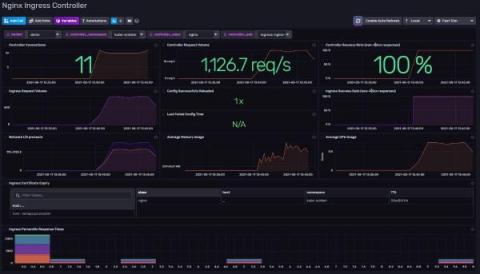
Today, many of the internet’s busiest websites and applications rely on NGINX to run smoothly. And many of those websites and apps are run as cloud-native services in Kubernetes. In particular, the NGINX Ingress Controller is a best-in-class traffic management solution for cloud‑native apps in Kubernetes and containerized environments that uses NGINX as a reverse proxy, load balancer, API gateway, cache, or web application firewall.
Your website is critical to your business. It is your digital shopfront where you engage with the world and turn prospects into customers. To convert the maximum number of people, you need to monitor your website to ensure an optimal experience. This guide will discuss six monitoring metrics that every business should track. By monitoring these metrics, you can ensure that you're providing the best experience to site visitors. Let's jump into this guide.