Operations | Monitoring | ITSM | DevOps | Cloud

4 Ways to Automate Application Security Ops

Maintaining an online business presence nowadays means that malicious actors are going to target and likely exploit any application vulnerabilities they can find sooner or later. According to the 2021 Mid Year Data Breach Report, although the number of breaches has declined by 24%, the staggering number of records that were exposed (18.8 billion) means that there is still room for improvement.


The Game Plan

IT Transformation Is More Than Technology—Its People, Culture, and Policy If you think introducing a shiny new tool or service is transformation. Think again. Our changemakers wrought fundamental change in how people work, communicate and collaborate. In episode 2 of The Change Makers we investigate how changemakers plan their work; set up their vision, objectives, and roadmap. And we learn how IT transformation often begins with something other than technology.

Understanding the Three Pillars of Observability

Observability and its implementation may look different to different people. But, underneath all the varying definitions is a single, clear concept: Most software that’s run today uses microservices or loosely coupled distributed architecture. While this design makes scaling and managing your system more straightforward, it can make troubleshooting issues more difficult. The three pillars of observability are different methods to track software systems, especially microservices.

Well-tested code: in search of meaningful coverage

If you work anywhere near the field of software development, you’ve likely already heard that you should always write code that is well-tested. Everyone wants to have well-tested code and for a good reason! Testing ensures our code is working as intended and protects against regression. Thoroughly testing code helps teams confidently ship software faster and with fewer issues.

Komodor Workflows: Automated Troubleshooting at the Speed of WHOOSH!

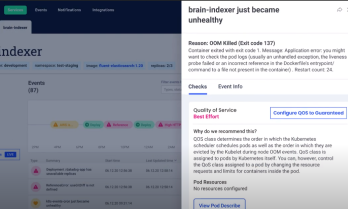
Today, just in time for Kubecon 2021, I am happy to announce the beta availability of Workflows. For me, this is our most exciting product announcement to date – a completely new capability that expands the definition of what Komodor is, as it charts the course for its next evolution. Let me start with the feature first. In a nutshell, Workflows is a series of smart algorithms that operate within the “depths” of Komodor.

How To Monitor Network Traffic

In today’s digital world, almost every business is driven by technology, whether big or small. With the advancement of technology, the associated threats to the security of the IT infrastructure come hand in hand. Therefore, businesses need network traffic analysis tools to keep an eye on their network. Monitoring network traffic continuously gives a business the insight to optimize and manage performance, minimize attack surfaces, intensify security, and better manage its resources.

Network AF, Episode 2: Backbone engineering and interconnection with Nina Bargisen

In episode 2 of Network AF, meet Nina Bargisen. Nina has spent over two decades in network engineering and talks to podcast host Avi Freedman about her history in interconnection and peering. She’s worked for companies like Netflix and TDC (formerly Tele Danmark Communications). Now Nina is Kentik’s director of GTM strategy focused on supporting service providers. Nina joins Avi on the Network AF podcast to discuss: Nina’s entry into networking was non-standard.

The benefits of hybrid cloud for financial institutions

Financial institutions and their service providers have traditionally owned and run their technology infrastructure on their own premises or in their own data centres. However, that’s changing with the advent of powerful public cloud services, such as Amazon Web Services, Google Cloud and Microsoft Azure.

3 Steps Government Employees Can Take to Become Good Cybercitizens

As cyberattacks become more sophisticated across ever-expanding attack surfaces, it’s easy to assume the security team will take care of risk management and mitigation. Indeed, employees—both within the agency and across the contractor community—are one of the greatest risks to the government’s security postures.